


Top Executive Assistant Responsibilities and Key Roles
The role of an EA goes past the typical office-management duties. They can take on strategic responsibilities, operational and logistical support, and financial and administrative duties, which directly impact the overall business.
Executive assistants handle important tasks like calendar management, travel planning, research support, and many others that keep directors and organizations running smoothly.
In this blog, we’ll discuss the core responsibilities of an executive assistant and explain why this role is very important for organizational efficiency.
What is an Executive Assistant?
Executive assistants directly work with your company’s high-level managers. They provide administrative support by planning, organizing, and reporting on various tasks. They’re skilled professionals who adapt easily, pay attention to details, and, above all, solve problems effectively.
In recent years, you can see that the demand for executive assistants has risen by 12% in fast-moving industries, like tech and finance. It proves that they play a valuable role in various departments.
The executive assistant tasks are basically managing complex schedules, supporting meetings, and communication across all departments. They must combine professionalism to maintain clear communication between executives and others.
Strategic Responsibilities of an Executive Assistant
The prospect of business leadership is transforming, and organizations are learning the essential role of executive assistants in their success. Before, they were just staff members. Now, they are seen as important partners who directly help the organization succeed.
These experts help your company reach its goals. Many companies have seen how they affect company culture, vision, and overall objectives.
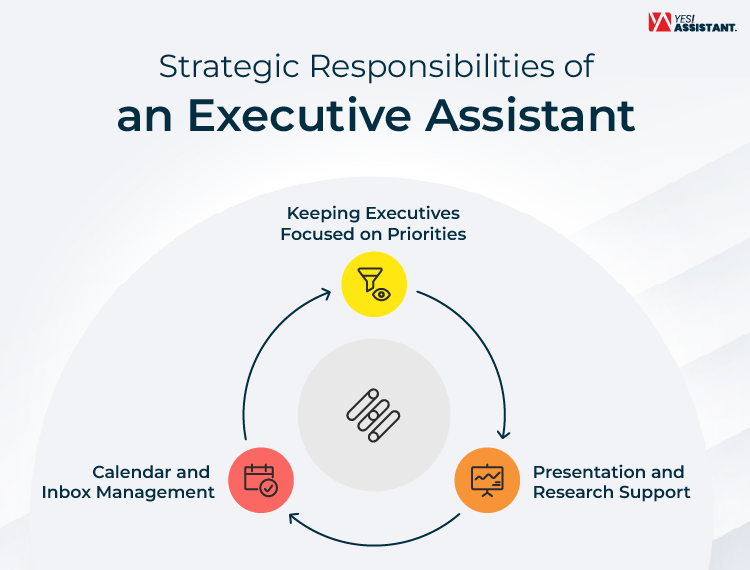
Keeping Executives Focused on Priorities
As a personal assistant, you should work closely with your executives. Your main task is to organize their schedule and help them prioritize their work.
- Set Clear Goals with Deadlines: Your directors may need to meet deadlines on time. It’s your duty to help them set goals based on priorities by breaking down larger projects into smaller tasks.
- Utilize Effective Tools and Techniques: You can guide your directors to use time management and task management tools to increase productivity. For example, you can use Trello or Motion to manage workloads
- Delegate Tasks with Priority: It’s a part of your duty to motivate your managers to delegate tasks that are manageable by others. You can also assist them in identifying key players in a team who can handle tasks with priority.
- Motivate Breaks and Self-Care: You need to motivate your officers to take regular breaks to stay productive. Exercise or playing games can improve their overall well-being.
Presentation and Research Support
An executive assistant’s responsibilities play a key role in driving the executive’s success in high-stakes meetings and presentations.
For any professional meeting or a media interview, you need to provide proper tools, information, and feedback. In terms of research support:
- Know Your Audience: Take your time to research your audience. This will shape your content, tone, and style of your meeting or presentation to meet their needs.
- Market Analysis: Collect details about your competitors and current trends. Then your managers can understand the market forces, new possibilities, and buyer demands more effectively.
- Stakeholder Insight: Create brief reports that focus on key metrics and clear summaries of business performance. This will lead your executives to make better forecasts and decisions.
- Data Summarization: Concise reports and highlight the key metrics and actionable summaries that show business performance. It will assist your executives in forecasting and making informed decisions more clearly.
Calendar and Inbox Management
Managing calendars and inboxes is a next-door strategy to help busy executives tackle challenges like time management and overlapping meetings. As an executive assistant, you can handle this by:
- Schedule Optimization: Check deadlines and their importance to avoid overlapping work.
- Effective Communication with Stakeholders: Use clear communication to work with your team members, partners, clients, suppliers, and outside contacts.
- Meeting Coordination: Keep track of regular meetings over different time zones. Manage new requests according to specific needs.
- Facilitating Email for Better Scheduling: Handling your email can help you stay organized. It also helps your busy officials to reply quickly, improving communication.
Operational and Logistical Support
The purpose of operations in a company is to promote and support efficient business processes. Managers have to face a myriad of issues to ensure a flexible operation, like budget limitations, lack of communication, inefficiency, etc.
Logistics plays an important role in providing assistance to the inventory and supply chain. It’s about actively planning, executing, and managing the flow of goods, services, and information within the system.
Hiring a virtual executive assistant can greatly improve your logistics and operations. They are reliable, skilled, and experienced in managing many tasks effectively.
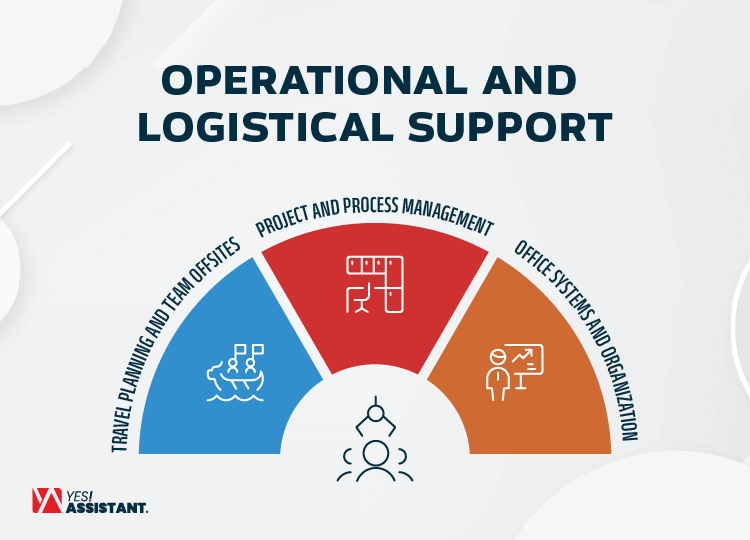
Travel Planning and Team Offsites
Behind every successful and effortless business trip, an EA manages many tasks at once. They ensure transportation, verify meeting locations, check that the technology is ready for presentations, and keep contacts on schedule.
It’s also an executive assistant’s responsibility to organize off-site meetings that will give the team a chance to connect outside the office environment. The correct setting can lead to real progress, unlike standard meetings or virtual ones. They’re arranged to give teams a break from daily life and create a space for strategic planning and team building.
Project and Process Management
In the project management field, business process and project management have been used alternatively. However, these two are two different business factors with different goals, values, and stages.
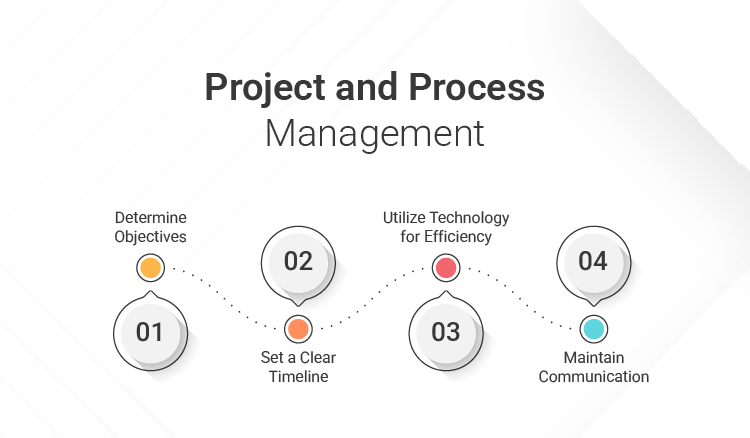
Project management is an essential skill that is required in an executive assistant. However, it is often ignored during traditional training. As an EA, you should:
- Determine Objectives: Use the Specific, Measurable, Achievable, Relevant, and Time-bound (SMART) goals framework as it can help you define, action, and measure a company’s goals and objectives effectively.
- Set a Clear Timeline: A precise timeline can help you anticipate major milestones and maintain focus with tools like Trello, Asana, and Gantt charts, etc.
- Utilize Technology for Efficiency: Technology is the gateway and secret weapon for staying organized. For instance, you can use cloud-based platforms or team collaboration apps to manage overall workflows among the team members.
- Maintain Communication: By providing accurate information, you can bridge the gap between your senior executives, team members, and stakeholders.
Whether it’s streamlining the workflows or solving problems, process improvement is a weapon that you can easily master by working alongside a manager.
- Identify: At first, you have to find the major problems as part of the process movement. By exploring the root causes of inefficiencies, you can make improvements that can notably impact organizational performance.
- Plan: From this stage, you must plan process improvement strategies. You have to create a detailed map that outlines actionable solutions.
- Execute: After mapping out the entire process, it’s time for the execution phase in process improvement. This is where you put your ideas into action, applying the changes and solutions you’ve identified.
- Review: Reviewing is the last stage in the process improvement. It ensures the new process you’ve applied is delivering on its intended goals and continuing to add value over time.
Office Systems and Organization
The office system carries various meanings to different people. It basically indicates the various components of an office, e.g., computers and work equipment, and their physical layout. It also focuses on how employees are interacting within an office culture.
Office organization consists of two interconnected levels that work together to create an operating workplace.
- The first level is the functions of office management, an active process of organizing work activities, assigning responsibilities, and more. For example, A project manager is holding a weekly meeting to check progress and find issues that are delaying the project. The manager is also assigning tasks to team members based on their skills to ensure the project is completed on time.
- The second level is the organizational structure, a network of relationships between individuals and their duties within the office. For instance, at a marketing agency, the creative team reports to the Creative Manager, and the account management team reports to the Client Service Manager. But both managers will coordinate to ensure the client campaign’s success.
Financial and Administrative Duties
The role of an administrative assistant has changed over the years. In the past, their job was mainly about official tasks. The focus has moved gradually, and now, they play a vital role in improving an organization’s efficiency and productivity.
They are expected to take on more strategic roles in financial operations that have a direct impact on the business.
Your company can face tighter budgets and an increased focus on cost efficiency at any time.
That’s why an executive assistant with financial literacy works like a spur for senior executives.
Expense Reporting and Budget Oversight
Expense reports are your easy solution to monitor expenses. It can help you improve your costs and financial decisions. If you fail to keep correct financial records, it can lead to serious outcomes, like legal fines, cash flow problems, operational issues, and others.
An executive assistant can effectively manage your financial records and reporting by:
- Managing your costs to limit your budget and avoid extra costs.
- Keeping a clear record of your costs, like operating costs, internal and external costs, etc.
- Finding ways to lower your costs and improve your spending.
- Taking part in financial planning to allocate your resources more efficiently.
Benchmarking and Planning Assistance
Financial benchmarking evaluates your company’s financial performance against established financial standards. Your CFOs, internal and external analysts, and consultants strongly rely on benchmarking to understand how the company is performing financially. For instance, you have a manufacturing company, and your competitor in the same industry has a net profit margin of 22% but yours is at 15%. In that case, you need to work on your expenses and revenue strategies more.
Financial planning is as significant as financial benchmarking for your organization to gain operational excellence. It helps your Chief Operating Officers (COOs) take data-driven decisions and review resource allocation for your company’s growth.
An administrative assistant with financial expertise will help your financial advisors in many ways. From preparing your financial reports to implementing cost-effective financial planning practices, they can play a key role in guiding your financial advisors to take essential steps for the company’s overall well-being.
Conclusion
An effective executive assistant is more than an employee. They play a major role in your company to ensure its growth and success. If you’re thinking of stepping into this world, you should ask yourself if you’re ready to do more than support.
The role isn’t just a simple position. As we’ve discussed, an executive administrator helps top management focus on what matters by managing their deadlines. Furthermore, to support project and process improvement, you must support operations and logistics. For the company’s profitable growth, your financial advisors may also need your assistance with financial planning and reporting, and to make informed decisions.