
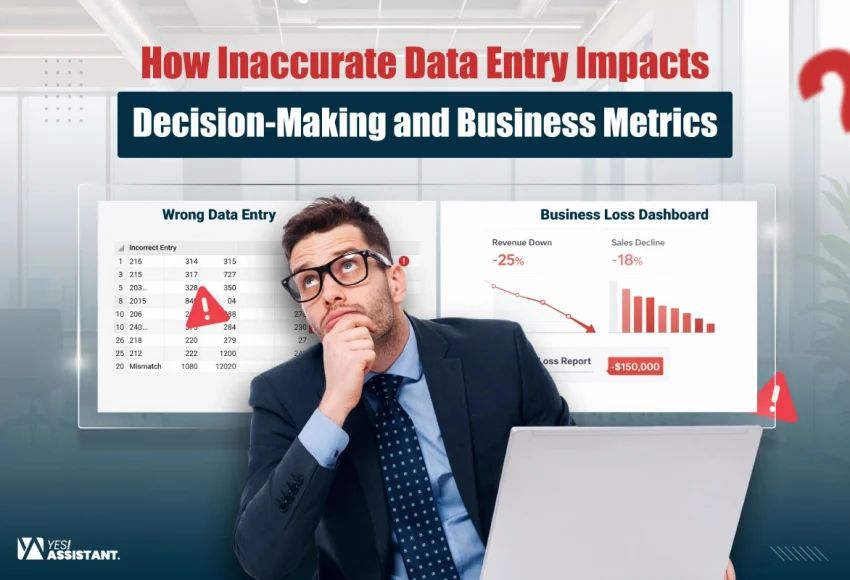
How Inaccurate Data Entry Impacts Decision-Making and Business Metrics
Inaccurate data entry is a silent killer in your business. These disorganized data formats damage your database, waste money, and cause confusion. Any small errors cause big financial losses and operational problems.
Furthermore, defective information burns your key performance indicators and critical business metrics. The leadership team faces a problem when stakeholders lose confidence in reporting insights. This misinformation drains your business capital and results in missed strategic market opportunities.
This guide demonstrates the risks your business faces from false data and disconnected systems. This examines how accurate solutions and standardized data protocols restore your competitive advantage. See actionable strategies to transform your data into reliable assets for business growth.
Understanding Data Entry Accuracy
Accurate data is not just a requirement for your business operation; it’s the guts of your strategic competitive advantage. While AI-powered data entry software can grow your business, if the system relies on inaccurate data, it can sink your business. In a high-functioning business, input quality is not a one-time achievement but a continuous standard.
It includes ensuring your information is within the following steps:
- Correct: This clears data from typos, eliminates errors, or misinterpretations.
- Consistent: Standardize your records across all departments. For example, fixing date formats “DD/MM/YYYY vs. MM/DD/YYYY” reduces scheduling conflicts.
- Complete: Including all necessary factors required for meaningful analysis.
When these standards are missed, the resulting “bad data” creates a “trash in, trash out” cycle, leading even the most advanced AI and analytics tools to produce flawed conclusions. Ensuring more accurate information, find a data entry partner to enhance your business growth.
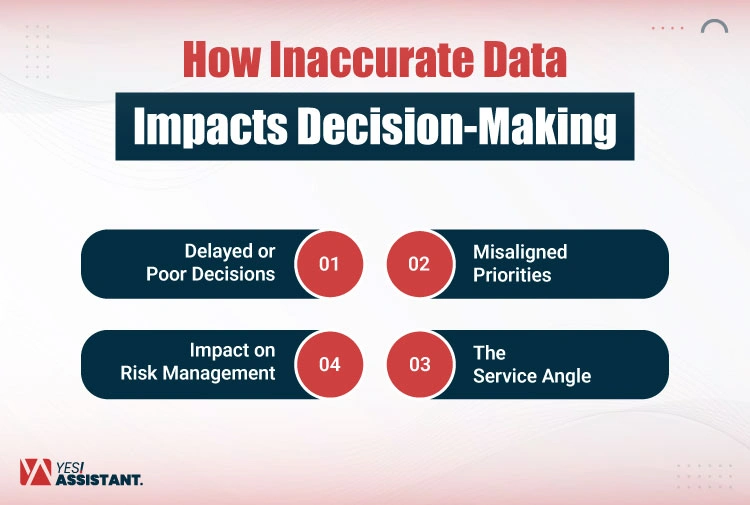
How Inaccurate Data Impacts Decision-Making?
Strategic decisions are only as powerful as the evidence supporting them. When your data entry system is incorrect, the leadership decisions no longer make sense.
Delayed or Poor Decisions
Incorrect input leads to the misplacement of your “decision-making,” and management will hesitate to pull the trigger on critical investments. Again, failing to sort out defective information can lead to a business disaster. For example, Ford’s “Edsel” car project failed due to misinterpreted market research.
Wasting Time on Validation: Defective inputs took 27% longer to clean and correct, resulting in delays for strategic actions. (Stacy Roach, on “What is the True Cost of Bad Data for Your Business?” on 27 November 2024)
Missed Opportunities and Trust: When you demonstrate a report based on faulty data, your stakeholders lose confidence in the insights, resulting in delayed business decisions. The risk of poor data entry leading to missed opportunities with your partners.
Compliance Risks: Inaccurate figures, potentially missing regulatory requirements like GDPR or HIPAA compliance rules, resulting in facing a series of follow-ups and fines.
Immobilized Decisions: Low-quality data is delaying decision-making, resulting in a 72% increase in operating time and delayed actions.
Misaligned Priorities
Inaccurate data failed to paint a real scenario of your business operations. You may invest in a product line that appears profitable due to data entry errors. On the other hand, you’re neglecting another high-growth sector that was not reported at all.
This happened due to misallocation of resources, draining your capital that has been used for genuine innovation.
Misalignment of the Marketing Team: Suggesting to the wrong audiences due to outdated data.
Failed to Develop the Right Product: Misinterpreted inaccurate user feedback, resulting in product development going beyond market needs.
Targeting the Wrong Direction: Misleading market research, leading to a missed target. For example, in the 1980s, Coca-Cola failed to meet market demand due to a misunderstanding of customers’ tastes.
Impact on Risk Management:
Bad data impacts your business decisions and severely undermines your risk management. Inaccurate data leads to your inventory counts “stock-outs” during high-demand of customers. Therefore, you can’t expand your position, resulting in a complete withdrawal from the competitive market.
This inaccurate data costs $12.9 million per year, according to estimates, it drains 15% to 25% of total revenue. (By Salma Bakouk, “Understanding the Impact of Bad Data” on January 19, 2024)
Misleading Data: Misinformation disrupted your analysis and flawed risk management strategies.
Underestimating Risk-Weighted Assets: Uncertain risk management creates challenges in accurate conclusions and compromises with your operational strategies.
Data Inconsistency: Significantly, erroneous statistics risk your assessment, leading to ineffective risk strategies.
The Service Angle
Consistent and accurate information helps your partner to make effective decisions and grow business revenue. On the contrary, faulty data acts as “a hidden bottleneck” of business performance, directly damaging your stakeholders’ decision-making. These lead to irrelevant marketing, billing errors, and poor support interactions.
These common errors in data entry result in customers deciding to switch to a competitor for better service.
Irrelevant Offers: Your service page offers a bunch of products, but irrelevant to the customer’s choice.
Undermined Reliability: When service terms are incorrect, it appears disorganized and uninformed, and causes customers to lose confidence.
Unified Customer Profile: Misinformation prevents you to see complete view of a customer, leading to bad experiences across various channels. These include customer updates, including email or contact number.
Effects on Business Metrics: Insights into Inaccurate Data
Your datasets seem organized; a simple error entry acts as a “hidden enemy” in the spreadsheet. Significantly, this wrong information is lost across every key performance indicator (KPI).
Financial Metrics
- Revenue Loss: Poor data can cost businesses an average of $15 million per year. These lead to missed sales opportunities, and missed pricing strategies can lose money from your tables.
- Regulatory Penalties: Failing to meet accuracy results in massive fines, especially in the healthcare and finance sectors. Likewise, violating GDPR standards can cost up to 4% of global revenue. (Srikar Sai, “GDPR Fines In 2026: Penalty Structure, Calculation Criteria, and Biggest Fines So Far”, Dec 17, 2025)
Operational Metrics
- Increased Costs: Employees spend more time detecting and removing errors that ruin from 25% to 40% of the operational hours. These increased your costs due to wasting more time correcting data errors rather than performing core jobs. (Adam Pitman, “Workday Research Finds AI Productivity Gains Are Lost to Rework,” January 16, 2026)
- Supply Chain Inefficiency: Incorrect entry, including raw materials or lead times, causes production delays and increases your warehouse operational costs.
Customer Metrics
- Customer Lifetime Value (LTV): When service quality is compromised by errors, it increases customer frustration, ultimately reducing the Lifetime Value (LTV) of each client relationship
Marketing Metrics
- Marketing ROI: Mistargeted campaigns based on inaccurate demographic data result in wasted advertising spend and lower conversion rates.
Common Causes of Inaccurate Data Entry
Errors in data entry occur mainly from human errors or manual recording. Identify the root cause of incorrect data entry in the following steps:
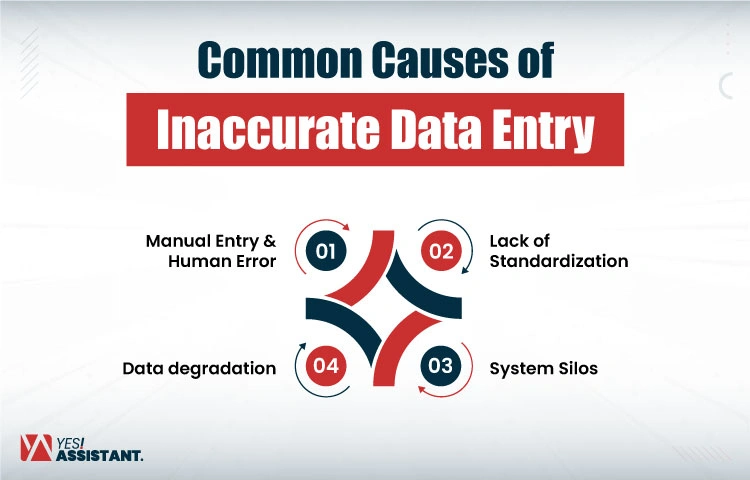
Manual Entry & Human Error: When you require managing high volumes of information entry, even the most careful staff can make mistakes. See how manual or human errors appear:
- Common entry occurs when the slips of digits or letters are misplaced, like writing “524” instead of “542”.
- High volumes of data processing often lead to monotony, causing your staff to overlook mandatory fields or misinterpret handwritten documents.
- Without setting “double-check” validation potentially causes errors. Suppose you record a customer’s email without the “@” sign, the validation rule can stop you from avoiding data entry errors.
Lack of Standardization: Without strict organization, data formatting guidelines (abbreviations, units, punctuation), it’s impossible to sort or analyze data accurately.
- Entering similar information in different styles, like “Street” vs. “St”, creates duplicate records under a single source.
- Using different regional date formats like “DD/MM/YYYY” vs. MM/DD/YYYY”, create a unique schedule or identify conflicts.
- Unable to follow unique Data entry protocols indicates a lack of clear training on manual entry, resulting in messy entry.
Data degradation: Information changes after some time. If a company does not have a process for regular cleansing and validation, records naturally become outdated and irrelevant.
- Integrate inactive lists for customers moving, changing phone numbers, or switching jobs without active updates. Your CRM becomes a store of inaccessible leads.
- No regular schedules to clean up unnecessary data, resulting in gathering a bulk of inactive information, and costs more in cleansing effort.
- In the case of regular software updates, your system accumulates older data and becomes corrupt. This happened due to irregular data formatting during the update to your systems.
System Silos: Collecting data across non-integrated databases inevitably leads to conversion errors and duplicates.
- When your sales, marketing, and finance teams use different software that potentially creates human error due to scattered operations.
- Information discrepancies appear when all systems are not updated simultaneously, leading to conflicting information across the organization.
- When moving data between inconsistent systems, often removing essential portions or “tags” results in the remaining information becoming less useful.
Conclusion
Consistent and accurate data is not just the backbone of your business; it’s the lifeblood of your business. When your datasets produce disordered or wrong figures, it slows your business, misleads decision-making, and loses your leadership credibility. If you provide data services to businesses, you may lose your client because misinformation frustrates your client.
Furthermore, inaccurate or erroneous input can block your strategic decision and waste your resources. Therefore, you can use manual or automated data entry tools and software to eliminate errors. Maintaining data entry rules, policy, and procedures to record information into the system can potentially give you quality insights into analyzing the competitive market.