
Easy Guide to Accounts Payable Outsourcing vs. In-House AP
Choosing between accounts payable outsourcing and an in-house AP team is a very important decision for growing finance teams. With accounts payable outsourcing, companies hire an external service provider to handle tasks such as invoice processing, data entry, payment processing, and vendor management. On the other hand, in-house AP means handling these tasks with your own internal finance team only.
As businesses grow, manual AP work increases the workload. This leads to payment execution delays, duplicate payments, vendor disputes, and compliance risks. And soon after, CFOs and finance managers face a decision that is not just about hiring more staff. It is about deciding whether to outsource accounts payable or manage it in-house.
In this guide, we will compare accounts payable outsourcing vs. in-house AP and explain the key factors to consider when choosing the best option for your company.
Key Takeaways
- In-house AP offers more control. But costs and workloads can increase as the business grows.
- AP outsourcing can reduce workload and costs while helping businesses manage higher invoice volumes.
- AP automation software can reduce manual work and errors while helping internal teams process more invoices.
- A hybrid AP model gives you great flexibility. Your internal AP team handles important decisions while an outside provider manages routine tasks.
- The right AP model depends on your business requirements. Evaluate your costs, invoice volume, team size, technology, level of control, and future growth.
Accounts Payable Outsourcing vs. In-House AP: The Short Answer
So, what is accounts payable outsourcing? It’s a service that helps businesses save money, manage more invoices, and get support from AP specialists. It can also use automation software to speed up work, reduce manual tasks, and prevent data errors.
In-house AP gives businesses more control but can cost them more and may require hiring extra staff as the business grows. And for this reason, outsourcing is often a good choice for developing businesses that don’t know how to process high invoice volumes.
The Four Accounts Payable Models Businesses Can Choose From
Businesses can manage their accounts payable (AP) using different kinds of models. But the right model depends entirely on the company’s size, invoice volume, team capacity, and use of technology.
Here are the 4 main models to choose from –
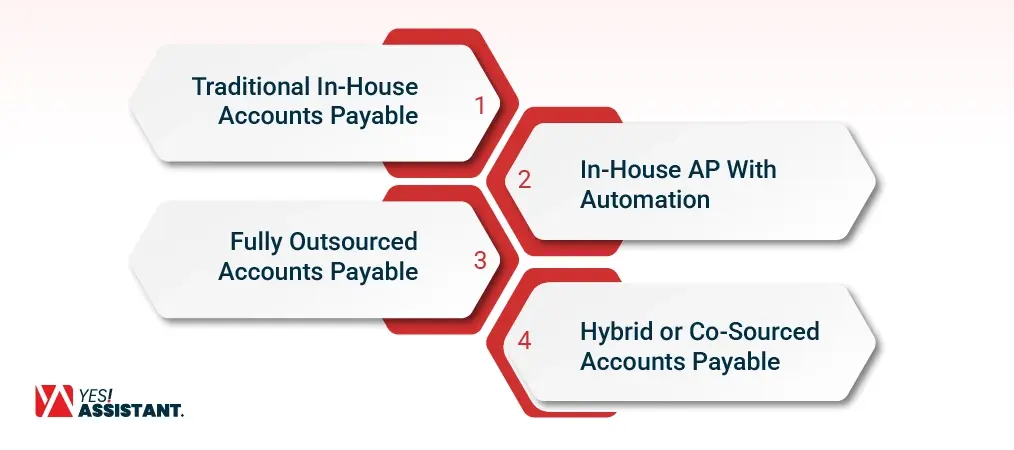
Traditional In-House Accounts Payable
In the traditional in-house accounts payable model, your very own finance team handles the full accounts payable process from start to finish. This includes receiving vendor invoices, entering data, getting approvals, replying to vendors and completing payment processing.
This model gives businesses direct control over their AP process. However, it will become quite challenging when invoice volumes start to grow. And with more manual work, the risk of errors and delays increases too.
In-House AP With Automation
In-house AP automation works as usual with your internal team, but with added software features to handle repetitive tasks. AP software captures invoice data, sends invoices for approval, matches vendor invoices with purchase orders and reduces manual data entry.
This method helps internal teams process more invoices without adding much manual work. It also improves accuracy and makes the AP process easier to scale.
Fully Outsourced Accounts Payable
With fully outsourced Accounts Payable, an external service provider manages most, if not all of the AP processes. The provider will handle invoice processing, data entry, vendor communication, approvals and payments based on the agreed terms.
This model lowers the workload on internal finance teams. It also gives businesses access to skilled AP support without building a larger in-house team.
Hybrid or Co-Sourced Accounts Payable
A hybrid or co-sourced AP model combines internal staff with outside vendor support. Your finance team keeps control of important tasks while an external provider handles specifically selected AP activities.
An example would be: your team might manage approvals and payment decisions while the provider handles invoice data entry and processing.
This model gives businesses more flexibility while keeping all the important AP decisions in-house. The accounting data entry service vendor can handle manual tasks.
In-House vs. Outsourced Accounts Payable: Head-to-Head Comparison
Both in-house and outsourced AP can work well for a business. Here’s the complete comparison breakdown –
| Factor | Accounts Payable Outsourcing | In-House Accounts Payable |
| Cost | Pay only for the services you need | Covers the employees’ salaries, benefits, tools, and other expenses |
| Handling Growth | Support can increase as AP needs grow | Growth may require more employees |
| Staff Skills | Get support from trained AP professionals | Use the skills of your existing team |
| Tools & Software | Provider may supply AP tools and systems | Company manages its own AP software |
| Daily Oversight | Provider manages day-to-day AP activities | Finance team manages the entire process |
| Invoice Processing | Can handle large invoice workloads efficiently | Processing depends on available staff |
| Accuracy | Automated checks can help catch common errors | Manual work may increase the chance of mistakes |
| Ideal Use | Useful for businesses that want flexible AP support | Suitable for businesses that prefer internal control |
Below, we will be covering each of the factors in more detail:
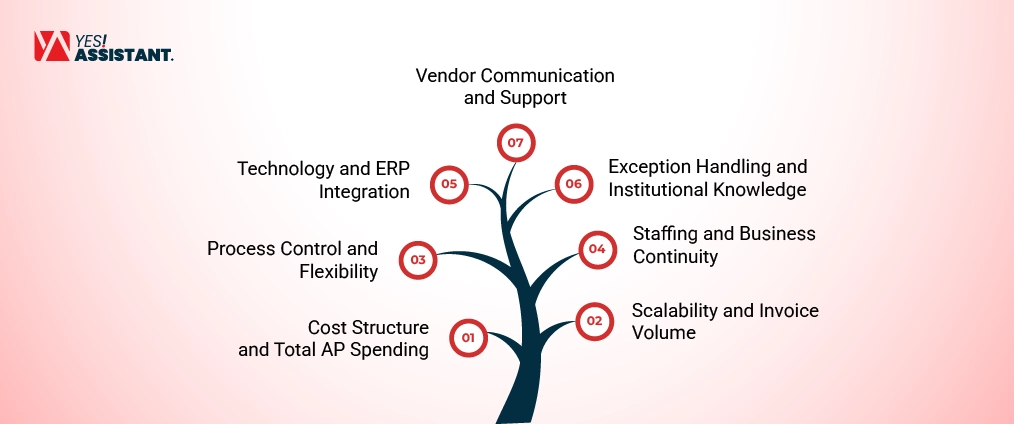
Cost Structure and Total AP Spending
According to the Institute of Financial Operations & Leadership (IFOL), in-house AP can have higher costs because businesses must pay for their salaries, benefits, training, software, and other required resources. Outsourcing these tasks is cost-saving because the provider handles the staff and many of the tools needed for AP themselves.
Scalability and Invoice Volume
As invoice volumes increase, an in-house team may need more employees and resources for managing them. Outsourcing accounts payable teams, however, can manage higher volumes without requiring the business to hire additional staff. This can make outsourcing useful during periods of rapid growth or heavy seasonal demand.
Process Control and Flexibility
In-house AP gives direct control to businesses over the workflows, approval steps and payment processes. On the other hand, an outsourcing provider has more responsibility for daily AP work. But businesses are still able to set clear rules, approval steps, and service requirements as necessary.
Staffing and Business Continuity
An in-house AP team depends fully on having enough skilled workers available. Hiring and training can also take a huge amount of time. With outsourcing providers, they manage all the AP staff and can deliver support when invoice volumes increase or internal resources become limited.
Technology and ERP Integration
In-house AP requires businesses to invest in and maintain their own AP technology and software. Outsourced providers may already have default AP software and automated processes. However, the vendor’s systems need to be set up to work with the company’s existing accounting or ERP system.
Exception Handling and Institutional Knowledge
In-house AP teams usually know the company’s rules, vendors, and payment process well. But an outsourced provider will also handle invoice issues and vendor disputes using precise processes. Clear instructions and regular communication are important to make sure unusual cases are handled correctly.
Vendor Communication and Support
In-house teams can communicate directly with vendors and quickly reply to all payment questions. With outsourced accounts payable, the provider is also able to handle vendor communication as part of the service. This reduces the workload for your finance team while keeping vendor relationships and communications organised.
Accounts Payable Outsourcing vs. In-House AP: Which Model Should You Choose?
The right Accounts Payable model depends on your invoice volume, budget allocation, team size, and set business goals. In-house AP’s can work well when a company wants direct control and has an experienced finance team. As invoice volumes grow, outsourcing can reduce manual work and give businesses access to skilled AP professionals and useful technology.
An in-house accounts payable team should be perfect if your business has a consistently stable invoice volume with enough staff to manage day-to-day AP tasks easily. This model gives your AP management team direct control over approvals, payments, vendors, and internal processes without any third-party involvement.
Choose accounts payable outsourcing if your AP workload is growing faster than your internal team can easily manage. AP outsourcing helps with invoice processing, vendor communication, payment scheduling, compliance, and reporting. AP automation software can also reduce data entry, speed up invoice approvals, and lower the risk of errors.
For many growing businesses, a hybrid AP model delivers a perfect balance between the two options.
Your internal team can handle important decisions while an external provider takes care of routine AP tasks.
What Should You Look for in an Outsourced Accounts Payable Partner?
When partnering with an outsourced accounts payable company. Always start by looking for a professional provider with strong security, trustworthy technology and clear pricing. Make sure they are able to work with your existing accounting and ERP systems before shifting to a new one.
Ask how they handle invoices, manage approvals and prevent duplicate or wrong payments.
Check their price tag and whether it’s clear or if they’re hiding any extra fees for software and additional services.
You should also be looking for real-time reporting systems, so that you can check vendor AP activities and where the cash flows.
In short, a good provider should offer secure systems, simple processes, clear communication, and support as your business expands.
Frequently Asked Questions
Is outsourcing accounts payable cheaper than keeping it in-house?
Outsourcing accounts payable can be cheaper than keeping it in-house. Outsourcing helps to reduce costs related to salaries, training and software. However, the overall savings depend on invoice volume and the service provider.
How many invoices per month justify outsourcing AP?
There is no fixed number for every business. However, outsourcing can become very useful as vendor invoices grow and internal teams continue to struggle with the workload.
Can you outsource AP without giving up payment approval?
Yes, your internal AP team can still give the final payment approval. The outsourced provider can only process invoice receipts, check details and prepare the payment outline. Meanwhile, the authorised employees make the final payment decision.
What is the difference between AP outsourcing and AP automation?
AP outsourcing means giving a third party your AP system tasks, while AP automation uses software to handle all the repetitive tasks. Outsourcing can also include automation software as part of the service they provide.
Can an outsourced AP team work inside an existing ERP?
Yes, outsourced AP teams can work inside an existing ERP system.
Is outsourced accounts payable secure?
Outsourced accounts payable is very secure if you choose a trusted provider. Providers should use encryption, multi-factor authentication, access controls, and strong security measures to protect financial data.
How long does it take to transition accounts payable to an outsourced provider?
The transition fully depends on your size and the complexity of the business. This process usually involves setting up new and connected work systems, testing the processes, and moving all the operators.
Conclusion
Your choice of model between accounts payable outsourcing vs. in-house AP depends completely on your business needs. The in-house AP model presents more control over your methods and works well with steady invoice volumes and a well-trained finance team.
On the other hand, Accounts payable outsourcing services can greatly reduce workload and costs while managing growth without hiring extra employees. And lastly, a hybrid model lets you keep critical decisions in-house while outsourcing routine manual tasks.
Before finalising which to pick, consider the AP costs, invoice volume, team capacity, technology, control, and future growth because the right model will improve your business’s efficiency and support the company’s growth.