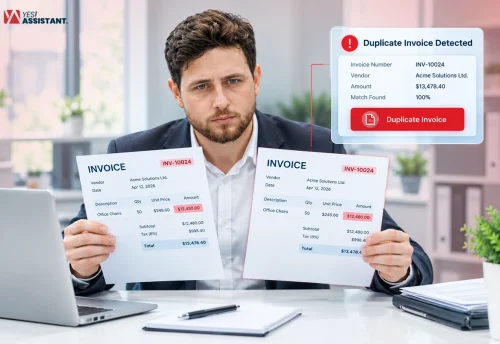


Benefits of Accounts Payable Outsourcing: What Actually Changes in Your Finance Operation
Accounts payable (AP) outsourcing changes what actually happens inside your finance operation. This is an effective step that lowers cost per invoice, improves internal control and reduces late fees. In the meantime, your finance team saves the time that they had to spend working manually.
In AP outsourcing, you hand over the work to a team dedicated to this task instead of hiring new people to handle piles of invoices. The outsourcing team comes with experience in maintaining clean records, tracking the results, and avoiding errors or fraud.
This method is not only about saving money, but it is more about freeing the in-house team from the piles of data entry and invoice work. Allowing the in-house team to focus on core duties of the company and generate more revenue than ever.
Key Takeaways
- Lowers and stabilizes your cost per invoice versus in-house processing.
- Covers the full cycle: receipt, matching, approvals, payments, reporting.
- Frees your finance team for higher-value, strategic work.
- Not ideal for low volume, complex approvals, or messy data.
- Track cost per invoice and error rate to confirm it’s working.
What Accounts Payable Outsourcing Actually Covers
Accounts payable outsourcing is not just someone else checking your invoice and paying your bills. Instead, it covers an important topic, which is the “end-to-end accounts payable process”. When an outsourced team handles this topic, they cover the functions mentioned in the SLA, which may include these functional areas:
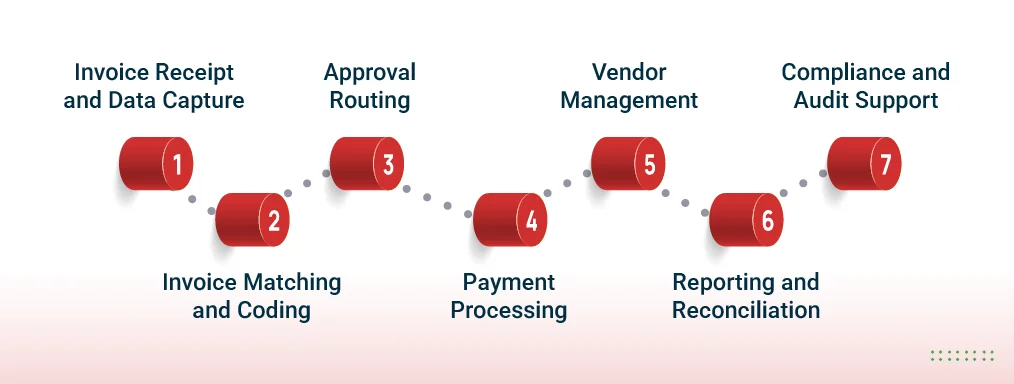
- Invoice Receipt and Data Capture: Collecting invoices from email, mail, or vendor portals and AP data entry.
- Invoice Matching and Coding: Matching invoices to purchase orders and receipts (2-way or 3-way match), and coding them to the correct GL accounts.
- Approval Routing: Sending invoices through your existing approval chain and following up on delays.
- Payment Processing: Scheduling and executing payments (ACH, check, wire, or card) based on your terms and cash flow needs.
- Vendor Management: Handling vendor inquiries, resolving discrepancies, and maintaining vendor master data.
- Reporting and Reconciliation: Providing AP aging reports, accrual data, and month-end reconciliation support.
- Compliance and Audit Support: Maintaining documentation trails for internal controls and external audits.
9 Benefits of Accounts Payable Outsourcing
Outsourcing accounts payable is beneficial both to the company and in-house employees. For the company, outsourcing typically provides a dedicated team at a lower cost than an in-house team, though savings can vary. For the in-house employees, work is simplified. Instead of spending hours on repetitive tasks, they can now focus on core duties. Here are the top 9 benefits of accounts payable outsourcing services explained:
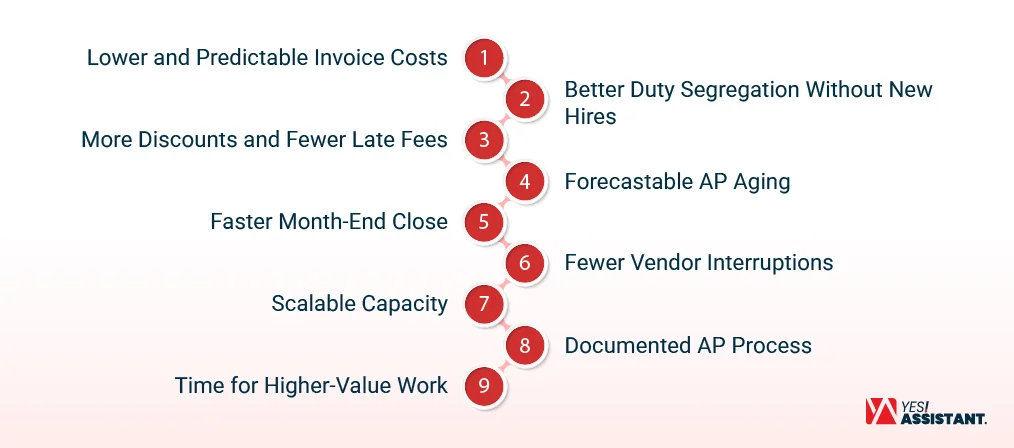
1. A Lower and More Predictable Cost Per Invoice
In-house AP comes with hidden costs. The hidden costs include employee salaries, training, benefits, software, error correction, etc., so the cost per invoice in an in-house finance team varies month to month depending on the situation.
On the other hand, outsourcing is more predictable because you get a fixed price per invoice. No matter how busy the months get, you enjoy the benefits at the same predictable cost per invoice.
2. Stronger Segregation of Duties Without Expanding the Finance Team
One of the biggest problems with a small in-house finance team is separating responsibilities. It is important to separate invoice entry, approval, and payment across different people, which is easier to do with outsourcing. With outsourcing, you do not have to hire people.
The BPO already has a structure ready for your AP to take care of. Allowing the chance to separate important responsibilities without expanding the finance team.
3. More Early-payment Discounts and Fewer Late Fees
The best ways to make AP effective for business are to reach more payment discounts and fewer late fees. When the invoices are sitting in someone’s inbox, early payment discounts are missed; on top of that, late fees creep in.
When you outsource your AP, the dedicated team is especially focused on processing invoices faster, catching every early payment discount they can while eliminating late fees.
4. A Current AP Aging Report You Can Actually Forecast From
When handling AP in-house, the aging report is typically delayed by days or weeks. On the other hand, when a dedicated team is in charge, the invoices are entered as they come in.
Because of that reason, the aging report is more accurate and shows what is actually going on. Allowing you an AP aging report you can actually forecast from.
5. A Cleaner and Faster Month-end Close
If you handle AP in-house, you know the hassle of looking for missing invoices, unclear coding, or unapproved bills at the month-end. But the good thing about AP outsourcing is the team keeps it documented from start to end, so the month is clear and traceable.
6. Vendor Inquiries Stop Interrupting Your Finance Team
When handling AP in-house, your finance team might get flooded with vendor inquiries saying, “Where is my payment?” It causes the in-house team to lose focus on what they are supposed to do rather than answering inquiries.
Outsource providers act as the first line of defense to those vendor inquiries. Allows your finance team to focus on how to generate more revenue rather than answering “where is my payment?”
7. Capacity Expands When Invoice Volume Spikes
Those seasonal spikes create extra work that puts pressure on the in-house team. To manage it, companies often outsource document processing services to outside agencies.
The advantage of AP outsourcing is that it can scale up during the volume spike and even scale down when it is not needed.
Outsourcing AP allows you to scale up and scale down your team according to the needs. It does not even require you to hire new people for the tasks.
8. Your AP Process Finally Gets Documented
In many companies, the finance team consists of only 2-3 people; they operate the whole AP process. Due to excessive pressure, they can not document all the invoices and related information. But when an outsourced team is handling the AP process, the whole process is documented.
Allowing you to train new hires faster and even switch providers in a short time period.
9. Your Finance Team Gets Time Back for Higher-Value Work
Every hour that is saved from manual data entry, chasing invoices, and vendor inquiries. Your team can focus on important tasks. That includes forecasting, strategic decisions, and analysis.
While the outsourced AP team is focusing on talking to vendors, chasing invoices, and data entry, your team can focus on generating more revenue.
When Accounts Payable Outsourcing May Not Deliver Much Benefit
Outsourcing Accounts payable may not deliver much value. This is true because outsourcing your accounts payable is not always a win. But more than that, it depends on the current situation of your business. In a few situations, it is not better to switch at all:
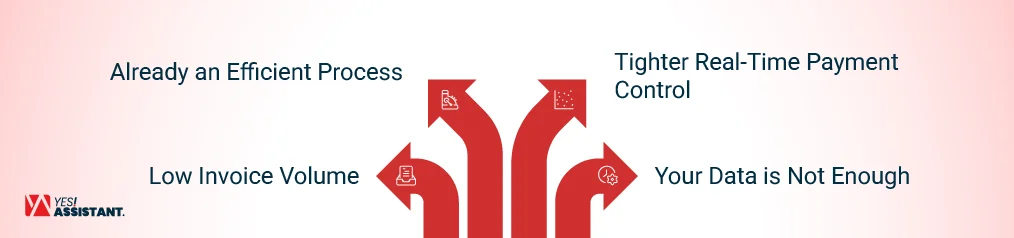
- Low Invoice Volume: If your company is handling few invoices, it is a sign it may not deliver much value. Because the outsourcing cost for a few invoices might beat the current in-house cost.
- Already an Efficient Process: If your company is already efficient in AP, outsourcing might not provide much value. Because if you already have a fast process that runs clean, with few errors, outsourcing won’t add much value. Because the gap between outsourcing and your current state is small.
- Need for Tight, Real-time Payment Control: If your company has a complex system of approval, an outsourced team might not be familiar with it. They might slow things down, make errors, and require heavy oversight to get right. It eliminates the time-saving advantage of outsourcing.
- Your Data is Not Enough: If your data is not consistent or you do not have good control over it, chances are high that outsourcing won’t work. You need to fix those data issues before you start outsourcing. Because outsourcing with inconsistent data might cause more confusion than benefit.
How to Measure Whether AP Outsourcing is Delivering the Benefits
Measuring whether AP outsourcing is delivering the benefits or not includes tracking key performance indicators (KPI). These KPIs include cost savings, efficiency, accuracy, and vendor satisfaction. One key factor is whether the provider is completing the service level agreements (SLAs).
- Cost Per Invoice: Calculate the total cost per invoice. Follow the mentioned formula to calculate. Cost per Invoice = Total AP Processing Costs / Total Number of Invoices Processed.
- Invoice Processing Time: Track the average time/day it takes to process an invoice to the final payment to measure the speed and secure early payment discounts.
- Straight-Through Processing (STP) Rate: Measure the number of invoices that are approved, matched, and posted without any manual intervention.
- Error and Exception Rate: Look into the percentage of duplicate payments, wrong data, or any other wrong information that requires human intervention to correct.
- Early Payment Discount Capture & Late Fee Avoidance: Track the number of early payment discounts and the late fees due to the late payment process.
- Vendor Inquiry Resolution Time: Measure how quickly the outsourced team resolves vendor payment queries or discrepancies escalated through their support channel.
Measuring these key factors will help you measure whether your AP outsourcing is delivering the benefits or not. Also, it will help you make the right decision for your business.
Frequently Asked Questions About Accounts Payable Outsourcing
What is the biggest benefit of outsourcing accounts payable?
The biggest benefit of outsourcing is considered saving time. When outsourcing AP, instead of manual data entry and chasing invoices, your team can focus on higher-value tasks like cash flow planning. Saving time also leads to other benefits such as lower cost, better control, and fewer errors. It also makes it easy to process payments faster, which often unlocks early payment discounts.
Does outsourcing accounts payable save money?
Yes, in most cases, outsourcing AP saves money. Because you skip the cost of hiring, training, and maintaining. You also get a more documented, predictable cost per invoice. When working with an outsourced provider, the number of early payment discounts increases and late payment fees decrease. So considering all these facts, outsourcing AP really saves money.
Do you lose control of payments when you outsource AP?
No, you don’t lose control of payments when you outsource AP. Instead, you set the rules, and your provider follows them. You still approve invoices and payment terms, and also decide when money goes out. The only thing that changes is who handles the manual work in between, such as data entry, invoice processing, etc.
Is AP outsourcing safer than managing accounts payable in-house?
No option is safer than the other one; it is a trade-off. Handling AP in-house allows full control and no data sharing with a third party. But it is more liable to human error, internal fraud or duplicate payments. On the other hand, outsourced AP uses dedicated software to prevent fraud, maintain audit trails, and minimize errors. But it comes with the risk of sharing data with a third party.
Is accounts payable outsourcing better than AP automation?
Both are different and solve different problems. AP automation speeds up the process, but it still needs human supervision to provide results. On the other hand, outsourcing provides actual people who will do the work. Many companies combine both for best results.
How do you calculate the ROI of accounts payable outsourcing?
To calculate the ROI of accounts payable outsourcing, you need to compare your total in-house baseline costs against the ongoing outsourcing fees and net operational improvements. Use this basic formula to calculate AP Outsourcing ROI = ((In-House Cost – Outsourcing Cost) / Outsourcing Cost) × 100.
Final Takeaway
Outsourcing your company’s accounts payable is not only about cutting costs. It is more about taking away the extra weight of manual work from your finance team. In this way, the finance team can focus on core tasks and use strategies to generate more revenue. If done correctly, it provides predictable cost per invoice, fewer late fees, and more early payment discounts.
Outsourcing AP is not a universal solution. Low invoice volume, complex approval chain, or messy data can limit its capabilities. The companies that benefit the most from AP outsourcing are the ones that keep measuring. Measuring criteria like cost per invoice, processing time, and error rates can help you measure the whole process.