
Difference Between PO and Non-PO Invoice
Key Takeaways
- The invoices are created against a purchase order and a formal procurement process and are known as PO invoices, such as manufacturing invoices or supplier invoices.
- Invoices that are created without a pre-approved purchase order are usually known as non-PO invoices, such as invoices for repair services or recurring software subscriptions.
- PO invoices are usually approved through procurement, while non-PO invoices require separate multi-level approval after submission and this is one of the major differences between these two types of invoices.
- Common steps in the PO invoice processing workflow include approving the purchase order, confirming product or service delivery, and matching the invoice against the purchase order.
- Major steps in the non-PO invoice processing workflow include capturing and reviewing invoice details, assigning budget ownership and routing the invoice for approval, and handling exceptions.
- Non-PO invoices are usually more difficult to process than PO invoices because they can’t be matched against a purchase order, require multiple levels of approval and GL coding, and may increase the risk of invoice fraud and duplicates.
Business invoices are mainly categorized into two types: PO and non-PO invoices. The accounts payable team of a business needs to process both types of invoices separately because the validation and approval processes for these two types of invoices are not the same. In this blog, we are going to discuss what PO and non-PO invoices are and the major differences between them.
What Is a PO Invoice?
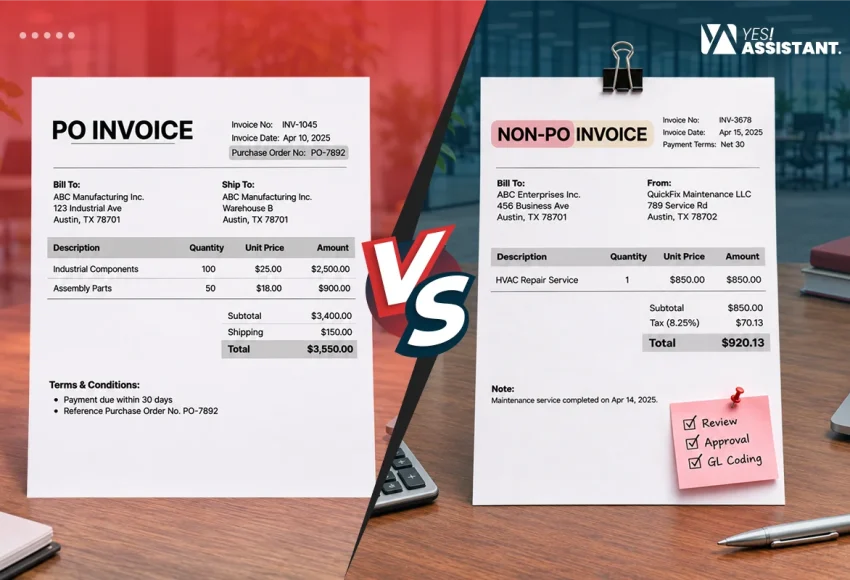
Businesses can create a purchase order and send it to a supplier when they need to buy products or services, usually on a large scale. The purchase order usually acts as a formal record of ordering products or services under agreed terms and conditions. A PO invoice is a document that a seller creates to fulfill a purchase order. It usually includes buyer and seller information, product description, quantity, price, shipping details, etc.
Some common examples of PO invoices are the following:
- Raw materials and manufacturing invoices.
- Office equipment supplier invoices.
- Invoices for recurring purchases.
- Service invoices.
What Is a Non-PO Invoice?
A business may need to buy a product or service without a formal procurement process or purchase order. The invoice created without a purchase order is called a non-PO invoice. Invoice processing in accounts payable has a different workflow for non-PO invoices because they can’t be verified against a purchase order.
Some common examples of non-PO invoices include the following:
- Employee travel expense invoices.
- Recurring software subscription invoices.
- Utility expense invoices, such as electricity or internet.
- Emergency maintenance or repair service invoices.
What Is the Difference Between a PO and Non-PO Invoice?
AP teams or invoice processing services don’t handle PO and non-PO invoices using the same process because there are some key differences between them. The table below includes the major differences:
| Comparison Factor | PO Invoice | Non-PO Invoice |
| Purchase order | Linked to a PO | No corresponding PO |
| Approval | Usually approved through the procurement/PO process | Requires separate approval |
| Validation | Often uses two-way or three-way matching | Relies on coding, documentation and approval |
| Common examples | Inventory, equipment, planned purchases | Utilities, rent, subscriptions, professional services |
| AP processing | More standardized | More manual and exception-prone |
| Main control | PO and receipt matching | Approval and expense validation |
How Are PO and Non-PO Invoices Processed?
PO invoices are created following a standard procurement process and purchase order. The processing of PO invoices requires matching and verification against a purchase order. Non-PO invoices are usually created without a formal procurement process.
This is why the workflows for processing PO and non-PO invoices are not very similar to each other. However, businesses can automate the invoice processing workflow for both PO and non-PO invoices.
PO Invoice Processing Workflow
Businesses often want to buy products or services following a formal procurement process. PO invoice processing starts when the procurement team of a business selects a vendor and decides to send them an order to buy the required products or services.
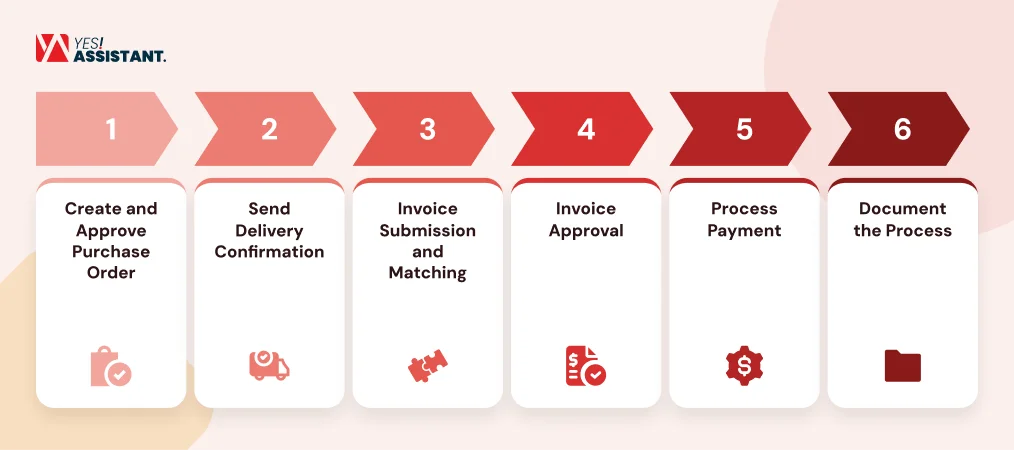
The key steps of a PO invoice processing workflow usually include the following:
1. Create and Approve Purchase Order
The procurement team creates a request to buy the goods or services necessary for a business. They submit the request to the appropriate roles or departments for approval. After authorization, the procurement team sends the request to vendors who can supply the goods or services.
2. Send Delivery Confirmation
The vendor sends the products after receiving the purchase order. The procurement team receives the products, matches them against the purchase order and sends a goods received receipt to confirm the delivery.
3. Invoice Submission and Matching
The vendor sends an invoice to the buyer after receiving delivery confirmation. This invoice includes the PO number, product details, price and other key information. The AP team matches the invoice against relevant documents, and this process is called invoice matching. There are mainly two types of systems that the AP team can compare: 2-way vs. 3-way invoice matching for validating invoices.
4. Invoice Approval
While matching the invoice, the accounts payable team can detect discrepancies in the invoice, such as missing PO numbers, incorrect pricing, wrong vendor addresses and duplicate invoices. The invoice processing team can flag invoices that look fake or suspicious to help avoid invoice scams. They can also escalate an invoice issue to a supplier and stop processing the invoice until the vendor fixes it.
5. Process Payment
The invoice is processed for payment if it is approved. The accounts payable team can send payment to a supplier based on agreed terms or their internal policies. After sending the payment, the invoice processing team records the invoice as paid.
6. Document the Process
The AP team documents the process after the supplier confirms they have been paid. They can store the invoice and transaction details in their invoice processing system or other records. Recording the processing details is important for audits, compliance and answering any questions about the payments.
Non-PO Invoice Processing Workflow
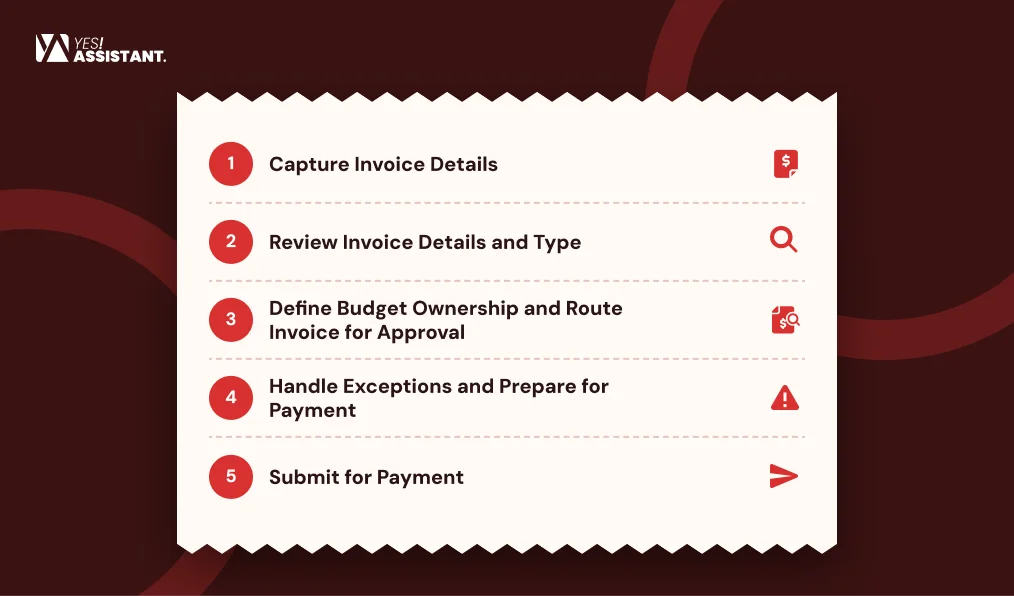
Some of the major steps in the non-PO invoice processing workflow usually include the following:
1. Capture Invoice Details
Non-PO invoices are created without a purchase order. They are commonly used for paying small expenses such as employee reimbursements, utility bills and recurring software subscriptions. Once someone submits a non-PO invoice, the AP team usually captures the details, such as the vendor name, vendor’s tax information, product or service details and price.
2. Review Invoice Details and Type
The AP team may check the vendor’s name, address and tax information. They can validate the expense claim by checking whether the service or goods were actually provided or whether the vendor actually exists. They can also classify the expenses to decide which department or role should approve them. For example, they can determine whether the expense is a recurring software subscription or a travel expense for an employee.
3. Define Budget Ownership and Route Invoice for Approval
Businesses need to account for an expense to a project, team or department. This is necessary for establishing budget ownership, which means identifying the role or department responsible for managing and approving the budget for a specific expense. The accounts payable team sends the invoice to the appropriate role or department after assigning the budget ownership.
4. Handle Exceptions and Prepare for Payment
The AP team escalates the invoice if they notice any issues before payment, such as an inflated amount, changed bank details or a duplicate invoice number. This type of check helps a business avoid invoice scams. After handling the exception, the accounts payable team checks the payment terms and methods. Then, they verify the approval and check if there is any reason to hold the payment.
5. Submit for Payment
The AP or finance team sends the payment to a vendor if an invoice is finally ready for payment and there is no reason to hold it. They record the payment details, such as bank transactions, processor records and fees, and update their ledger.
Why Are Non-PO Invoices More Difficult to Process?
One key difference between PO and non-PO invoices is the complexity the AP team can experience while processing them. Some AP professionals often find non-PO invoice processing more difficult than PO invoice processing.
Some of the reasons for this can be:
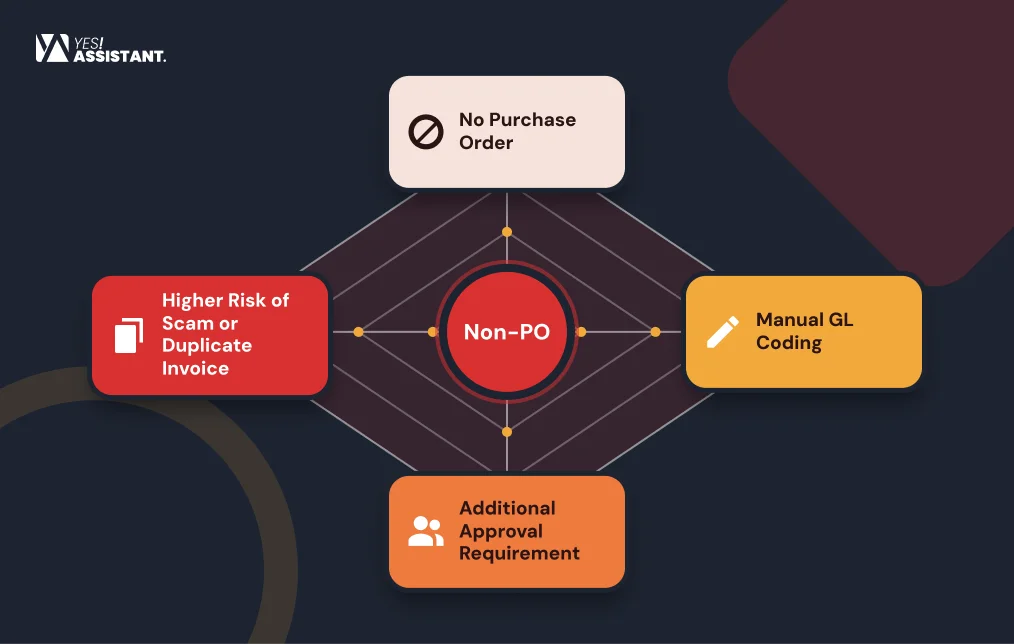
No Purchase Order
PO invoices can use 2-way and 3-way matching, where the accounts payable team can verify an invoice against a PO and goods received notes (GRN). This helps them identify if the product or service details and other key information don’t match.
Manual GL Coding
The AP team needs to assign GL coding or specific accounting categories, such as cost centers and departments, to an invoice for recording it in the financial system of a business. Non-PO invoices are not created as part of the formal procurement process. So, the accounts payable team needs to review and assign the GL code manually while processing them.
Additional Approval Requirement
Non-PO invoices usually require additional review. The AP team needs to manually verify who requested the goods or services and whether they were actually delivered. They may also check if the vendor is a verified supplier and is listed in the vendor master file.
Then, they can check whether the expense has budget approval as part of a specific contract or project. A non-PO invoice may often require multilevel approval and routing since the expense was never pre-approved. High-amount non-PO invoices may require authorization from multiple roles or departments.
Higher Risk of Scam or Duplicate Invoice
A non-PO invoice can’t be verified against a purchase order, which increases the chance of a scam or duplicate invoice. The AP team can’t just find the details of non-PO invoices by matching them against a purchase order. They need to perform multiple reviews and verifications.
Scammers can send an invoice to a business for services or goods they never delivered, using this as an opportunity. Sometimes, a vendor or employee can also submit an expense multiple times to a business. This is how non-PO invoices can increase the risk of fraud and duplicate invoices.
Conclusion
A business needs to process and validate both PO and non-PO invoices as part of its regular accounts payable operations. PO invoices are created as part of a formal procurement process and can be matched with a purchase order, which makes it easier to identify discrepancies. Non-PO invoices are usually created for expenses that do not have pre-approval. This creates some major differences in the processing of PO and non-PO invoices, including their validation and approval.
FAQs
What is the main difference between a PO and non-PO invoice?
There are several differences between PO and non-PO invoices, which can be seen in how they are created, authorized and validated. However, the key difference is that PO invoices are created against a purchase order or formal procurement request, while non-PO invoices are created for expenses that usually don’t have budget pre-approval.
Do non-PO invoices require approval?
Yes, and non-PO invoice approval can often be more complex than PO invoice approval. The accounts payable team usually verifies budget approval, GL coding and approval from specific departments or roles based on the spending threshold before processing non-PO invoices.
What are 2-way and 3-way matching for a PO invoice?
The accounts payable team uses two methods for validating invoices against procurement records, called 2-way and 3-way matching. In a 2-way system, a PO invoice is matched against its purchase order, while in a 3-way system, it is also matched against the goods received note (GRN).
Can non-PO invoice processing be automated?
Yes, non-PO invoice processing can also be automated using OCR and AI technology for data extraction, vendor verification and assigning GL codes.
Can a BPO company process both PO and non-PO invoices?
Yes, many outsourcing invoice processing services can handle both PO and non-PO invoice processing tasks.