


How Multitasking Reduces Business Efficiency?
Many business owners believe that doing more at once means getting more done. Multitasking is a productivity myth that actually slows your business growth. While you think multiple tasking is extra productive skills, switching between tasks constantly drains your mental stress and hurts your bottom line.
In this blog, you will learn how multitasking increases error rates, slows your task, impacts on decision-making, mental fatigue, and impacts on revenue. Also, how to fix multitasking effects on your organization setting priorities, engage in core jobs and set strategies.
What is Multitasking in a Business Context?
Generally multi-tasking refers to work on two or more tasks at a time. In a business context, multitasking is generally defined as the ability to handle multiple responsibilities, projects or tasks for quick succession. Besides, Multi-tasking in business means you’re checking emails during client meetings, answering text at the board-meeting, or switching one to another tasks.
Here are examples of Multitasking in Business Context
- Manipulate deadlines and resources for multiple working groups.
- Watching a new project’s video tutorial while driving to an ongoing task.
- Talking with clients while typing into documents, or updating system information.
- Scrolling social media updates while in a meeting
- Talking to a person while writing a to-do list.
5 Ways Multitasking Reduces Business Efficiency
You may expect to get more effective results on multitasking. But multitasking reduces your business efficiency due to high error rates, slow task completion, low decision-making, or mental exhaustion. This task overload leads to burnout, and resulting in stack of incomplete and low-quality tasks.
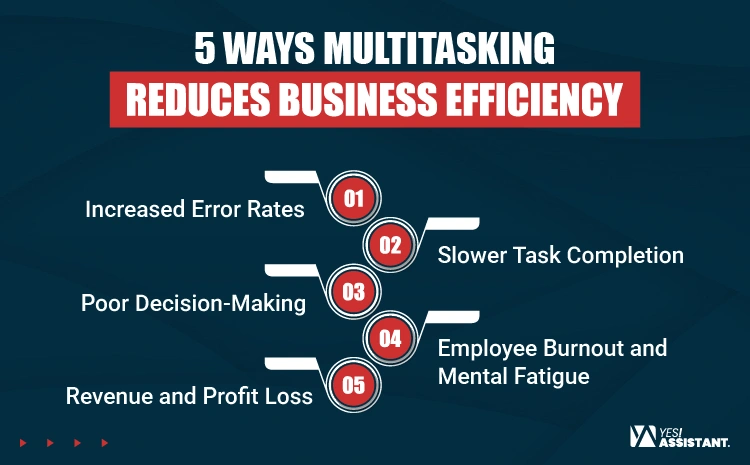
Here are five ways multitasking reduces efficiency:
Increased Error Rates
Switching your concentration between tasks increases chances of making mistakes as your brain fights to manage multiple information at a time. This multi-tasking causes error rates that can rise up to 50% of your total work. This rate of error costs your business and decreases business growth.
Key ways to increase error rates
- Decline Performance: Multiple times task switching increases significant rate of errors, and decision-making.
- Reduce Focus: Multitasking detaches your proper attention from main tasks, reducing work quality.
- Reduce Quality: Incomplete understanding, rush into new tasks lead to decreased tasks quality.
- Increase Error and Rework: Multiple functions in your brain decreases accuracy, leading to more mistakes and repetitive correction.
Slower Task Completion
Constantly reengaging with different tasks wastes time and mental energy. It can often take twice as long to complete tasks, which is a common time leak in businesses. This causes mental drain or wasting time as brains take 23-minutes to re-focus after switching tasks, leading to decreased productivity.
Key ways multitasking slows completion in a business context:
- Context Switching Costs: Your brain cannot process multiple tasks simultaneously. After shifting from one to another task, causing a delay to get back into productivity flow.
- Mental Blockage and Jams: Continuous switch causes mental overload, making your thinking slower at processing information. This leads to reduced cognitive function, affecting your decision-making.
- Reduce Quality and Workflow: Reduce your deep attention, and efficiency flow that leads to longer your high-valued tasks completion.
- Workload Creates Jam: Compared to highway crowds, excessive multitasking causes your project to back up, reducing overall output of the work.
Poor Decision-Making
Multitasking drains your cognitive resources. This task overloads often leads to inappropriate decision-making due to poor tasks organization, can blocks your business growth. But your main focus should apply on businesses’ legal analysis, problem-solving, and weighting options effectively.
The Cost of Poor Task Organization
Key ways multitasking Poor Decision-Making in a business context:
- Drains Your Mental Accelerator: Your memory space is limited but excessive workload decreases your working memory, and blocks your brain. Therefore, you will lose strength and be unable to differentiate between right or wrong information.
- Blocks New Idea Generation: When your working memory is full, there is no room left for a moment of sudden realization required for creative thinking.
- Encourages Marginal Choices: A stressed brain tends to choose the easiest way to find results instead of finding unique solutions.
- Unable to Prioritize Urgency: Multitaskers often fall into the trap of addressing the most urgent tasks. This hurts your long-term business outcomes.
Employee Burnout and Mental Fatigue
The constant task manipulation stresses your brain, leading to chronic burnout, exhaustion, and decreased satisfaction. This can significantly damage your ability to maintain a healthy work-life balance.
How multitasking Employee Burnout and Mental Fatigue in a business context:
- Elevated Stress: While you are involved with multiple tasks, your internal pressure will increase. This causes high-impact on your productivity and business.
- Health Risks: Long-term stressing from multitasking, leads to physical illness and mental exhaustion.
- Forced Downtime: If you don’t manage your workload; at last, your full body forces you to stop through burnout.
- Reduce Efficiency: At beginning you feel no pressure involved with multitasking, and seem to complete the task immediately. But there is no sign of completing tasks within targeted time. Thus, you will be in a hurry to complete, which causes an increased error rate.
Revenue and Profit Loss
Taskoverload reduces business revenue and profit by slashing productivity by up to 40% and increasing errors due to cognitive switching costs. It causes slower decision-making, missed opportunities, and employee burnout. This resulted in significant financial losses, potentially costing millions annually in lost productivity for large companies.
Key Drivers of Financial Loss
- Decreased Productivity & Time Cost: This constant task switching reduces up to 2.1 hours lost per employee daily, says Curt Steinhorst.
- Costly Errors and Lose Contract: A stressed employee makes mistakes twice or more. In business services, these errors are fixed by expensive costs, resulting in missed opportunities and lost deals.
- Low Quality Decision-Making: Workload loses ability to process complex information, leading to poor financial decisions in accounting, budgeting, or investment.
- Decline sales: In sales, taskload leads to lower-valued work, where employees focus on busywork rather than close deals.
How to Reduce Multitasking in Your Organization?
As a business, you may work with strategic planning in sales, marketing, hiring, product development. Effective planning can keep you ahead of the competitive market. If a task is necessary but has no core value, use automation or outsource a virtual assistant service to keep your focus on the big picture.
Therefore, you need to take steps to reduce multitasking in your organization. Here are the steps to fix task switching to ensure the task completion within deadlines.
Avoid Tasks that Breaks Your Focus
You think multitasking increases your capability. But, at last, it will be the cause of destroying your morale, mental burnout and staying away from decision-making. A business strategy planner needs to take decisions from a series of information banks through evaluating situations, and constant analysis.
- Identify hidden causes of distractions and put systems in place to reduce distraction.
- Stop notification from email, messages, or notifications that drain your brain.
- Batch your similar task together in a convenient way.
- Take regular breaks while working with high-valued tasks.
Engage Functions that Ensure Business Growth
Just focus on tasks that ensure your business growth. You must engage with high-value functions, and make sure long-term success.
- Determine which activities directly bring in revenue or improve your product.
- Assign virtual assistant to handle administrative tasks, that focus on scaling
- Block time where you only work on major growth projects without interruption.
Set Your Priorities
If you’ve 10-20 tasks priority, then nothing is prioritized. Select 3-4 relevant tasks with clear priorities helps you manage your mental energy and keep everything on the right track.
- Focus on the 20% of tasks that produce 80% of your business results.
- Choose only 3 “must-do” tasks everyday to avoid feeling overwhelmed.
- Determine meetings or projects that do not align with your current goals.
Create a Routine
A predictable routine can eliminate sudden multiple tasking decisions. When you have a set schedule, your brain doesn’t have to write on what to do next. This consistency builds your speed and lower stress.
- Assign specific hours to check emails, join meetings and perform creative work.
- Start your day with your most strategic tasks to avoid distractions.
- Spend 10 minutes at the end of the day planning for next workdays routine.
Determine Your Strategy Rather Than Execution
Your value is your vision, not just doing the work. If you spend all your time executing small details, you lose insights of a big picture. Thereby, stay calm to determine a clear strategy that focuses on your future growth.
- Spend more time to design your systems that run your business.
- Delegate executive tasks to your support staff or assistant
- Use data and reports to track results instead of overseeing every step of the process.
Final Thoughts
Business owners may think multitasking is a shortcut to success. But this is actually a roadblock to your business efficiency. It leads to higher error rates, mental burnout, and lost business revenue.
To grow your organization, you must stop doing everything and start doing your core activities. Therefore, you need to set priorities, creating routines, and delegating non-core tasks to remote assistants. This will protect your mental energy and focus on the big picture.