

BPO Escalation Matrix: A Complete Guide to Levels, Triggers and SLAs
If your problem-solving strategy sounds like “hope someone notices before the client does”, it is high time to do something about it. BPO escalation matrix is a structured framework that defines who handles a problem based on the severity of the problem.
Every outsourced support team deals with missed deadlines, billing errors and frustrated customers. Without a clear escalation process about how each issue should be handled and who should handle it, these issues stay unresolved, and it slowly erodes customer relationships. This guide will teach what an escalation matrix is, why it matters and its core components.
Key Takeaways
- Escalation matrix = defines who handles an issue based on severity.
- Four parts: severity levels, triggers, tiered ownership, SLAs.
- Small teams use 3 tiers: Front-line → Supervisor → Account Manager.
- Escalate on set triggers (SLA breach, risk, bad sentiment), not gut feel.
- Review and test the matrix quarterly to keep it working as issues evolve.
What is a BPO Escalation Matrix?
A BPO escalation matrix is exactly what it sounds like. This is a structured framework that defines who will handle a problem based on its severity. An escalation matrix is designed in support levels; each level responds to higher levels of severity or urgency. A frontline team member handles minor problems; major problems are handled by higher-ups, including a manager, executive, or an external specialist, depending on the level of difficulty.
Escalation metrics are used across BPO sectors, including IT, customer service, virtual assistance, and telecom, etc. But the final goal is always the same: to ensure the issues are addressed at the appropriate severity level within a short time frame.
For example, A customer’s Wi-Fi dies and they call the customer support service. L1, meaning an agent tells them to restart, but it does not fix the issue. The agent escalates the issue to L2, a team leader, who finds out the entire region is facing the same problem. L2 escalates to L3; here, L3, a CTO, tries to fix the issue with their technical team. But the problem is not resolved, and the business relationship is at risk, which escalates the issue to L4. This is what an escalation matrix looks like.
Why an Escalation Matrix Matters When You Outsource
An escalation matrix matters because it improves accountability within the organization. It gives a clear view of who is responsible for addressing issues at each stage, improves customer service, and protects revenue while providing a reliable business operation.
Objections or problems are supposed to occur in any business model. Problems will occur, and they must be fixed, but without an escalation matrix, there is no designated person to handle it. But an escalation matrix makes sure there are individuals ready to handle specific problems.
An escalation matrix is a vital element of any business, especially when you are outsourcing. It addresses issues effectively, helps prevent delays or confusion, and provides an exact solution instead of increasing customer dissatisfaction.
Here is why it matters more than you think:
Problems Are Addressed Quickly
If there is no dedicated individual to solve problems, this core task becomes secondary. Meaning the problems are ignored, passed around, delayed, and often forgotten. No one on the support team knows who’s responsible for fixing it.
Scenario: You find a problem around 5 pm; without clear tiered ownership, you might not be able to fix it until the next business day. Eventually, the next business day can be next week. On the other hand, having an escalation matrix fixes problems faster and leaves little room for delay.
Proper problem-solving pipeline
Without a dedicated escalation process, ownership stays ambiguous. Without dedicated staff working on it, no one knows who can fix it. It takes time, requires unpredictable quality passes, and can lead to wrong decisions as well.
Scenario: Your support team receives an objection; there is no dedicated individual to solve the problem, so you ask someone to help the situation. They make a decision that needs approval from 3 other people, but the escalation matrix changes the game totally. The objection comes in, is escalated to the person who can help, and the objection gets solved. Helps your BPO stay away from hassle and save time at the same time.
Reduces Cost
Another reason why an escalation matrix matters in outsourcing is that it reduces overall operational costs. Having a proper escalation matrix setup helps to address problems early, creates a proper hierarchy, and most importantly lets your team focus on core tasks rather than other things.
Scenario: A billing error is reported; without any matrix, it bounces between three people. Once it reaches the finance department, it is already 2 days and several hours wasted. On the other hand, with proper implementation of an escalation matrix, the issue goes straight to the finance department.
The Four Components Every Escalation Matrix Needs
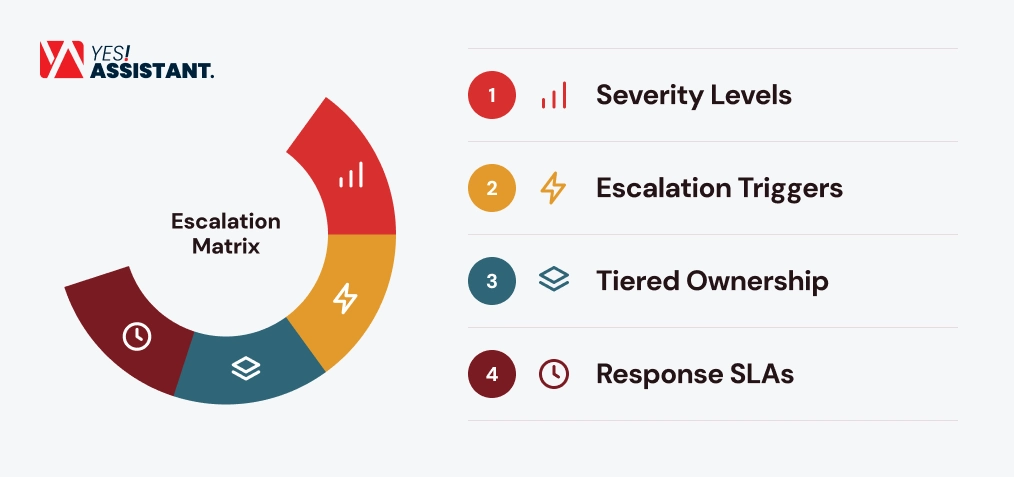
Every process has some core components it can not operate without. For an escalation matrix, there is no exception as well. The four components every escalation matrix needs are severity levels, escalation triggers, tiered ownership and Response SLAs. Here is a brief explanation of these four core components for better understanding:
Severity Levels
Severity levels mean labeling a problem based on how serious it is. Such as if a customer is charged twice for one subscription, it is marked “critical”. Similar to hospitals prioritizing patients by health condition, not by who came first. A less serious issue like a slow-loading page will be marked as “Low”.
Escalation Triggers
These are the rules that decide when a problem should move to the next level of the process. As the payment issue was marked “critical,” if the agent is unable to fix the issue, it is escalated to a higher level. The agent tried to refund, but the system blocked it, so there is guesswork rather than escalating the issue.
Tiered Ownership
Tiered ownership means the specific people who are responsible for handling different issues at different stages. The agent escalates the issues to the team leader; the team leader finds out that other people are also having this issue. As it is a bigger issue now, the team lead escalates it to the manager, who brings in the technical team to fix the issue. Each level only appears if the previous one cannot solve it.
Response SLAs
Response SLAs refer to the timeline for responding to or fixing the issue. When a critical issue is raised by a customer, it is directly transferred to the technical team through the front desk or call center agent. Then the tech team responds within 15 minutes and lets the client know that the issue will be solved within 1 hour max.
A 3-Tier Escalation Matrix for VA and Small BPO Teams
A tier matrix organizes a small BPO team’s capacity into levels. All of them come with their own scope and responsibilities. BPO teams are trained to make the process smoother and free of confusion. This makes sure each objection reaches the right person without being passed around to 3 people. VA and small BPO teams usually don’t require a 5-tier escalation matrix; a 3-tier escalation matrix just works fine. Here is a proper demonstration of a 3-tier escalation for VA and small BPO teams.
Tier 1: Virtual Assistant / Frontline Agent
The frontline team is the first line of people who receive the issue. Their main task is to sort out the objection and take the required steps. Frontline agents are supposed to close the objection if it is routine or escalate it to the person specifically responsible for it.
Typical Tier 1 scope includes:
- Updating status, scheduling requests and basic account questions.
- Basic standard replies as a document or script.
- Performing simple troubleshooting that does not require any specialist.
- Transferring the problem to higher-ups but gathering all information at the front-line service desk so Tier 2 is informed about what is happening.
Tier 2: Team Lead / Supervisor
Tier 2 does what Tier 1 can not. Typically, VAs or frontline agents can not take any action where detailed judgment is required.
Typical Tier 2 scope includes:
- Requests that do not fall under standard policy, including refunds, exceptions and adjustments.
- Trying to fix an issue that the VA already tried but failed.
- Decisions that require higher evaluation.
- Communicating between VA and client when required. Such as when new alignment is required.
Tier 3: Owner / Account Manager
This tier exists for situations where mishandling the situation can cause serious consequences. This often requires sign-off from a department head or the account owner. It is used to save relationships and solve problems no one else can.
Typical Tier 3 scope includes:
- Situations where client dissatisfaction risks contract termination.
- Legal, compliance or concerns regarding the contract.
- Issues tied to revenue or retention.
- Complaints that Tier 1 and Tier 2 failed to fix.
Clients usually don’t come this far, but if it reaches this level, the client is already frustrated. It will require a perfect combination of time, tone and an effective solution.
What Should You Ask Your VA or BPO Provider About Escalation?
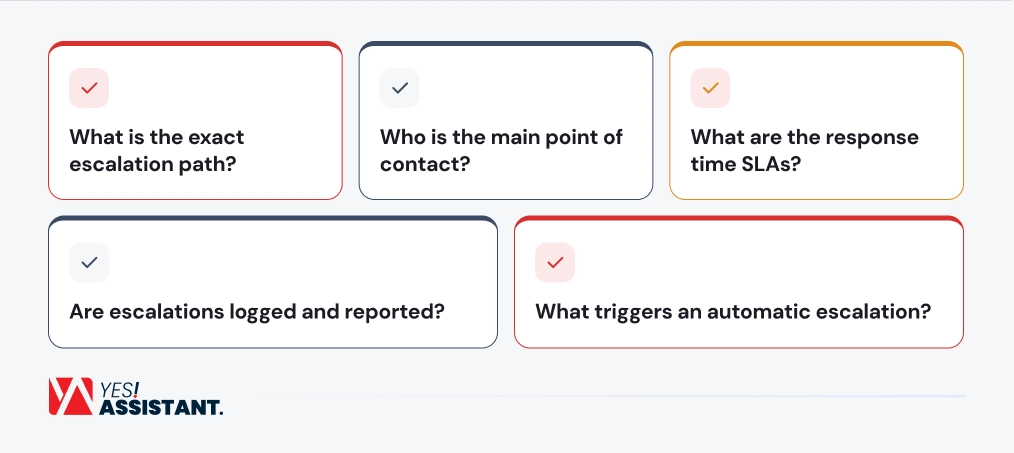
When working with a VA or BPO service provider, you must ask some questions to evaluate their capability. These questions should evaluate their knowledge in their field. Asking questions regarding defining clear triggers, response times, and points of contact will help you assess their seriousness and knowledge about what they do.
What is the Exact Escalation Path?
This question verifies the routing system of your outsourced team. Because you need to know if a question or issue is left unresolved, does it travel sideways to an expert or upwards to a senior? This is usually used to prevent confusion.
Who is the Main Point of Contact?
This strongly establishes individual accountability and does not let escalated issues get lost in the generic team mailbox. This is mainly used for crisis management and emergency overrides.
What Are the Response Time SLAs?
This is one of the most important questions you should ask. SLAs turn vague promises into fast and effective support. This helps to contractually enforce speed and accountability.
Are Escalations Logged and Reported?
This question changes the narrative that you hold with your provider. It turns your simple vendor agreement into a data-driven strategic partnership. This question is often used to analyze and bring out the root cause of problems.
What Triggers an Automatic Escalation?
This question clears the guessing game of confusion and sets clear boundaries for frontline VAs. This is used to manage risk and protect business liabilities.
Conclusion
A BPO escalation matrix turns confusion into solutions and chaos into clarity. By defining clear severity levels, triggers, tiered ownership and response SLAs, teams are clear about their roles. It creates a clear rule of who handles what and when, protecting client relationships is more important than anything. For most small BPO teams, a 3-4 tier matrix is good enough to get things done smoothly.
But there is a fact: a BPO matrix only works when the right people are placed at the right positions. This is where workforce management in BPO steps in to ensure that frontline people working at each level are trained and ready. The right escalation matrix not only solves problems but also lowers costs, strengthens the relationship with customers, and provides faster resolutions.
FAQs
What is the difference between an escalation matrix and an escalation policy?
The difference between an escalation matrix and an escalation policy is that an escalation matrix defines who handles a problem. On the other hand, an escalation policy defines how and why an escalation happens. An escalation matrix is more about mapping the issues to the right person, but an escalation policy says why a problem should move up the chain.
How many levels should an escalation matrix have?
Most escalation matrices have 3-4 levels, but can have 5 for critical issues. L1 handles routine issues. L2 team leads step in when L1 can’t solve it. L3 managers handle larger issues. L4 senior leadership handles business risks. L5 handles critical issues L4 fails to resolve, like contract disputes.
What is the difference between hierarchical and functional escalation?
The main difference between them is direction. Hierarchical escalation moves an issue upward through the chain of command: Agent> Supervisor> Manager, based on severity. On the other hand, functional escalation moves it sideways to a specialist team based on seniority.
What happens when an issue is escalated to an outsourced team?
When an issue is escalated to an outsourced team, the issue’s history is shared with a higher-tier specialist. The specialist tries to solve the issue with advanced techniques, making sure the issues don’t pile up.
How often should you review or test an escalation matrix?
The escalation matrix should be tested or reviewed quarterly or immediately after any major changes. It is recommended to run simulation drills at least once a year to make sure everything is working as it should be and is dependable.