


What Is BPO? Business Process Outsourcing Explained
Business process outsourcing is not just a back-office management decision anymore, but it has become a core operating decision in modern days. Here in this guide, we will explore what a BPO is, including its working models and what types of outsourced tasks it can handle. We will also highlight the risks involved in using BPO services, their pricing, and a reusable checklist for choosing a provider.
Quick Answer
Business process outsourcing (BPO) is a method of contracting an external provider for handling repetitive business tasks or processes. Some of these tasks may include customer support, payroll, data entry, and IT support. In this type of contract, the client keeps the ownership of the business while their outsourcing operational partner runs the business, ensuring the specific standards according to an agreement.
According to a market analysis report from Grand View Research, the global BPO market had a value of $328.4 billion, and it is expected to reach $695.8 billion by 2033.
What is BPO?
Business process outsourcing is a type of outsourcing method where a company uses a third-party provider to run a particular business process for it. This usually includes some repetitive routine tasks such as bookkeeping, payroll processing, data entry, and customer support.
The major goal of using BPO services is to achieve efficiency with external support without compromising the control of the business. In this type of contract, the provider will handle the agreed process following specific targets and report back to you.
Let’s think about a growing company that needs to handle more customer calls than its capacity. So they contract a service provider who already has a system and customer call specialists to serve their customers. The provider answers the calls following the company’s customer service while it focuses on its core business operations.
BPOs are mostly meant to handle ongoing repetitive tasks with consistency and expertise. It is not ideal to outsource sensitive and confidential or strategic tasks that should be performed by in-house staff.
What Gets Outsourced: Processes, Not Products
In BPO, you outsource a process, not a product. The company keeps full ownership of its offering, brand, and customer relationships. What changes is how certain work gets done behind the scenes.
Processes that companies commonly outsource include:
- Customer support
- Payroll processing
- Data management and data entry
- Accounting and bookkeeping
- Technical support and IT services
- HR administration
These functions support the business. They do not define its value in the market. So outsourcing them improves efficiency without touching the company’s identity or core mission.
Who Does the Work: An External Vendor or Partner
An external vendor or business partner does the outsourced work. This provider runs its own workforce, management, and systems. It specializes in specific processes and brings trained people and dedicated tools.
A capable BPO provider typically has:
- Its own workforce
- An independent management structure
- Specialised operational systems
- Proven expertise in specific processes
The client still owns the outcome. The client sets expectations, defines service level requirements, and tracks performance while the vendor performs the work. A clear agreement is made to set some responsibilities and measurable outcomes that maintain accountability in a relationship for both parties.
BPO vs Outsourcing vs Offshoring
People often confuse these three terms. They are related but describe different things. BPO is about what work is outsourced. Outsourcing is about who performs the work. Offshoring is about where the work is done.
| Concept | Focus | What it means |
| BPO | Type of work | Outsourcing specific business processes, such as customer service, payroll, or IT support |
| Outsourcing | Who performs the work | Assigning tasks to a third-party company instead of internal employees |
| Offshoring | Location of work | Moving business operations to another country |
What is Outsourcing?
Processing your work with a third-party service that is not under your control is called outsourcing. They will be responsible for hiring, training, and managing professionals who will complete your work. The major difference between outsourcing and completing work with in-house employees is who is responsible for providing the workforce. It usually has nothing to do with your quality or type of work.
What is Offshoring?
Offshoring means moving business work to another country. You can offshore to your own team abroad or to an external provider in another country. It is different from outsourcing, which is not about geography but who you hand over your task to. You can outsource inside your own country or across borders.
So these are separate decisions. One is about location. The other is about responsibility and management. A worked example:
- A company hires another firm to handle customer support. That is outsourcing.
- The task being handed over is customer service. That is BPO.
- The provider sits in another country. That is offshoring.
BPO vs In-House Operations
The table below shows the main difference between performing your task with your own team and a service provider:
| Aspect | In-house operation | BPO |
| Workforce | Company employees | Provider’s employees |
| Management | Controlled directly by the company | Managed by the provider |
| Cost | Higher fixed cost | Often lower and variable |
| Expertise | Limited to internal skills | Access to specialist expertise |
| Focus | Core and support tasks | Mostly support processes |
How BPO Works, Step by Step
A BPO engagement follows a structured path. Each step reduces risk, protects quality, and keeps the provider’s work aligned with business goals. The client gives away specific responsibilities, not control, and expects the work to be done on time, with fewer errors and consistent quality.
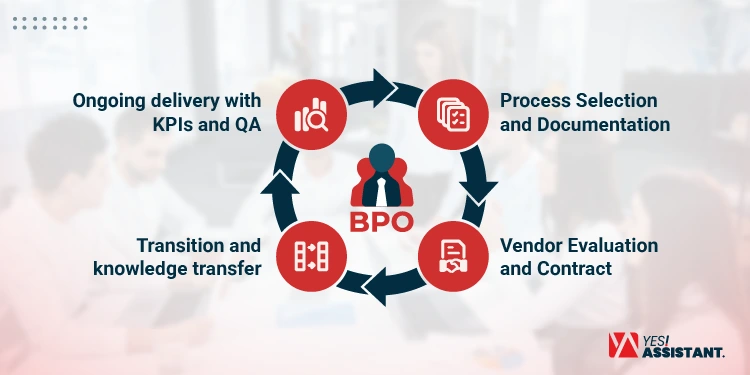
1. Process Selection and Documentation
First, decide which processes to outsource. Companies usually pick tasks that are:
- Repetitive and rule-based
- Time-consuming
- Non-core to the company’s main value
- Easy to measure
Then document each process clearly. Good documentation tells the provider exactly how the work should run. It usually covers:
- Workflow steps
- Task responsibilities
- Tools and software used
- Expected outcomes and quality standards
2. Vendor Evaluation and Contract
Next, choose a capable provider. Evaluation focuses on experience, industry knowledge, security standards, scalability, and cost structure. Once you select a provider, you sign a formal contract. The contract sets the operating framework and defines:
- Scope of work
- Pricing and payment structure
- Service level agreements (SLAs)
- Data protection policies
- Performance expectations
3. Transition and knowledge transfer
During transition, you move knowledge from your team to the provider’s team. This phase usually includes:
- Training sessions
- Process walkthroughs
- Access to systems and tools
- Documentation reviews
The goal is not just to correct work. It is a provider team that performs independently while holding the same quality and accuracy as your internal team.
4. Ongoing delivery with KPIs and QA
Once live, the provider delivers daily and reports back. Performance runs against preset KPIs, with regular quality assurance checks. This stage relies on:
- Key performance indicators (KPIs)
- Quality assurance (QA) checks
- Operational reports
Through corrective action, they aim to ensure consistency, target achievement, and closing the performance gap.
SLAs, KPIs, and Governance
There are three mechanisms for BPO partnerships to ensure accountability and transparency, which are service level agreements, key performance indicators, and governance.
Service level agreements (SLAs) are formal documents of agreement that contain the service standards a provider must meet. It establishes some clear expectations between a client and their service delivery partner. It usually includes the following key information:
- Expected service quality
- Response and resolution times
- Performance targets
- Data protection requirements
- Penalties for service failures
Key performance indicators (KPIs) provide objective data on how a provider is performing their tasks and delivering their services.
| KPI | Purpose |
| Average Handle Time (AHT) | Measures efficiency in customer interactions |
| Customer Satisfaction Score (CSAT) | Tracks service quality |
| Accuracy Rate | Measures error-free task completion |
| Turnaround Time (TAT) | Tracks the speed of task completion |
| First Contact Resolution (FCR) | Measures issues resolved in one interaction |
Reporting and escalation keep the relationship between the business and the BPO transparent. Most providers submit reports with a regular timeframe, such as daily operations reports, weekly performance reviews, and monthly strategic reports. When the performance of a provider slips, a predefined escalation channel directs it to the appropriate management level. This ensures that small issues don’t cause long service disruptions.
Types of BPO
BPOs can be classified into two major types based on the areas of operation for a business, which include the following:
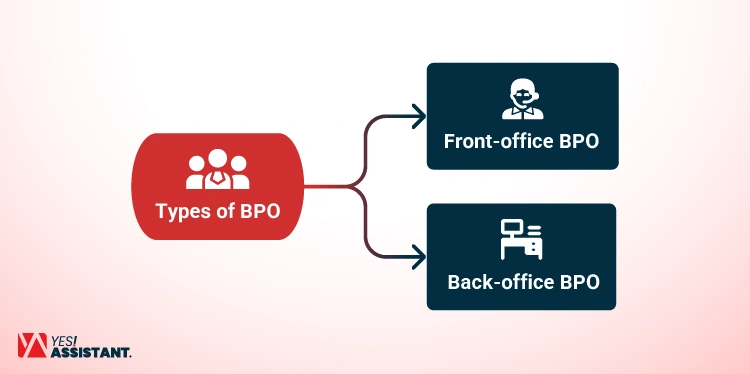
Front-office BPO
Front-office BPO usually specializes in direct interaction with prospects and customers. They can help you with customer support and communication activities.
Here are some of the services this type of BPO can offer:
- Customer service: A third-party service that handles outbound communication and different customer support activities via phone, email, or live chat.
- Sales support and lead qualification: Help you with the sales or lead generation process by sending sales-qualified prospects to your internal sales team. Some of the activities that this type of BPO provides include lead qualification, follow-ups, appointment setting, etc.
- Technical support: An external team that provides technical support to your customers, such as troubleshooting and providing guidance on system issues or escalation. This type of provider usually has knowledge and training on operating specific tools that you use. They usually maintain strict quality and standard response times to support their clients.
Back-office BPO
Back-office BPO performs important business operations and compliance tasks that don’t require customer interaction. Some of these services may include the following:
- Data entry and processing. Teams enter, update, verify, and manage large volumes of data with accuracy, speed, and consistency. This often includes data cleansing to remove duplicates and errors.
- Finance and accounting. This covers accounts payable, accounts receivable, bookkeeping, invoice processing, and financial reporting. You use it when you need an accurate financial process without building the team in-house.
- HR support. This covers payroll, employee records, onboarding support, and recruitment coordination. It demands confidentiality, compliance, and a consistent process.
Location Models in BPO
BPO types are defined by the categories of work that are outsourced. Similarly, location models are where the work is processed: onshore, nearshore, and offshore. It can impact several key factors for processing business activities, including cost, communication, time zone, and legal requirements.
| Model | What it means | Best for |
| Onshore | Provider in the same country as the client | High compliance, sensitive data, and real-time communication |
| Nearshore | Provider in a nearby country, similar time zone | Collaboration-heavy work with moderate cost savings |
| Offshore | Provider in a distant country | Cost efficiency and scalable, process-driven operations |
The onshore model can be useful for maintaining cultural alignment, and it makes compliance easy to follow compared to the other models. Nearshore models are easy to collaborate with the working team, and they can help you get faster responses than the offshore model. One of the major benefits of the offshore model is that it can be highly cost-effective for performing work at a large scale. However, you need to carefully adjust to the time zone, data security, and quality if you choose the offshore model.
Related Outsourcing Terms
You will also see narrower terms for specialist work:
- ITO (IT outsourcing) is related to outsourcing infrastructure management, software support, system monitoring, network administration, and help desk. It lets companies manage IT without a large in-house team.
- KPO (knowledge process outsourcing) refers to outsourcing high-skill, knowledge-based work such as research, analytics, market analysis, and strategic support. It needs expertise and judgment, not just rule-following.
- LPO (legal process outsourcing) is related to outsourcing legal support work such as document review, legal research, contract drafting support, and compliance documentation. Trained legal professionals handle it under strict confidentiality.
Common BPO services by function
Businesses often choose BPO services to perform specific activities to support their growth, customer experience, and keep their internal operation running smoothly.
- Sales support or outsourcing sales support matters most for outbound teams. A sales support provider can conduct research, outreach, and follow-up for your business. So that your in-house sales teams or sales reps can focus more on securing a deal. Some of its key services include lead research and list building, cold calling and outbound outreach, lead qualification and nurturing, appointment setting, and CRM pipeline updates.
- Call center services handle voice-based customer and prospect communication, inbound and outbound. Key services include inbound customer calls, outbound follow-up calls, inquiry handling, order confirmation calls, and basic technical support.
- Customer support provides regular support before and after a sale, focused on satisfaction and issue resolution. Some of its key services include email and live chat support, ticket management, complaint handling, feedback collection, and after-sales support.
- Back-office support for internal operational work that needs accuracy and confidentiality. Some of its key supports include data entry and processing, document management, CRM, and database maintenance and reporting.
- Finance and accounting support to improve cash flow and cut administrative load. Key services include accounts payable, accounts receivable follow-ups, invoice generation, expense tracking, and payroll assistance.
- Human resources management-related activities such as recruitment and employee administration. Key services include resume screening, candidate outreach, interview scheduling, onboarding documentation, and HR record management.
- Marketing support such as research, execution, and reporting for campaigns so your in-house team can focus on strategy. Key services include market and competitor research, email campaign support, lead data enrichment, and campaign reporting.
- IT and technical support for system stability, which can include help desk support, software and tool assistance, user access management, system monitoring, and issue escalation.
- 24/7 operational support to maintain ongoing coverage across different time zones. Some of these key services include after-hours support, night-shift follow-ups, continuous CRM updates, and round-the-clock monitoring.
Benefits of BPO for Businesses
BPO allows your team to focus on growth by handling repetitive or low-value tasks with their expert teams. Their support helps you to reduce the workload and operational cost of your business.
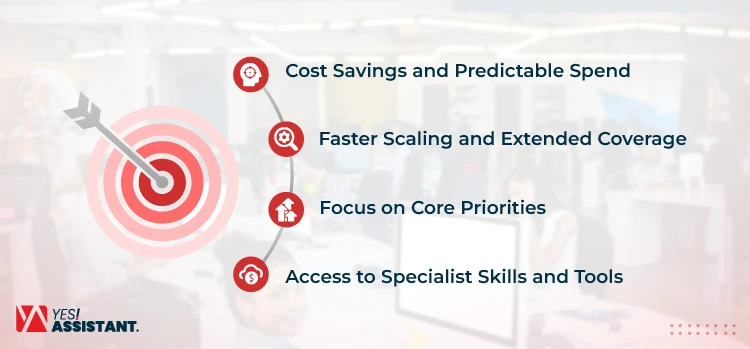
Cost Savings and Predictable Spend
The major reason why companies outsource their tasks is to save costs. Hiring and maintaining an in-house team has an ongoing cost, which includes the salaries, benefits, rent of office space and equipment, and other management costs. A provider can optimize all those costs by outsourcing their activities to a BPO service provider.
Outsourcing can reduce operational costs by up to 20% to 70%, according to Deloitte’s 2024 Global Outsourcing Survey. Two factors drive the savings. First, many providers operate where labor costs are lower, so you get the skill for a fraction of the local cost. Second, BPO shifts fixed costs to variable costs. You pay by hour, transaction, project, or outcome instead of carrying a full salaried team.
Common pricing models include:
| Pricing model | Description |
| Hourly | Payment based on hours worked |
| Per transaction | Payment per task or process completed |
| Project-based | Fixed cost for a specific project |
| Outcome-based | Payment based on results |
Faster Scaling and Extended Coverage
Internal hiring can take weeks or months, within which you will be posting, interviewing, onboarding, and training an employee. While a BPO’s service provider already has an expert team to do your work, they allow you to add or reduce your work capability on demand.
Hiring internally takes weeks or months across posting, interviewing, onboarding, and training. Providers bring trained teams that start quickly, so you can add or reduce capacity almost on demand. This helps most during seasonal peaks. E-commerce at the holidays, travel in peak season, and tax services during filing season all spike. A team provided by a third party can scale fast, and you can again scale it back when your workload drops. It won’t cause any layoffs or internal disruption to your business.
Having a global team means you can ensure ongoing operation for your business since your workflow will be situated in different time zones. This will allow you to offer customer support, conduct sales outreach, or do back-office processing outside business hours, even when your internal team works in standard shifts.
Focus on Core Priorities
Taking off some of the routine work from your internal team means they can spend more time on high-value work. Senior staff of your team can lose a major portion of their productive hours for handling tasks such as data entry, customer support, lead qualification, and back office support. Handing these tasks to a provider frees internal people for tasks such as product development, market expansion, and customer experience. The result is higher productivity and a stronger competitive position.
Access to Specialist Skills and Tools
A business needs to operate a lot of activities as it scales, but nobody can master every tool or expertise. BPO services can provide the specialists and infrastructure, which can be expensive to manage for a growing business:
- Experienced agents trained in specific processes
- Standard operating procedures (SOPs)
- CRM platforms and automation tools
- Performance analytics and reporting
- Quality assurance and compliance monitoring
Industry Data
The BPO industry has grown due to globalization and the rising cost pressure of operating a business. Here are some key statistics on it:
- The market size of the global BPO industry was $328.4 in 2025, and it is predicted to reach $695.8 billion by 2033.
- AI adoption is becoming more popular, as a recent survey shows 83% of executives are using AI as a part of their outsourced services.
- Continued investment is expected from executives, as studies show that around 80% have plans to maintain or increase third-party outsourcing.
- The Philippines has become one of the largest delivery hubs, where about 98 million workers are projected to join the BPO industry in 2026.
These figures show how far outsourcing has moved into mainstream business operations.
Risks and Challenges of BPO
A BPO can introduce operational, security, or strategic risks to a business. It can have a negative impact on customer experience, brand reputation, and profile. Some of the key risks and challenges in this industry are the following:
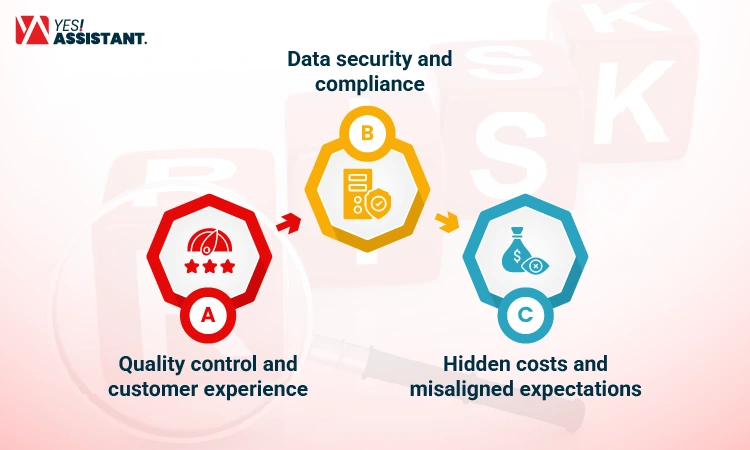
Quality Control and Customer Experience
When an external team handles customer interactions, you have less direct control over daily execution. Two issues come up most.
- Balancing script adherence with personalization can be challenging. Most service-providing teams use scripts for accuracy, compliance, and brand consistency. Scripts help new agents perform faster and reduce legal risk. But heavy scripting can make conversations feel robotic. A study shows that about 60% of customers report frequent frustration when dealing with chatbots, per Zendesk’s CX Trends research.
- Need continuous coaching and QA to keep provider teams aligned with your tone, policies, and targets. Agents may also work across multiple clients, which raises the risk of drift. Strong QA programs need regular call monitoring, performance scorecards, feedback sessions, and refresher training because, without them, quality can decline.
Data Security and Compliance
BPO service providers who handle data needs often process sensitive information, including personal details, payment data, medical records, or confidential information. A security breach at the provider level can directly impact a client.
Here are some key challenges with processing data with a BPO service:
Access control can be compromised, as more agents on shared systems mean more exposure. Strong setups use role-based permissions, secure authentication, and access limited by job function.
Lack of encryption and audit trails can make incident tracking difficult. Data should be encrypted during storing and sharing. Audit trails are necessary to track data access by users. Security incidents can be hard to investigate without proper logging or records.
Adhering to several compliance frameworks based on industry and geography, and providers such as the following:
- GDPR, for data privacy and consent
- HIPAA, for healthcare data
- PCI DSS, for payment card security
- SOC 2, for operational and security controls
- ISO 27001, for information security management
Non-compliance can lead to heavy fines, legal penalties, and loss of trust.
Hidden Costs and Misaligned Expectations
BPO is often chosen for savings, but there are some hidden costs of using it. Here are some of them:
- Transition can reduce productivity, as moving a process takes documentation, training, and support.
- Rework might be necessary if quality expectations are unclear or errors lead to repeated work, which adds cost and wastes time.
- There is a management overhead cost for allocating internal resources because even outsourced work needs monitoring, feedback, and coordination.
- Expectation gaps and delays can occur from SLA reading differences, overestimated productivity, or communication gaps. Clear contracts, realistic KPIs, and pilot programs reduce these risks.
BPO Checklist
A BPO checklist can guide you to structure the steps, standards, and responsibilities of your relationship with the provider. It can be used for tracking the performance of your service provider once you start working with them.
| Area | Status |
| Onboarding and training program | Comprehensive / Basic / None |
| SOPs and workflow documentation | Fully documented / Partial / None |
| Agent knowledge and product familiarity | High / Medium / Low |
| KPI tracking (CSAT, AHT, resolution rate) | Monitored / Partial / Not tracked |
| Daily and weekly reporting | Consistent / Inconsistent / None |
| Quality assurance model | Structured / Limited / Unclear |
| Escalation process | Documented / Informal / None |
| Communication channels | Established / Limited / None |
| Technology and tools setup | Functional / Partial / Not functional |
| Process improvement feedback loop | Implemented / Partial / None |
| SLA compliance | _____ % |
| Error rate | _____ % |
| CSAT | _____ % |
| AHT | _____ minutes |
BPO Risk Checklist
A BPO risk checklist helps you assess outsourcing risk before you select or manage a provider. It covers five areas: security, quality, compliance, continuity, and cost. You can use it during vendor selection to avoid predictable failures.
| Risk area | Status |
| Data security (encryption, access control) | Strong / Moderate / Weak |
| Regulatory compliance (GDPR, HIPAA, PCI DSS) | Fully compliant / Partial / Not compliant |
| Vendor financial stability | Stable / Moderate / Risky |
| Business continuity and disaster recovery | Documented and tested / Documented only / None |
| Legal and contract risk | Covered / Partial / Not addressed |
| Vendor reputation and references | Verified / Partial / Not verified |
| Hidden costs and extra fees | None / Minor / Significant |
| Infrastructure reliability | Strong / Moderate / Weak |
| Employee turnover rate | _____ % |
| Security incident history | None / Minor / Major |
| Backup and redundancy | Complete / Partial / None |
| Pilot project risk | Low / Medium / High |
When Should a Company Use BPO?
BPO works well when it is used for the right purpose. So you shouldn’t only consider the outcome of outsourcing but also why or when it might be necessary for a business. Here are some key facts that can help you to decide:
Good Fit
- Processing repetitive and process-driven high-volume tasks like customer service, data entry, payroll, and billing. Outsourcing them frees your team for strategic work.
- Companies that have a workflow with clear SOPs and measurable outcomes. Since your provider can replicate the work as written. The quality of a work may not be consistent and often goes down when you don’t have any documented expectations.
- There is a need to scale quickly as you face rapid growth, seasonal spikes, or new-market expansion. In this type of case, outsourcing providers can handle your work with their trained workforce and flexible capacity. It will help you to avoid waiting for long hiring cycles to process your work.
Bad Fit
- Businesses that own highly sensitive intellectual property, such as proprietary algorithms, perform core R&D, or have some key competitive advantages, need strong security and contractual protection for outsourcing. They can be at risk of legal and competitive exposure without them.
- Companies with undefined or shifting processes. BPO works when workflows are stable. When processes are not clear and change constantly, it can reduce productivity and create frustration for both parties.
- Work that needs a deep internal context. Strategy, core product decisions, and sensitive leadership work rely on internal knowledge and judgment. Handing them to a provider without documentation leads to poor results.
How to Choose the Right BPO Provider
Selecting a BPO provider is an important decision. The right partner can help you grow your business by reducing costs and increasing your operational efficiency. A wrong will cause you to miss KPIs, as well as security risks and loss of productivity. So you should use a structured evaluation rather than just a price comparison for choosing the right one.
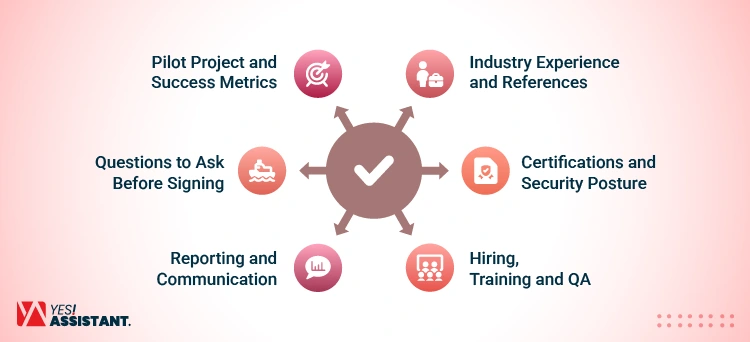
Industry Experience and References
Check if your provider has experience in supporting businesses in your industry. It is necessary because a healthcare-focused provider usually knows HIPAA better than a general one.
Ask your provider about case studies, references, and client retention rates. A high retention rate usually indicates that the provider is consistent and reliable with their service.
Certifications and Security Posture
According to IBM’s Cost of a Data Breach Report 2025, the global average cost of a data breach is about $4.44 million. This stat shows that security matters a lot for any business. Before choosing a provider, check whether they comply with data and privacy laws that apply to your business, such as HIPAA, GDPR, or PCI DSS.
You should also check their certification, such as
- ISO 9001 for quality management
- ISO 27001 for information security
- SOC 2 for data handling
Hiring, Training, and QA
You must review how your provider hires and trains their staff because a high turnover can impact consistency. These trainings should also cover customer handling and compliance. A strong QA process is usually made of continuous monitoring, feedback loops, and corrective actions, and you should also check whether their process includes them.
Reporting and Communication
Check for real-time reporting on KPIs and exceptions, plus clear dashboards. Understand meeting cadence, escalation channels, and responsiveness. Clear communication reduces delays and risk.
Questions to Ask Before Signing
There are some questions you should ask about the following topics:
Team Structure and Turnover
Ask who your dedicated account managers are, whether an operations manager will be supervising daily performance, and what their reporting structure would be. You should ask about your backup cover and whether cross-trained staff, succession planning, and continuity coverage are going to protect you if key people leave.
Tooling and Integrations
Tools and integration can reduce manual work, data duplication, and delays. This is why you should ask an outsourcing provider about the tools, such as CRM, dialer, ticketing, and workflow systems, they use.
Escalation and Incident Handling
A good provider follows a documented incident management system with root cause analysis and a preventive action framework. You should ask your provider about incident response time, escalation matrix, and who will be responsible for each step of incident handling.
Pilot Project and Success Metrics
Do not start with a full rollout. Run a pilot first to validate capability before a long-term commitment. A typical pilot runs 30 to 90 days. During it, define process boundaries, assign a limited and measurable function, then set baseline benchmarks.
Always attach KPIs to the pilot, then watch how the provider performs against them:
- SLA compliance rate
- Error rate
- Average Handle Time (AHT)
- Customer Satisfaction Score (CSAT)
- Cost per transaction
If the provider meets or beats agreed benchmarks, you can move to a long-term contract with confidence.
Vendor Evaluation Checklist
| Evaluation area | Status |
| Industry experience in your sector | Proven / Limited / None |
| Relevant case studies provided | Yes / No |
| Client references verified | Verified / Not verified |
| Client retention rate | _____ % |
| Regulatory compliance (HIPAA, GDPR, PCI DSS) | Fully compliant / Partial / Not compliant |
| Certifications (ISO 9001, ISO 27001, SOC 2) | Certified / Not certified |
| Data security framework | Strong / Moderate / Weak |
| Disaster recovery readiness | Documented and tested / Documented only / None |
| Structured training program | Comprehensive / Basic / None |
| QA model | Structured / Limited / Unclear |
| SLA compliance (pilot) | _____ % |
| Cost per transaction | $ _____ |
| CRM and tool compatibility | Compatible / Needs integration / Not compatible |
| Real-time KPI reporting | Available / Limited / None |
| Pilot project success | Meets KPIs / Partial / Fails |
Fill this in for each shortlisted provider and compare them side by side. Then, select the one that meets the most critical KPIs, but not just the lowest price.
BPO Pricing Models and Cost Factors
Pricing is about more than monthly cost. It also covers risk allocation, scalability, and how well payments align with performance. The four common models follow.
Per hour. You pay by agent hour, often USD 10 to 25, depending on location and skill. Best for consulting support, short-term campaigns, and projects with uncertain scope. Main risk: weak incentive for efficiency, so cost can climb if work runs slowly.
Per FTE (full-time equivalent). You pay a fixed monthly cost for a dedicated agent who works only on your account. Best for customer support, back-office work, and long-term engagements. Main risk: you pay for idle capacity in slow periods.
Per transaction. You pay a set rate per completed task, call, or processed unit. Total cost equals volume times unit price. Best for data entry, claims processing, and high-volume work. Main risk: the provider may favor speed over quality, so QA matters.
Outcome-based. You pay against results, such as sales closed or SLA achievement, often with a base fee plus a performance bonus. Best for sales outsourcing and lead generation. Main risk: disputes over measurement and more complex contracts.
| Pricing model | Best for | Main risk |
| Per hour | Short-term or flexible projects | Budget overrun if hours rise |
| Per FTE | Long-term, stable operations | Paying for idle capacity |
| Per transaction | High-volume, repetitive work | Speed prioritized over quality |
| Outcome-based | Revenue or KPI-driven work | Measurement disputes |
What drives cost? Choosing a low-priced service may not always lower your cost. It is because a good provider can deliver error-free work and help you avoid rework. While a cheaper one may lead you to frequent rework. BPO pricing can be based on several factors, such as the level of skill required to handle a process and its complexity, compliance issues, operation hours, technology needs, etc. When choosing a model, you should check whether it is suitable for operation and risk tolerance, but not just the budget.
Best Practices for a Successful BPO Partnership
Building strong partnerships is an ongoing process. It takes a clear process, accountability, measurable KPIs, and continuous improvement to establish one.
Document SOPs and define ownership. Clear SOPs mean work continues regardless of who is on shift. Build detailed process maps, define who owns what, and set clear decision rights.
Set clear SLAs and QA standards. SLAs define performance benchmarks. QA frameworks keep quality measurable. Define your SLA metrics, use QA scorecards, and run calibration sessions.
Build a communication rhythm. It is necessary to have regular and structured communication to keep your BPO partner aligned. So you run daily or weekly operational check-ins, monthly performance reviews, and a clear escalation matrix.
Improve continuously. Use root cause analysis and an optimization roadmap. Identify repetitive tasks for automation, apply workflow tools, and review the roadmap each quarter. Automation reduces cost, improves accuracy, and speeds turnaround.
BPO Trends to Watch
The industry is shifting toward AI-enabled efficiency, automation-first workflows, and flexible delivery. The main trends follow.
AI, chatbots, and agent assist. AI can now operate in the core service layer, not just the outer level. It can handle a large share of routine Tier-1 queries, guides agents in real time, and improves compliance monitoring. According to Gartner, third-party GenAI tools will handle about 40% of customer service issues by 2027. Many leading service providers are already using AI-based self-service with human support.
Knowledge base management. BPO service providers use knowledge bases not just as documents but also as live operational assets. Training cycles can be shortened, and first-contact resolution can be established by using AI-powered search, auto-summarization, and content governance.
RPA and workflow automation. Robotic process automation removes repetitive, rule-based steps, so agents focus on exceptions and higher-value work. Common targets include data entry, invoice and claims processing, CRM updates, and reconciliation. The result is faster turnaround, fewer manual errors, and better SLA adherence.
Nearshoring and hybrid delivery. Cost efficiency alone no longer defines strategy. Companies now weigh resilience, time-zone alignment, and flexibility. Nearshore delivery supports real-time collaboration. Multi-site and hybrid models spread risk and strengthen business continuity.
| Delivery model | Primary benefit | Trade-off |
| Onshore | Compliance and control | Higher cost |
| Nearshore | Collaboration and time-zone match | Moderate savings |
| Offshore | Cost efficiency and scale | Time-zone complexity |
| Hybrid | Cost, resilience, and flexibility | Operational complexity |
FAQs About BPO
What is the difference between BPO and KPO?
BPO and KPO handle different types of tasks. BPO handles process-based repetitive tasks such as support and data entry. KPO usually handles tasks that are knowledge-based, such as research and analytics.
Is BPO only call centers?
No, call center tasks are mostly related to phone calls. But a BPO provides a wide range of services for a business, which can include finance, HR, IT support, and back-office operational tasks.
Which industries use BPO most?
Some of the industries that often rely on BPO are banking, healthcare, telecom, retail, etc.
How do you measure BPO performance?
The performance of BPO can be measured through KPI and SLAs. Some of the common metrics used for this purpose include AHT, FCR, CSAT, SLA adherence, and cost per transaction.
Is BPO safe for sensitive data?
Yes, but only if sensitive information is protected with strong security standards. The leading BPO service providers use encryption, data privacy, compliance standard certifications, and strict access control to protect their information.
How long does a BPO transition take?
The time a BPO transition can take can vary based on process complexity, compliance requirements, and system integration. Small process changes can take 3-6 months, while a full process transition can take up to 12-18 months.
Final Note
BPO services are not just a solution for reducing the operational cost of a business. They can also help you perform tasks with higher accuracy, maintain compliance standards, and deliver better customer experiences.
An outsourcing partner who has a skilled workforce and proper setup can help you scale your business and gain a competitive edge in your industry. While considering an outsourcing partner, you should start following a clear, documented process, clear SLAs, and measurable outcomes. This will help you get positive results from your outsourcing models.