
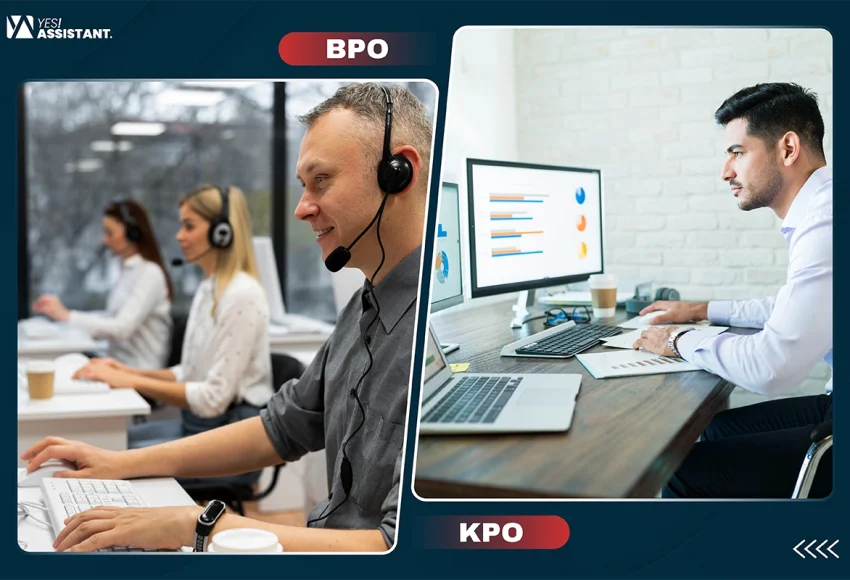
BPO vs KPO: Understanding the Key Differences, Benefits, and Business Applications
Key Takeaways
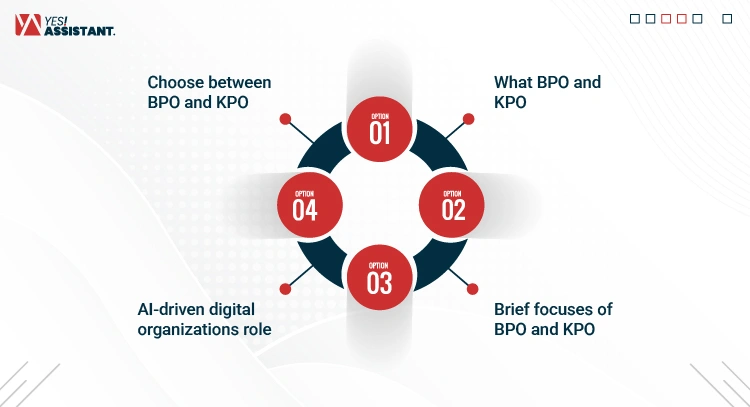
- BPO focuses on delegating routine, repetitive operational tasks to reduce costs and increase efficiency, while KPO assigns complex, knowledge-based research and analytical tasks to external experts to drive strategic growth.
- Significantly, BPO focuses on executive tasks, like repetitive, process-driven tasks. KPO focuses on thinking, like strategy setting, analytics, and problem solving.
- Regarding AI automation, BPO industry optimizes with higher productivity and processes complex and messy data sets for informed decision-making.
- Choosing between BPO and KPO depends on your specific goals. When you need to reduce daily overhead, choose BPO, and if you need high-value strategic work, choose KPO.
What is BPO (Business Process Outsourcing)?
Business process outsourcing is a method of transferring or delegating a third party vendor to handle their operational tasks or daily repetitive tasks. Most of the businesses use the BPO system to minimize operational costs related to resource costs, space costs, and office expenses. Under BPO rules, businesses can manufacture their products through remote parties and distribute them to the main stakeholders.
In BPO settings, companies transfer easy and daily repeated tasks to a remote third-party vendor. These tasks belong to non-core operational functions but are repetitive. This is mainly categorized in two ways:
- Front-Office BPO: A retail company hires a BPO company and hands over customer operations services, like live chat, messaging and quick responses. The company tracks only how hours of support it provides, customer satisfaction and resolution rate in weekly reporting.
- Back-Office BPO: A large company selects a BPO provider to handle invoice processing or image processing. Therefore, the provider updates workflows, reduces processing errors, and provides faster services to provide monthly outcomes.
In both front-office and back-office systems, companies overview the outcomes’ accuracy and customer experiences. Again, BPO companies continue operations as per the company’s direction.
How BPO Works
If you want to learn about the outsourcing industry, just read the Investopedia BPO. The standard BPO workflow operates within following process:
- Monitoring & Reporting: Performance is tracked continuously via KPIs and dashboards to ensure efficiency, accuracy, and continuous service improvement.
- Vendor Selection & Onboarding: The company detects non-core tasks, sets expectations and BPO partners with remote external outsourcing partners.
- Workflow Adjustment: The BPO company studies the client’s workflow, integrates communication channels, and trains the agents about brand standards.
- Daily Implementation: Companies dedicate teams to manage the outsourced tasks, like answering calls, processing orders and updating databases.
Common BPO Services
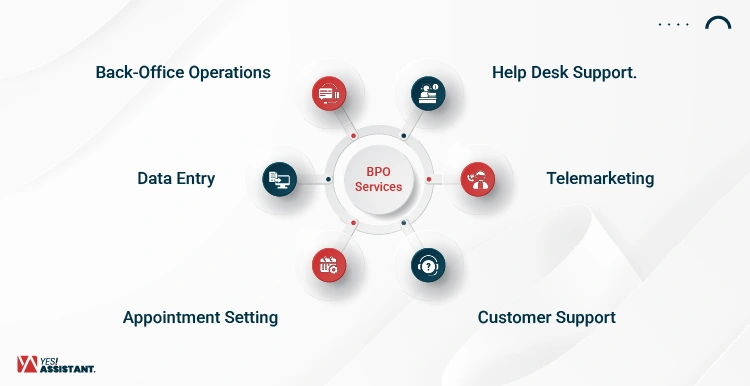
Today, BPO provider range from daily tasks to complex industry-specific workflows. Here are most relevant services that are commonly used:
- Customer Support: Handling inbound queries, solving customer complaints, and managing customer relations across multiple communication channels.
- Telemarketing: Assign an external team to manage outbound calling campaigns to generate leads, schedule meetings, or upsell products.
- Data Entry: A large company hires a provider for quality data entry, verification, double-entry and entry into the company’s internal systems.
- Appointment Setting: Facing potential clients, acting as corresponding company representatives to schedule consultations, meetings or field visits with prospects.
- Help Desk Support: External party support to corresponding company’s technical team to diagnose issues, walk users through troubleshooting and resolve systems.
- Back-Office Operations: Internal processes like payroll processing, supply chain management, and accounting are operated by specialist vendors.
Industries That Use BPO
Businesses are now moving into the BPO process, which facilitates their daily operations and saves costs, time and resources. Popular industry who use BPO most:
- Information Technology Industry.
- Health Service Providing Industry
- Banking and Financial Company.
- E-Commerce & Retail
- Telecommunication
- Travel & Hospitality
- Manufacturing
- E-Learning & Education.
- Human Resource & Recruitment
- Real Estate
What is KPO (Knowledge Process Outsourcing)?
Knowledge Process Outsourcing refers to assigning external parties for complex knowledge-based research tasks. Besides, KPO involves advanced analytical skills and critical thinking capabilities. It circles around financial analysis, market research, intellectual property handling, and managing database information.
According to KPO definition, companies outsource complex, information-driven processes that require domain expertise and critical thinking. KPO focuses on value creation through high-level analytical capabilities. Besides, companies utilize KPO to achieve success with specialized skills and external knowledge bases that drive strategic decisions.
How KPO Works
The KPO workflow is centered around specialized analysis and strategic partnership:
- Requirement Analysis: The client identifies specific knowledge gaps, research needs, or identifies complex processes that require expertise.
- Partner Selection & Domain Alignment: The company selects a KPO service provider who specializes in skills, like legal and financial. This ensures alignment with internal compliance and strategic objectives.
- Research & Execution: The KPO team performs advanced tasks such as data modeling, market forecasting, or regulatory research. Also, the KPO team uses specialized tools and intellectual capital.
- Insight Delivery: The provider delivers actionable analysis, strategic recommendations and high-level outcomes that directly impact on business decision-making.
Common KPO Services
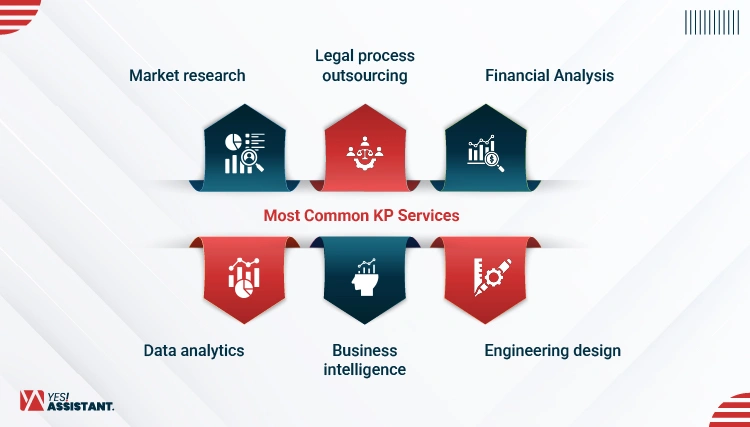
See the following steps, which are most commonly used in KPO services.
- Market research: Track ongoing market trends, customer behaviors and competitors’ footsteps.
- Financial Analysis: Analysis of ongoing market insights and help companies to decide on investment, budget and forecast.
- Legal process outsourcing: Monitor legal issues, review, and conduct document processing and evaluate regulatory issues.
- Data analytics: Evaluate complicated data to identify patterns, determine mode of operation, and help to make decisions.
- Business intelligence: Help businesses to provide strategic insights and track performance metrics.
- Engineering design: Use specialized technical expertise to create designs, product models, and advanced engineering solutions.
Industries That Use KPO
- Financial Services & Investment Banking
- Pharmaceuticals & Biotechnology
- Legal Assistance & Services
- Information Technology
- Manufacturing & Engineering
- Healthcare Research
- Media & Publishing
- Marketing & Advertising
BPO vs KPO: Quick Comparison Table
Both BPO and KPO have different features. KPI ensures routine, administrative, repetitive processes. Besides, KPO works on analyzing the market, creating reports and measuring success.
| Particulars | BPO | KPO |
| Definition | Outsourcing routine, administrative or non-core processes. | Outsourcing complex, informative and specialized tasks. |
| Skill Level | Focus on operational efficiency and basic execution. | Depends on advanced expertise, research and domain knowledge. |
| Process Complexity | High volume, repetitive and standardized workflows. | Process on highly complex, analytical, and variable tasks. |
| Decision Making | Process-driven; follows predefined protocols and rules. | Insights-driven; requires critical thinking and strategic decisions. |
| Cost | Typically lower; tasks focuses on cost-efficiency and savings. | Typically higher, focus the premium value and expert labor. |
| Technology Usage | Uses tools for task automation and volume handling. | Employs advanced tools for data science and business intelligence. |
| Business Impact | Enhances your daily operational speed and cost-effective processes. | Facilitates your business with long-term strategic growth and competitive advantage. |
| Examples | Applicable for customer support, data entry, and payroll management. | Market research, legal outsourcing, and data analytics. |
Key Differences Between BPO and KPO
Choose the right partner for your business. BPO provider is great for executing tasks as per client direction or project needs. Therefore, a company needs business process outsourcing services to keep your daily operations running or expert research to plan your future.
Nature of Work
Regarding the nature of two businesses, KPI executes the work to keep your business running every day. On the other hand, KPO helps you to find the big picture to solve problems that need extra thought.
BPO:
- BPO is like executing your tasks and acts as your extra hands.
- Again, BPO follows a clear map to complete your work.
KPO:
- KPO is like a research team that invests in your business.
- KPO creates a map to help you reach your new goal.
Required Expertise
For BPO, you need a team which is good at following steps. With KPO, you need people who have expertise in research and analysis of your business’s next steps.
BPO:
- BPO requires assistants who are first learners and follow instructions perfectly.
- BPO team learns your company rules and serves accordingly.
KPO:
- Again, KPO requires people with college degrees or years of experience in things like law or money.
- KPO teams bring new ideas from their industry to your business.
Employee Skill Levels
Considering skills levels in BPO needs ready and quick service for clients. The KPO needs smart, creative and analytical hands.
BPO:
- BPO requires great multitasking and friendly resources.
- Someone who can type fast and stay organized in BPO settings.
KPO:
- KPO experts are great at reading charts and writing reports.
- KPO tasks need someone who can connect the dots and think clearly.
Decision-Making Responsibilities
BPO is about performing what you tell them to do. KPO is about telling you what you should do next to grow.
BPO:
- BPO partners wait for your order before they act.
- BPO provides waiting for what you asked them to do.
KPO:
- KPO provides suggestions for informed decision-making based on facts.
- KPO partners act as your consultants who share facts so you can choose.
Value Delivered to Businesses
BPO saves your money on time-consuming tasks like back office support, while KPO helps you to make smarter choices.
BPO:
- BPO helps you get document management services to get first result
- BPO makes your daily life easier by providing necessary support.
KPO:
- KPO helps you find new ways to make money and pass the competition.
- KPO makes your business stronger by giving you smart, expert advice.
Technology and Automation Requirements
BPO uses tech to speed up simple work. KPO uses tech to find hidden secrets in your data.
BPO:
- BPO uses tools for data capture services to avoid mistakes.
- BPO uses tech to handle high-volume tasks without a single error.
KPO:
- KPO uses tech to analyze numbers that are too big for one person to track.
- KPO uses advanced software to predict what will happen next.
Cost Structure
Because the work is different, the price is too. BPO is usually about saving money on bulk tasks, while KPO is about paying for top talent.
BPO:
- BPO is often paid by how much work is done, like one invoice.
- BPO is a way to cut costs on things like company billing and payables.
KPO:
- KPO is an investment where you pay for experts to help you grow.
- KPO is often paid by the hour or by the project.
Scalability
It is easy to add more BPO workers when your business grows. It is harder to find KPO experts because they need special training.
BPO:
- BPO grows quickly because it is easy to hire more people for routine tasks.
- BPO can handle 10 or 1,000 tasks without changing much.
KPO:
- KPO grows when you have more big problems that need solving.
- KPO takes more time to grow because experts are hard to find.
Pros and Cons of BPO & KPO
Both BPO and KPO belong to the outsourcing process, which is a great choice for businesses but has a tough part of BPO and KPO. If you think of BPO as your “helping hand” for daily tasks, then KPO is your “expert advisor” for big decisions.
Pros of BPO
- Saves you money: You don’t have to pay for office space or equipment.
- Focus on Business: You can spend more time on your business for setting goals, while someone else handles your busy work.
- Faster repetitive tasks: BPO is great for getting repetitive tasks done quickly.
Cons of BPO
- No Direct Control: You don’t see the ongoing work done every minute.
- Quality can vary: If the provider is not clear about instructions, mistakes can happen.
- Eyes on Faster productivity: As you outsource for higher productivity in less time, it might lack a personal touch.
Pros of KPO
- Expert insights: You’ll get smart people who can help you to solve complex problems.
- Helps you grow: It gives you a better strategy to stay ahead of competitors.
- Better results: You’ll informed-decisions, advise with accurate data.
Cons of KPO
- Costs more: You are paying for a high-level expert. So, it’s an investment.
- Takes more time: This is not a quick fix; you need to build long-term relationships.
- Harder to start: You need to work with them to ensure the KPO team fits with your vision.
BPO vs KPO: Which is More Cost-effective?
Choosing the right outsourcing partner involves more than just price. Both Business Process Outsourcing (BPO) and Knowledge Process Outsourcing (KPO) offer cost-effective support to scale business, but serve different functions. Today, companies strategically select back-office outsourcing team based on task complexity and long-term value to ensure sustainable success.
Cost Factors in BPO
The BPO process saves your cash on the work you do every single day. Besides, BPO tasks are simple and usually happen in the same operation; you are paying for the volume of work rather than high-level strategy.
This helps you to keep your daily expenses low and easy to track. Using BPO in business creates a way to cut costs to make sure your routine tasks are finished on time.
Cost Factors in KPO
You’re just paying for deep experience and specialized skills regarding KPO cost factors. The experts have spent years learning trade, whether it is advanced data analysis or complex legal research.
At the beginning, it seems cost is higher, but you are paying to avoid cost mistakes and achieve deep insights. While your regular team members might miss valuable information, experts cover the insights with deep analysis.
Short-Term vs Long-Term ROI
When your aim is to get faster profit and lower your monthly bills, BPO is the best option for you. This can reduce your bills fast, especially for administrative routine tasks, like accounts payable outsourcing. The provider bills on an hourly basis as per task volume, whether your employees get a flat monthly salary.
On the other hand, KPO is a long-term game. You might spend more money at the start, but it is valued long-term with effective outcomes. Expert KPO insights help you to plan for profit and avoid big losses, making it a smart investment for the future.
When Lower Cost Should Not Be the Only Decision Factor
Choosing a low-cost provider can be attractive but something can be risky for businesses. If you are concerned about bills, you might miss quality support. Remember, quality tasks are very important for your business further; so, you must choose the best provider.
It is often much better to pay a fair price for high-quality work than a low price for work. Always focus on the value you get back rather than just what you pay out.
Conclusion
Hiring quality outsourcing service drives effective growth and helps your business scale. Experts can handle your daily recurring tasks or complex research projects. Therefore, choosing BPO and KPO depends on your operational help or analytical insight.
Use advanced tools like AI automation and data analytics, making these outsourcing solutions more powerful now. By optimizing business intelligence, you can transform raw data into a smart future plan. So, your business might get the right partner and stay ahead of the competitors.
FAQ
What is the main difference between BPO and KPO?
BPO simply focuses on administrative, repetitive daily tasks. KPO focuses on complex analytics that need deep thinking and expert advice.
Is KPO more expensive than BPO?
Definitely, KPO costs more because you’re paying for high-level experts and years of experience, while BPO pays for standard tasks and less cost.
Which industries benefit most from KPO?
Industries that rely on lots of data and research, such as banking, law, medicine, and engineering, benefit the most.
Can a company use both BPO and KPO Services?
Yes. Many businesses use both BPO to handle their daily busy work and KPO to get expert help on big strategy projects.
Is KPO a subset of BPO?
No, both BPO and KPO have independent approaches. BPO helps businesses with operational efficiency, while KPO helps with value
How does AI impact BPO and KPO?
Significantly, AI helps BPO to complete simple tasks faster. Again, KPO tools help experts to look at large amounts of data to find smart answers.
Which is better for startups, BPO or KPO?
It depends on your business goal. Startups use BPO to save time and daily work. Then, they hire KPO when they need expert strategies to grow.