
EOR vs. BPO Explained: Key Differences, Benefits and How to Choose
The key difference between EOR vs. BPO is scope or core responsibilities. BPO runs a specific process for you, while EOR employs workers abroad for you and acts as a local employer.
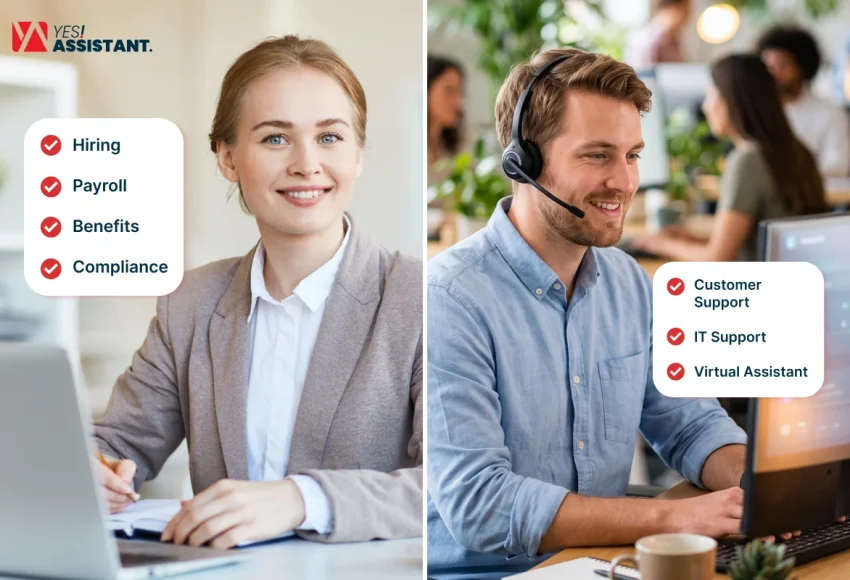
An EOR handles criteria like hiring, local compliance, payroll and benefits. A BPO provider runs full business functions such as customer support, IT support, virtual assistant, etc. Many businesses use both of the services for better results.
Every business looks for ways of saving money without losing quality and this is where the EOR vs BPO debate starts. This piece will break down both of the models. We will look into their differences, benefits and what factors to keep in mind when choosing.
Key Takeaways
- EOR employs workers for you, handling payroll, taxes, and compliance.
- BPO manages entire business functions using its own staff and tools.
- EOR suits market entry; BPO suits cost-cutting and scaling.
- Many businesses use both for maximum flexibility.
What is EOR?
An Employer of Record (EOR) is a third-party business model. In this model, the EOR company becomes the legal employer. It performs tasks like hiring, payroll, benefits administration, and compliance. It allows you to hire people, such as a virtual assistant, in a country where you don’t have a registered office or legal entity.
Key Features of EOR
There are some key features of EOR that make it different from other models. The features are:
- Acts as the legal employer in the worker’s country.
- Manages payroll and timely salary payments.
- Handles tax withholding and filings.
- Helps maintain compliance with local labor laws.
- Administers statutory and supplementary benefits.
- Drafts and manages compliant employment contracts.
- Removes the need to set up a local entity.
- Reduces misclassification and compliance risk.
Benefits of EOR
These benefits of EOR are what attract business owners to use this model. There are many different benefits of EOR and here are some core benefits mentioned below:
- Faster entry into new markets.
- Lower compliance and legal risk.
- No need to set up a foreign entity.
- Simplified payroll and benefits management.
- Easy to scale teams up or down.
What is BPO?
Business Process Outsourcing (BPO) is a business model where a company hires a third party to handle specific tasks. BPO providers take responsibility for the work they complete. In the BPO model, the provider uses their own staff, tools and systems to complete tasks like customer support, IT services and web design services etc.
Key Features of BPO
BPO comes with its own features for handling business processes for other companies. Other than that, they have some unique features:
- Manages business functions or processes.
- Uses its own trained staff and technology.
- Operates independently with its own management.
- Often specializes in specific industries or tasks.
- Delivers measurable output, not just staffing.
- Can be onshore, offshore, or nearshore.
Benefits of BPO
Just like every other business model, BPO also comes with different benefits. And these benefits are the main reason why many companies still depend on BPOs to sustain in the market. Some benefits of BPO are:
- Reduces operational workload and overhead.
- Access to specialized skills and technology.
- BPO costs are lower compared to in-house teams.
- Improves efficiency through process expertise.
- Scales operations without hiring internally.
- Frees up time to focus on core business.
EOR vs. BPO: Key Differences to Know
EOR and BPO are both successful business models. Yet, they have some differences that make them unique. These differences are what make business owners consider and choose the best choice for them.
Here are the key differences between EOR vs. BPO:
| Aspect | Employer of Record (EOR) | Business Process Outsourcing (BPO) |
| Core Focus | Employment and compliance. | Business processes and tasks. |
| Who Does the Work | EOR’s employee, under your direction. | The provider’s own staff. |
| Control Over Work | You manage daily tasks and output. | Provider manages the process. |
| Legal Employer | The EOR. | The BPO firm. |
| Best For | Hiring individuals in new countries. | Outsourcing entire functions. |
| Cost Structure | Pay per employee (salary + fee). | Pay for service or output. |
| Entity Setup Needed | No. | No. |
| Scalability | Scale headcount in specific countries. | Scale entire processes or teams. |
In simple words, an EOR lets you manage workers without setting up your own local entity. On the other hand, BPO gives you an outsourced remote team that runs the entire function for you. The whole difference is that EORs hire people for your specific needs; BPO is a process someone else manages.
Knowing the difference between EOR and BPO is important if you are thinking of outsourcing or hiring remote employees overseas. Staying informed saves you from surprise troubles and lets you evaluate your decision before you make it.
When Should You Choose an EOR?
Expanding your business into new markets should be exciting, not stressful. But hiring globally is not so easy; it is complicated with labor laws, compliance risk and tax regulations. And this is when you should choose an EOR; it helps you hire top talent faster while helping your company to comply with local employment laws.
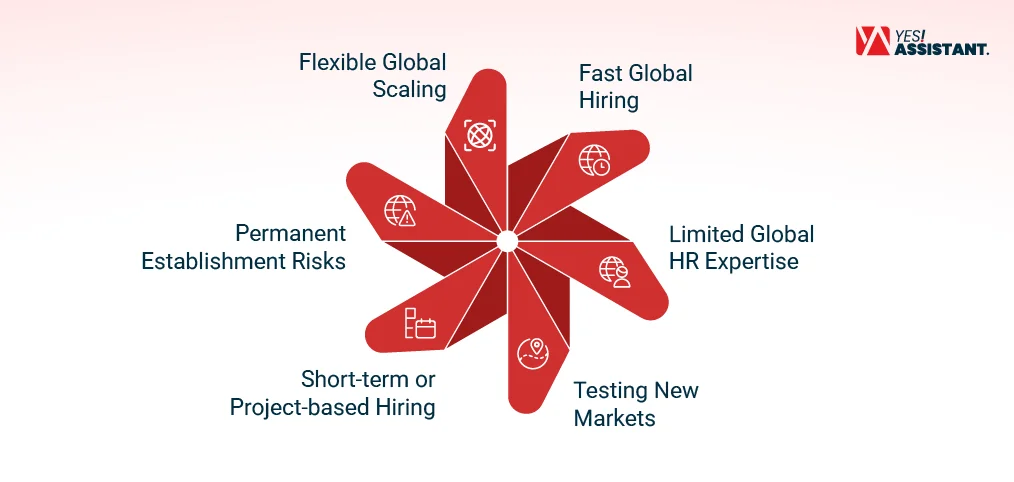
Here are some situations when you should choose an EOR-
- You Have to Hire Quickly in a New Country: The legal entity setup can take months. Whereas a general virtual assistant gives you support within days, the same can be done with an EOR, while maintaining compliance.
- Your Company Lacks In-House Global HR Expertise: Employment laws differ globally and errors can cost you a lot. An EOR helps ensure contracts, payroll and benefits comply with local labor laws.
- You Want to Test a New Market Before You Commit: The EOR allows you to hire and operate in a new market before investing in a long-term commitment.
- You’re Hiring for Short-term or Project-based Roles: For contract, seasonal, or project work, an EOR removes the admin burden while keeping workers legally protected.
- You’re Concerned About Permanent Establishment Risks: Hiring without a local entity can trigger tax and compliance risks. An EOR lowers employment liabilities, but can’t fully eliminate commercial tax exposure.
- You Need Flexibility in Scaling Global Teams: An EOR makes it easy to scale headcount up or down across countries, without entity setup or closure costs.
When Should You Choose BPO?
You should choose BPO if you want the entire process handled for you. If your business is in need of an experienced team rather than new hires, BPO is a good choice for you.
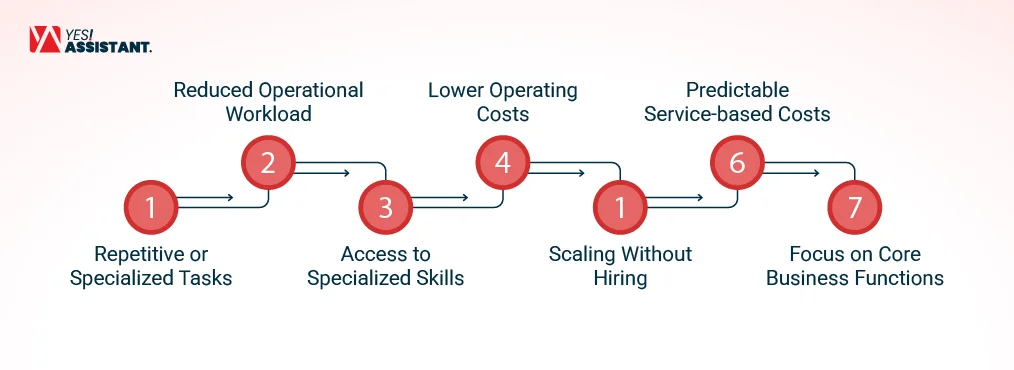
Here are some situations when you should choose a BPO:
- You Need to Outsource Repetitive or Specialized Processes: Repetitive tasks such as live chat support, manual data entry, and IT support can be handled more effectively by a BPO than by an in-house team.
- You Want to Reduce Operational Workload: In this event, you should go for a BPO, freeing the time of your in-house team to concentrate on core business.
- Requires Access to Specialized Skills or Technology: BPO service providers are likely to provide expertise in a specific field and technology that is difficult to get in-house.
- You Want to Reduce Your Operational Expenses: Many companies select BPO because of its cost-saving opportunities, which include the cost of living, scale and location.
- You Want to Scale Without Having to Hire More Employees: BPO companies can help you grow your business without the pressure of hiring more people, evaluating them on a daily basis, or managing them.
- You Want Predictable Output-Based Costs: BPO provides you with output-based or service-based costs as opposed to paying salaries and overhead.
- You Want to Focus on Core Business Functions: Outsourcing of repetitive, non-core tasks to a BPO will allow your in-house team to focus on what matters most for the business.
EOR vs. BPO: Which Model Suits Your Business Best?
When choosing between EOR and BPO, you need the right fit. This will depend on your business requirements and goals. This is a generic question: do you need control or do you want it to be handled?
Below are some considerations to help you determine which model is best for your business:
| Factor | Choose EOR | Choose BPO |
| What You Need | Hiring individuals to work under your direction. | An end-to-end process handled for you. |
| Desired Level of Control | Direct control over daily tasks and performance. | Less operational responsibility; comfortable without direct control. |
| Geographic Expansion | An EOR lets you employ workers without your own local entity. | Presence varies by provider and may not align with the specific market you need. |
| Compliance Responsibilities | Takes on employment compliance for individual workers. | Takes on operational/service-level compliance for the function. |
| Cost Structure | Scales with headcount (salary + service fee). | Tied to output, service levels, or a flat fee. |
| Long-term Business Strategy | A stepping stone before setting up your own entity. | A more permanent solution for non-core functions. |
Conclusion
Choosing between EOR and BPO depends on one core question: Do you want to handle the business, or do you want other people to handle it for you? EOR is the right choice when you want to hire and manage employees without complexity in a new country. BPO is the right choice if you want an experienced outsourced team to handle the process for you.
Many businesses do not depend on one choice, because combining both sometimes brings out the best results. Sometimes companies hire EOR for direct hires and BPO for outsourcing. At the end of the day, the right combination depends on your needs, compliance and risk tolerance.
FAQs
Can you switch between BPO and EOR?
Yes, you can switch between BPO and EOR. Businesses often do it when their needs evolve. You can start with a BPO and test the capability, then consider the EOR model to have more control. On the other hand, if handling the EOR staff becomes harder or more expensive, you can switch to BPO for better results. Switching between BPO and EOR may require contractual, compliance, or onboarding changes.
Can BPO replace an EOR?
Not fully; BPO handles processes using its own staff, not individual employment. An EOR is one way to employ internationally without establishing your own entity. If you need someone to work under your management in another country without setting up a local entity, an EOR can employ that worker for you.
Can a company use both EOR and BPO at the same time?
Yes. Many businesses use an EOR for direct hires and a BPO for outsourced functions, combining both for maximum flexibility.
Which option scales faster: EOR or BPO?
It depends on the need. EOR scales faster for hiring individuals in new countries, while BPO scales faster for expanding entire processes or teams.
Does using a BPO or EOR affect company culture?
Yes, EOR employees integrate closely into your culture since you manage them directly. While BPO teams operate independently, they can still align well through clear SLAs, shared goals, and regular communication. Many businesses build strong, effective partnerships with BPO teams, especially for processes that don’t require deep day-to-day culture immersion.