
How to Measure Back Office Productivity Metrics That Matter
Key Takeaways
- Back office productivity metrics are quantifiable measures used to evaluate the performance of back office operations.
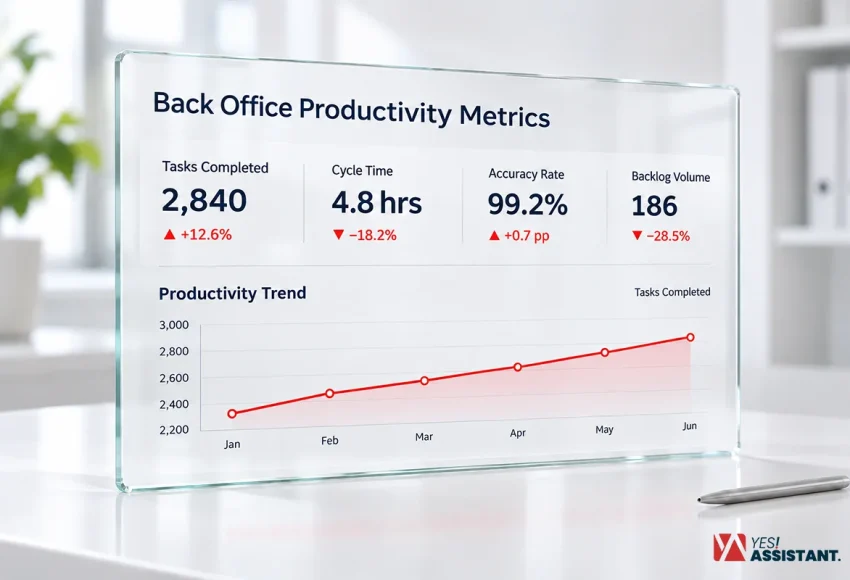
- Some key back office productivity metrics include cycle time, tasks completed per employee, first-time right percentage and error rate.
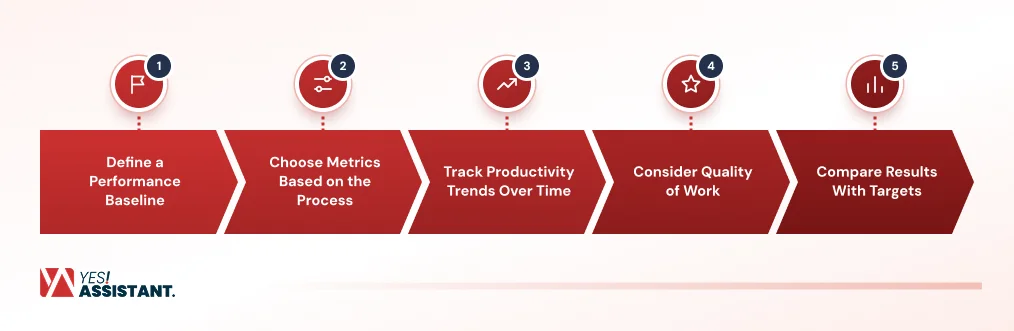
- Businesses should set a performance baseline, choose metrics based on the process, track productivity trends over time and take other steps to measure their back office performance.
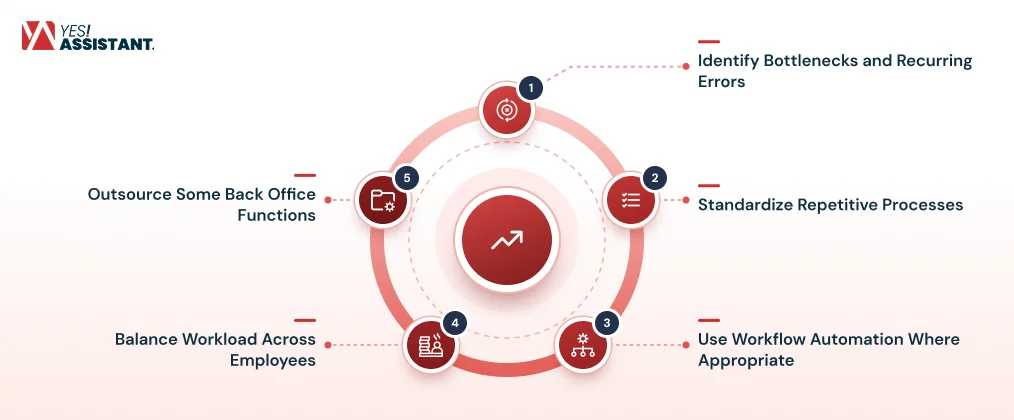
- Useful techniques to improve back office productivity metrics are identifying bottlenecks and reducing errors, standardizing repetitive business processes and using automation and outsourcing.
Back office operations include performing tasks that don’t require having any direct interaction with customers. Businesses need to regularly monitor their back office productivity and fix its weaknesses to maintain steady growth. This is why tracking the performance of back office teams and staff is important with a clear measurement system. In this blog, we are going to discuss the key productivity metrics businesses can use for measuring the performance of their employees.
What Are Back Office Productivity Metrics?
Back office productivity metrics are quantifiable measures that are used to evaluate the performance of back office operations. For example, the data entry task error rate can show how many errors occur during the process. If the error rate becomes higher than the average threshold, then it means the data entry team is spending a lot of time on rework. That means they are being less productive. Businesses or back office outsourcing companies can often get such meaningful insights from back office productivity metrics.
A business can use back office productivity metrics to:
- Track performance of different teams and staff.
- Adjust workload based on team or staff performance.
- Create strategies to improve back office performance.
- Identify inefficient back office workflow or processes.
- Assign projects and realistic goals to employees.
- Assess outcomes of different processes in back office outsourcing.
Key Back Office Productivity Metrics to Track
The table below includes some common productivity metrics that businesses frequently use to measure the productivity of their back office team. The metrics you need to use mostly depend on what you want to find out from the assessment.
| Metric | What It Measures | Why It Matters |
| Tasks completed per employee | Output per employee | Measures individual/team productivity |
| First-time right percentage | Number of correct outputs or results in the first attempt | Identifies whether staff need to perform frequent rework or revision |
| Cycle time | Time to complete a task or process | Identifies delays |
| Cost per transaction | Cost of completing each transaction | Tracks operational efficiency |
| Error and rework rate | Accuracy of completed work | Shows quality issues |
| Backlog volume | Uncompleted tasks | Highlights workload and capacity issues |
| SLA compliance | Tasks completed within agreed time | Measures service performance |
| Attrition rate | The percentage of employees who left the job but whose position has not been filled | Poor talent acquisition and employee management can often cause a high attrition rate |
| Employee engagement rate | Shows the percentage of employees who are engaged with their work and company | Low engagement can cause low productivity and a high attrition rate |
How to Measure Back Office Productivity
Back-office productivity measurement should start with a clear goal and a step-by-step approach. Before assessment, you need to decide the key metrics that will be most suitable to your process. It will help you understand the efficiency of your back office workers and where they lack.
Below are the key steps you should follow to measure your back office productivity:
Define a Performance Baseline
Business owners can sometimes have unrealistic expectations from their back office staff if they don’t know how an average worker performs. This is why first you need to establish a performance baseline based on the output of a specific process. For example, you find that a single worker from the AP team can process 10-12 invoices per hour. This data can help you set a standard performance baseline. If some workers process about 15 invoices, you can consider them efficient. A worker processing 6-7 invoices can be considered less productive.
To define this performance baseline, you can find the answer to the following questions first:
- How much time do workers spend on focused work?
- What should be the average performance look like at standard volume?
- How to exclude after-hours work or performance output from the baseline?
- Do their engagement trends have a sustainable output?
Choose Metrics Based on the Process
Back office operations can include different types of processes such HR administration, accounting or payroll processing. Sometimes, you will need more than a single performance metric to measure these processes.
Some of the common metrics to measure for different processes may include:
| Back Office Function | Common Metrics to Track |
| Accounts Payable (AP) | Invoice processing time, cost per invoice, accuracy rate, exception rate, on-time payment rate, backlog volume. |
| Human Resources (HR) | Time to hire, onboarding completion time, employee record accuracy, training completion rate, HR request response time, cost per hire. |
| Data Entry and Document Processing | Records processed per employee, processing time, data accuracy rate, error rate, exception rate, backlog volume. |
| Procurement and Vendor Management | Purchase order cycle time, vendor onboarding time, approval turnaround time, exception rate, procurement cost per transaction. |
| Order Processing | Order processing time, accuracy rate, orders processed per employee, exception rate, backlog volume, SLA compliance. |
| IT and Internal Support | First response time, resolution time, tickets resolved per employee, first-contact resolution rate, backlog volume, SLA compliance. |
Track Productivity Trends Over Time
Measuring the productivity of back office staff shouldn’t only rely on their output. It should also focus on an employee’s work behaviors, including their schedule adherence, productivity ratio and resource utilization. This is because some employees may still complete the work but if they need additional work hours or resources to complete it then it can be a productivity issue.
Consider Quality of Work
After selecting quality metrics and tracking trends over time, you should start measuring work quality. For example, in a data entry task, you should measure error or accuracy rate, records processed per employee and exception rate for several projects. Select a timeline for measuring the quality of work, such as the output of the last 2 weeks or months. It will help you understand the baseline performance of workers for that specific timeline.
Compare Results With Targets
Once you find out the baseline performance of the workers, you can start measuring them against your target. For example, if you have data entry tasks that take 12 hours a week from 3 agents and the baseline shows it should take 8-9 hours on average, then you are having slow performance.
It is necessary that you use different metrics to compare results with the target. This is because measuring output using a single metric may not give you a proper idea about employee productivity. There are some benchmarks you can define to evaluate the performance of back office staff. Below is a table that shows how you can use metrics and benchmarks for measuring back office productivity for different processes:
| Back Office Function | Slow | Standard | Efficient |
| Accounts payable (invoices/day per employee) | Fewer than 30 | 30–60 | More than 60 |
| Payroll processing (accuracy rate) | Below 95% | 95–98% | Above 98% |
| Data entry (accuracy rate) | Below 95% | 95–98% | Above 98% |
| HR administration (onboarding completion) | More than 10 business days | 5–10 business days | Fewer than 5 business days |
| Order processing (accuracy rate) | Below 95% | 95–98% | Above 98% |
How to Improve Back Office Productivity Based on Metrics
Most businesses have lower back office productivity due to some common reasons, such as hidden bottlenecks, frequent rework or heavy reliance on manual workflows. Here are some strategies that you can follow to remove the major issues that are responsible for poor back office productivity.
Identify Bottlenecks and Recurring Errors
A back office workflow can have stages where your process can often slow down. Identifying these bottlenecks is essential for improving back office operations and productivity. Back office bottlenecks happen mainly for two reasons: when your staff lacks the capacity to handle a task efficiently or when one or more stages in your workflow are not structured properly.
This is why you need to find out whether the employees handling your back office processes are overloaded with tasks. Then, you should identify where communication breaks down, delayed decisions and problems with task handoffs happen frequently.
Standardize Repetitive Processes
Back office staff may not deliver consistent performance without a standard workflow for a process. Measuring the performance of different teams and employees can also be difficult. This is why you can create SOPs for repetitive back office tasks. It will help the team understand what the efficient way to handle tasks is and what standard practices they should follow. This can significantly reduce errors and rework in back office tasks.
Use Workflow Automation Where Appropriate
Many back office tasks can be automated with software and technologies. Some of these tasks can include data entry, HR administration and invoice processing. Automation can reduce workload, operational costs and the risk of error in back office tasks. So you should consider automating some tasks to improve back office efficiency.
However, sometimes with a limited budget, full workflow automation may not be possible for you. In that case, you can automate specific steps of a process. For example, you want to automate invoice processing but if you don’t have the setup cost, then choose an automatic invoice capture system.
Balance Workload Across Employees
Back office operations can include some hidden workload that entrepreneurs ignore and don’t handle properly. These tasks may include administrative support, financial reporting and vendor management. When the volume of this workload increases, business owners may assign the additional tasks to back office workers who already have many scheduled tasks to perform. As a result, the back office staff has a task overload that leads to burnout.
This is why, before assigning tasks to back office workers, you should do a proper assessment to understand which teams or workers already have a heavy workload. It will help you balance the workload among the workers and protect them from task overload.
Outsource Some Back Office Functions
Outsourcing back office functions can often help you reduce operational workload and costs in your business. It can be very useful for distributing additional workload caused by seasonal demand. A business can outsource some of its back office tasks to a third-party provider to focus on other processes. Repetitive back office tasks such as data entry or document processing can often be outsourced so that the internal team can spend more time on high-value work.
Conclusion
Back office activities establish the foundation for internal operations and management of a business. The growth and scalability of a business depend a lot on the efficiency of its back office team. This is why you need to track the performance of your back office regularly with a measurement system that provides clear results. Back office productivity metrics are a key part of such a performance evaluation system.
FAQs
What are the most important back office productivity metrics?
Some of the most important back office productivity metrics include tasks completed per employee, cycle time, error rate, first-time right percentage and backlog volume.
How do you measure back office productivity?
Back office productivity can be measured in several steps, which include setting a baseline for performance measurement, choosing metrics based on the process, tracking productivity trends over time, and others.
What is a good productivity metric for back office teams?
First-time right percentage can be a good productivity metric for back office teams. It helps you understand how many work items are completed on the first attempt. Businesses can see how often a back office task needs rework based on this metric.
How can businesses improve back office productivity?
Businesses can use several techniques to improve their back office productivity, including identifying bottlenecks and reducing errors, standardizing repetitive processes, using automation and outsourcing some back office tasks.
What is the difference between productivity and efficiency in back office operations?
Back office productivity in a business means its ability to complete and handle activities within a specific time and back office efficiency means how well a business performs non-customer-facing tasks. Efficiency includes the ability to produce correct output with back office workers and other resources.