

How Interruptions Destroy Deep Work and Impact Business Productivity
Interruptions are just an inconvenience, It becomes part of workplaces as usual. This is like email notifications, quick messages, instant meeting requests, etc. Thereupon, focusing on depth is quite impossible due to sudden delays but these digital-noises integrated with your business.
Many professional managers work with the ability to multitask and quickly switch between tasks. But ultimately these become traps of your business that destroy overall performance and drive negative outcomes.
In this guide, you will learn how interruption affects your brain by reducing cognitive capacity, increasing errors, and reducing tolerances. Besides, effective ways to protect deep work from interruptions with turn off notification, close unnecessary tabs, and use shutdown rituals.
What is Deep Work? Definition of Deep Work
Deep work refers to your ability to concentrate on a difficult task, to ensure long-time engagement without getting distractions. It’s a state of deep flow that silences the world around you and unlocks your high-quality performance. Therefore, you can keep aside from your team communication tool, aim for a 60-90 minutes distraction free zone.
The core of deep work:
- Zero Distractions: Provide complete attention to core tasks without interruptions from emails, social media, or team members. .
- High Cognitive Demand: Tasks required great attention, like coding, writing, or strategic planning.
- Valuable Output: Results best quality of work spending less time.
- Flow State: Often leads to a zone, where you lose track of time.
What Counts as an Interruption?
Interruptions means things that unexpectedly disrupt your work. An ongoing task in progress may be interrupted for several reasons, like colleagues, partners, and clients. Besides, when you suddenly concentrate on something outside of your tasks, interrupt your current task and switch attention to another.
Interruptions can be counted within two steps.
External Interruptions
- Unexpected Digital Notification: Slack or team messages, chatbots and phone calls.
- Unnecessary Meetings: Meeting without agendas or involving too many people, leading to drain meetings.
- Environmental Noise: External visitors loud conversation, construction, or open-office chatting.
- Colleagues Interruption: Someone stopped at your desk or called for a quick question.
Internal Interruptions
- Internal Mind-Wandering: Suddenly thinking of separate, urgent tasks or team gathering
- Incentive Checking: Urges the situation to check email or social media before finishing the task at hand.
- Task-Switching Attitude: Actively switch to current tasks, and concentrate on multiple apps or projects.
How Interruptions Affect Your Brain
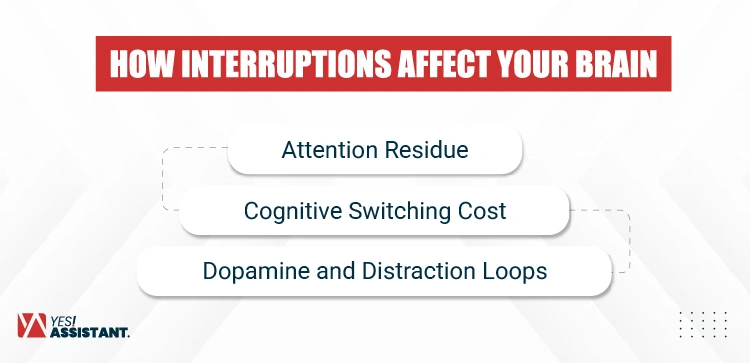
When you are in the middle of a big project, suddenly a notification pings, it’s not just a five-second distraction. Your brain already goes through a physical and mental struggle to get back on track. This interruption changes how your mind processes information, making it much harder to do your best work.
Attention Residue
Focusing on one task is like using strong glue. When you switch tasks, your brain stays stuck on the old one. This is called attention residue. Even if you are looking at a new document , part of your brain is still thinking about the last email you read.
- Your Brain Dump: This part of your mind is stuck in the past, you have less opportunity to solve new difficult problems.
- Change the Scenery: You might find yourself starting at the screen because your brain is trying to finish two different thoughts at once.
- Use Checklists: When you aren’t fully concentrated on your job you make small mistakes that you would usually catch if you were 100% focused.
Cognitive Switching Cost
Your brain works a bit like a computer hanging with heavy programs and junk files. Besides when you shift tasks, your mental software has to close one program and open another. This reloading time is called cognitive switching cost.
It’s the price you pay in time and energy, just to change what you are doing.
- You Lose Your Flow: It takes time to get back into the rhythm you had before the interruption. Which can lead to how multitasking reduces business efficiency.
- Your Brain Gets Tired: Constant switching uses up your mental fuel much faster, leading to a cognitive dysfunction feeling by afternoon.
- Drops Your Accuracy: The more you jump backward and forward, the more likely you are going to miss important details or skip steps in your work.
Dopamine and Distraction Loops
Every time your phone lights up or you hear a ringtone, your brain gets a tiny hit of a chemical called dopamine. This is the chemical reward. Your brain starts to crave that feeling.
Which creates a loop where you feel the need to check your phone even when there is no message.
- A check-in is a quick pause: You might find yourself opening your email or social media every few minutes without even thinking about it.
- Lost Patience: After a while, your brain gets used to quick hits of dopamine and loses your ability. Means you can’t sit silently and focus for a long time on hard tasks for more than a few minutes.
When your brain is disrupted, you can’t finish simple tasks easily which causes to lower your business growth. Many professional use a remote assistant service to handle these small interruptions and stay in silent zone. By letting these chores to someone else manage the “pings,” you protect your dopamine levels and keep your focus on high-level tasks.
How to Protect Deep Work From Interruptions
Just note down what you did earlier. This stops your brain to think more about the tasks. Protect your focus like a candle flame. Without a glass box even a tiny breeze will blow it out.
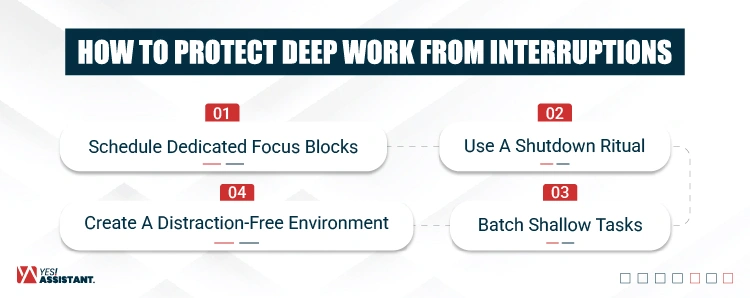
Here is how you can protect your deep work time and get more done.
Schedule Dedicated Focus Blocks
The best way to get your job done is likely to make a date with your work. Schedule 60 to 120 minutes everyday to focus on only one most important job. Where is your job only to concentrate on your job.
This prevents the mental toll of repetitive work from draining your energy before you get to the important stuff.
- Silence Alerts: Before you start, turn off all your notifications; thereupon, your phone and computer stay quiet.
- Tell your team: Let your team members know you are going dark for a bit. So, they don’t go round with quick questions.
- Guard your calendar: Mark your time as “busy” on your digital calendar. This makes sure nobody can invite you to a meeting during your focus hour.
- Pick your peak time: Try to schedule these time blocks when your brain feels most alert, like first thing in the morning.
Create A Distraction-Free Environment
Your workspace should be a “quiet zone” for all distractions. If you can see or hear something interesting, your brain wants to look at it. You have to make it hard for distractions to reach you.
Therefore, these interruptions become common time leaks in growing businesses that stop your progress.
- Hide your phone: Keep your phone in a locker or another place at your house. So, you will not be tempted to check it at once.
- Clean your browser: Close all tabs on your computer that aren’t related to your ongoing work. Open relevant sites that are related to tasks.
- Blocks time-wasting apps or sites: Use a website blocker to stop unauthorized or scam sites. Because, this will redirect your required sites to time wasting places.
- Use noise-free tools: Wear headphones or play noise-free music. This helps you block out loud sounds around you.
Batch Shallow Tasks
Shallow tasks are simple jobs. This includes answering emails, filling papers, and sending quick messages. Small jobs are not hard at all, but doing them all day long stops you from ever getting into a flow state.
For better consequence, perform all at once in a big group instead doing one by one small jobs.
- Save it for later: Determine two or three specific times during the day to check your inbox. This stops tendency to check every ten minutes.
- Keep your head clear: When you know you have set times for small tasks, your brain stops worrying about them during deep work time.
- Stay in the zone: Complete all your small tasks at once. This stops your brain from shifting back and forth between different jobs.
- Use a timer: Fixed 20 minutes to check all your emails. You should not spend too much time on easy work.
Use a Shutdown Ritual
When you finish your work session, this might clearly signal to your brain that the task is complete. This helps you to eliminate attention residue, which is the mental fog that lingers when you don’t fully close out a project. Like a cooling engine, your brain needs a routine to switch from hard work to a state of rest.
- Write it down: Spend five minutes looking at what you finished and writing down exactly what you need to do tomorrow.
- Clear the mental tabs: Close your projects properly helps your brain to stop thinking about remaining work. Therefore, you can actually relax.
- Check your list: Mark off your complete tasks. This creates a sense of win and accomplishment.
- Clean your desk: Keep your papers and pen into a distance area. As a result, you will not be distracted when you come back tomorrow.
Key Takeaways
Significantly, an Interrupted workday is one of the most hidden killers in business. This involves consistent task switching, excessive meetings and communication overload, undermining focus, and increasing cognitive stress. By using focus blocks, batching your small tasks, and creating a noise-free place, give your mind the space it needs to succeed.
You can’t make these leaks perfect over night. Start by blocking off one hour to turn off your phone and deep dive into your most important task. Once you feel the power of deep concentration, you won’t go back to a distracted workday. Your brain is a powerful tool, give it the quiet place that really shines your day.