

How Global Talent Access Changed Business Proven Ways It Reshapes Your Growth
Global talent access primary objective is searching for skilled resources from any location or area to fill up current resource needs. Moreover, global talent access is the strategic process of sourcing, hiring, and onboarding skilled professionals from anywhere in the world rather than narrowing it into local areas. It enhances company talent haunting without barriers and chooses efficient and potential expertise people from remote, virtual or hybrid setup.
Key areas of global talent access:
- Extended Talent Pool
- Strategic Recruitment
- Global Talent Mobility
Impact on Hiring and Workforce Strategy
Remote hiring workforce now becomes competitive. Businesses no longer hire people where talent who has only general knowledge. Many company demand multi-skilled professionals who are skilled in LLMs, machine learning, AI-driven workflows besides having manual skills and certifications.
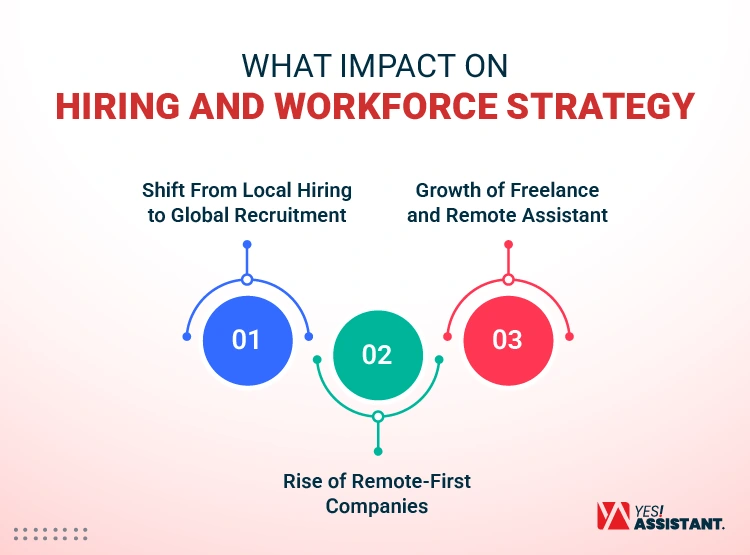
Shift From Local Hiring to Global Recruitment
Hiring a global talent requires no local rules and regulations. Open talent online platforms, like upwork, fiverr or Linkedin extendedly offer your skills talent haunting demands. Also, some companies directly offer you remote assistant services in customized, and cost effective ways.
Select talent Over Location
Under open source law, companies can hire any talent. There are no strict rules to hire an efficient person from other local or geographic areas. Besides, you don’t have to pay application fees, legal charges, with no federal obligation.
Verified Skills and Agility
Most of the online skilled talent providers focus on review, ratings, and certification of the candidate. Also, there are some skills specific industries, who provide your talents within industry skills need specific assistants.
Rise of Remote-First Companies
Most of the leading tech and professional services choose “remote-office” setup. Both employer and employee benefited from it, like office cost, in-house setup cost, utility bills. Companies favourite choices “remote” set up due to avoiding obligatory facilities like medicare-matching (FICA), federal insurance and compensions & benefits.
Flexible Office Timing
Using remote facilities, remote assistants or support assistants perform duties according to their personal preferences. Few companies provide online login devices to ensure your presence.
Outcome Based Performance
In this case, companies set metrics to track individuals’ work outcomes with effective results. Therefore, the company using productivity tools for remote assistant like Asana or Trello to track progress, monitor deadlines, and ensure transparency.
Growth of Freelance and Remote Assistant
When a company decides to hire a freelancer or remote assistant, they consider a highly skilled and proven-tracked professional. Thus, a professional must be strategic, deeply thoughtful and a decision-maker. Because, working from a distance as a “freelancer” or “remote assistant” is very challenging as most of the decisions may be instantly clarified by the employer.
Therefore, you must choose a person who can work independently, and agree with your flexible hiring policies.
Growth of Freelancer or Remote Assistant
Both freelancer or remote assistant demand is growing. Here, you can primarily consider freelancer vs remote assistant job responsibility and business needs. Indeed, a freelancer is hired for the duration of the project, short-term tasks basis, or specific needs.
Again, a remote assistant hiring to handle daily repetitive small tasks, or handling admin tasks. So, you should determine which is best for your company regarding the type of job requirement, regarding short-term or long-term basis.
Hiring From Platforms
Right now, companies need no advertising costs or sorting CVs. Marketplaces onboarding profiles with their project completion, rating and expertise. You can filter or search your requirements directly before hiring a convenient professional.
Challenges of Global Talent Access
Hiring global talent has a lot of positive aspects like cost savings, no contract obligations or no fixed terms. Despite having lots of facilities, there are significant obligations too to hire a remote assistant. This is like, corresponding countries labor law, managing time zone differences, and cultural and language barriers.
Communication Barriers
Remote access is world-wide, a great hiring opportunity for businesses. Specially, this is applicable for businesses who have no big budgets to manage their business. Hiring from remote has significant advantages but also has complications, like communication, time zone, and language gaps.
- Local time zones that do not match with your customers zone results in losing your business.
- Failing to navigate local time also slows your hiring process.
- Required addition of software to set working schedules.
- Language barrier is the significant threat to hiring remote workers.
Compliance and Legal Complexity
Businesses aimed at globalizing operations throughout the different zones or countries. Moreover, business expansion requires a diversified workforce. But this is another barrier when local compliance, taxation or contract rate do not match with your policy.
- Employment law, pay-rates, or tax regulation varies from country to country.
- Required local law advisors to fix the local issues cost can add additional charges.
- Required mandatory local government certification and renewal costs.
- Need a local lawyer to fix up local pay-rates, and other benefits.
Cultural Differences
Working in different languages, diversified accents, and non-verbal cues can lead to misunderstanding, or misinterpret tone. This also creates conflicts and arises between direct communication culture and indirect communication cultures. To overcome this situation, enterprises can do the following.
- Approaches to prioritize local cultural awareness and flexibility.
- Need a local interviewer to take interviews from locals and fair assessment.
- Need to hire bilingual language trainer to train and adopt with others
- Also, required cross-functional resources maintaining operational adjustment.
Data Security Risks
The core of a business strength is sensitive data that ensure long-term business success. When cross-functional operations start with different zones, and resources; there may be potential risks on data security. This includes unauthorized access, ransomware, intellectual property theft and regulatory non-compliance.
- Remote assistants may be targeted by phishing email in order to steal credential properties.
- Data security teams may not align with the global team and can lead to insecure databases.
- Personal software or tools handled by local resources that may spot mandatory security, where malware, or cybersecurity threat is apparent.
- Lack of multi-factor Authorization (MFA) leads to weak access control.
Future Trends in Global Talent Access
Global talent access gradually turned into high-tech driven AI tools to find more talents without manual efforts. Companies are now driving their policies within international policies, applying corresponding local regulations, and talent market places. It’s a high-tech, regulated and borderless marketplace where efficiency considers as new currency.
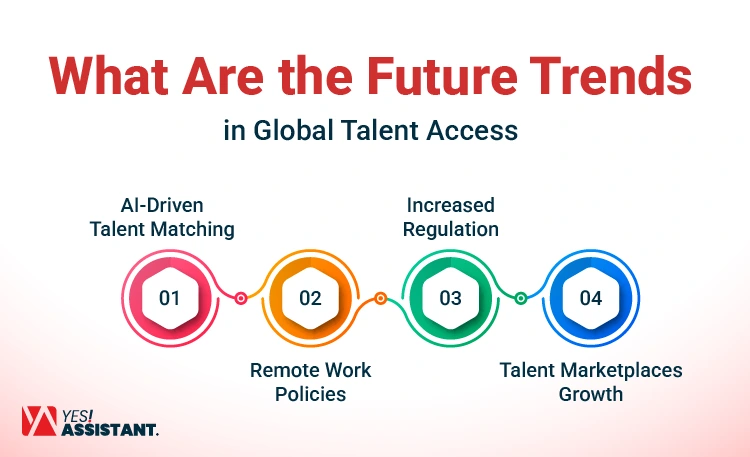
AI-Driven Talent Matching
AI tools bring a great opportunity for businesses to source and hire with accurate searching. Most of the AI-integrated hiring platform use predictive analytical intelligence to match candidate’s past performance using company’s specific keywords. Therefore, human resources team can saves hours of manual CV selection time and ensure right person is found in seconds.
- All algorithms analyze portfolios rather than just reading keywords.
- Machine learning gives you predictions insights on long-term employee retention rates.
- Automated bot systems handle the primary screening interview to save your time.
- Advance matching tools facilitate neutral selection during the hiring process.
Remote Work Policies
More companies now switching to the remote policies supporting international hirings. Businesses are now focusing on flexibility and results rather than hours of spend at desk. This new policies make it easier for a person in one country to feel like a full part of a team located thousands of miles away.
- Remote hiring policy requires digital contact to standardize work policies for all new hires.
- Compensate for home office setups are provided regardless of location.
- Standardized core hours are established to manage different time zones.
- Flexible leave policies that adjusted to the local holidays of the remote worker.
Increased Regulation
Remote work access linked to different countries and locations, government introduces strict rules for cross-boarder employment. As global hiring grows, corresponding countries government are stepping to ensure they collect proper taxes and protect workers right. Significantly, you must know different regions’ legal requirements before hiring a talent and international labor treaties to stay compliant.
- New tax laws target companies with large distributed workforces
- Mandatory health insurance requirements for international contractors
- Strict data privacy laws govern how employee info crosses borders
- Governments launch specialized visas to attract high-skilled remote talent
Talent Marketplaces Growth
Global platforms connecting businesses with skilled professionals to expand their operations. The gig economy is maturing into a professional talent super-highway. Large companies are using platforms as their primary tools to hire and build engineering and marketing departments.
- Niche marketplaces emerge for specific industries like AI-agency.
- Blockchain technology is used to verify candidate credentials instantly
- Integrated payment systems handle multi-currency payroll automatically
- Subscription-based hiring models allow companies to scale teams fast
Key Takeaways
Global talent access has fundamentally rewritten the rules of modern business by removing geographic limitations and allowing companies to hire the best resources. This change of hiring structure significantly reduces overhead costs and improves scalability while fostering a culture of diversity and constant innovation. However, it also recognizes a real challenges in compliance and communication that require strategic planning.
Significantly, this is a borderless hiring process not a temporarily trend but a core business strategy. Finally, global talent access defines how can most successful organization operate their business in a connected world.