
How Slow Invoice Processing Hurts Your Supply Chain
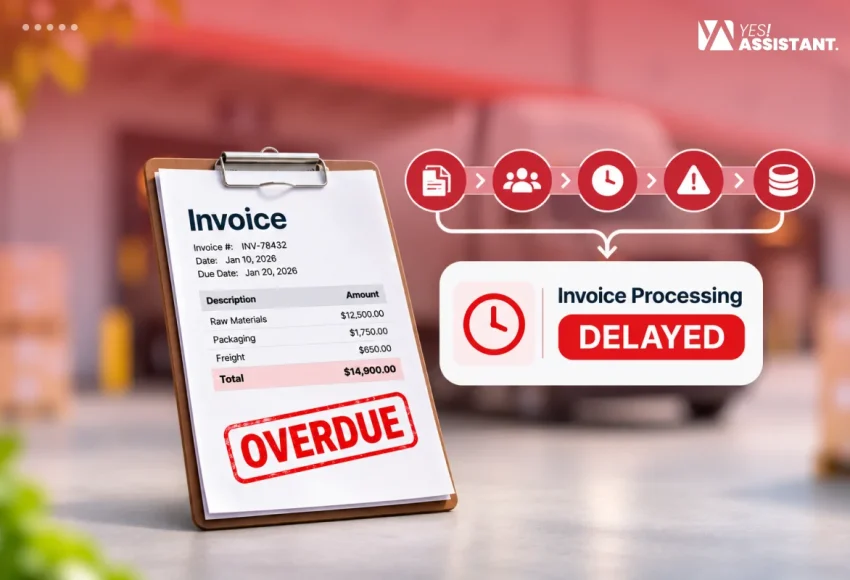
Slow invoice processing delays supplier payments, which breaks commitments and lowers your priority status. When supplier payments miss the deadline, they push your future order to the lowest-priority line. This back-office bottleneck ultimately delays on-time shipments, creates warehouse backlogs and halts product lines of critical parts.
Key Takeaways
- The average invoice costs $10.18 to process, and bottom-quartile AP teams pay $25 or more.
- Slow invoice approvals delay vendor payments, causing suppliers to deprioritize your orders, which ultimately stops physical shipments and pauses production lines.
- Shifting from manual data entry to automated AP tools slashes invoice cycle times by 70% and cuts processing fees down to under $3.00 per bill.
- Mid-sized operations processing $500K a month could miss $72,000 a year in 2% early-payment discounts.
What “Slow Invoice Processing” Actually Means
Slow invoice processing is defined as the total time a bill stays stuck in administrative queues waiting to be completed. To find out why bills move slowly, business teams use a precise framework popularized by automated platforms like Forwardly:
- Invoice Cycle Time: The total number of days it takes from the moment a bill arrives until the invoice is approved for payment.
- Touch Time: The actual minutes a human staff member spends physically working on or checking the bill.
Most bills do not move quickly because workers type slowly. A bill might only need 12 minutes of touch time, but it still takes 9 days of cycle time to finish because it sits waiting in a manager’s email inbox.
The Industry Benchmarks: Best-in-Class vs. Other AP Teams
According to the Ardent Partners State of ePayables Report, a stark efficiency divide exists between best-in-class AP teams and everyone else:
| Metric | All Other AP Teams | Automated AP (Best-in-Class) |
| Average Cycle Time | 13.5 days | 2.9 days or fewer |
| Touchless Processing Rate | 29.0% | 51.0% |
| Average Cost Per Invoice | It costs $12.42 | It costs $2.65 |
When your invoice cycle time extends the deadline, your supply chain bears the burden. It is better to stop bill delays than to rush your staff to type faster.
How Slow Invoice Processing Disrupts the Supply Chain (Step by Step)
Slow invoice processing interrupts the supply chain routine by turning back-office paperwork into a physical bottleneck. This official bottleneck blocks supplier payments, which weakens your vendor trust and lowers your priority status. Consequently, vendors delay future orders, which causes massive shipment delays and halts your physical product lines.
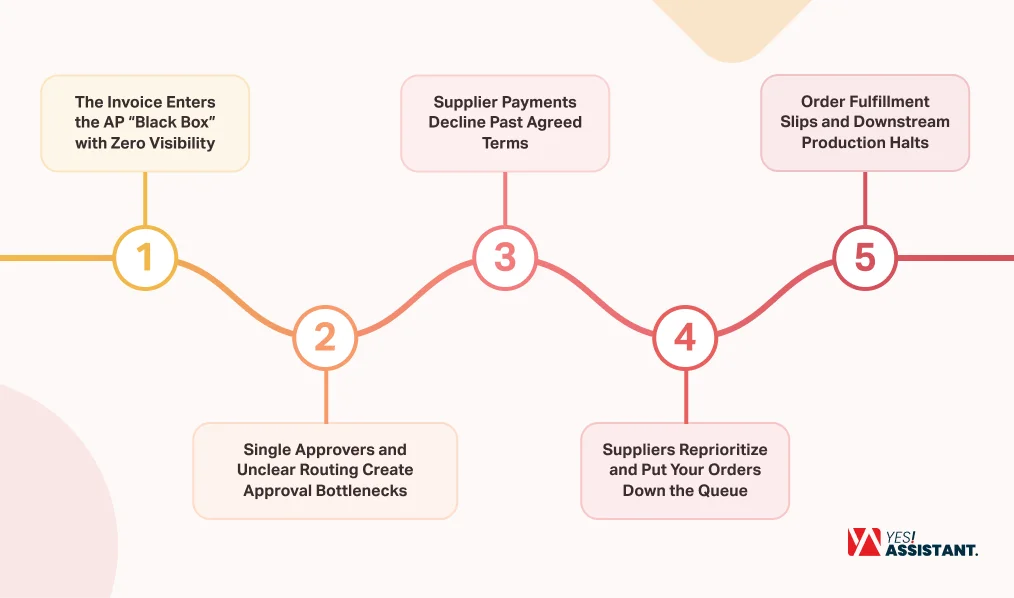
1. The Invoice Enters the AP “Black Box” with Zero Visibility
An invoice black box means a bill enters accounts payable and completely disappears from view until it finally exits. A hidden office mistake can cause a chain reaction that breaks your physical supply chain flow.
Moreover, this hidden office mistake happens because of a confusing machine learning system that hides how it processes your data. Also, your staff can’t see where the bill is sitting, stuck or lost.
As a result, this lack of tracking stops your team from fixing small office mistakes before they grow much bigger. You avoid these problems and automate invoice processing to ensure you pay suppliers on time. Significantly, an untouched invoice inside your office that causes a massive barrier for the next approval stage.
2. Single Approvers and Unclear Routing Create Approval Bottlenecks
An approval bottleneck happens when a single approver or confusing routing path delays the invoice. This admin obstruction stops your bills from moving fast and directly delays the payment your suppliers need. Hidden bottlenecks create shipment delays listed below:
- Problem Created with Single Sign-Off: When only one specific responsible person can authorize an invoice, their sudden absence immediately freezes the complete processing workflow.
- Confusing Routing Paths: Bills are passed around between departments with no clear owner. So, the account payable confused on looks at the next to approve the bill.
Every day an invoice is stuck in an unrouted area that shortens your time to pay bills. Accelerate your AP invoicing team by finding ways to improve invoice approval workflow and avoid late payments. Implementing these workflow improvements will maximize efficiency and build stronger supplier relationships.
3. Supplier Payments Decline Past Agreed Terms
A supplier payment delay means businesses’ internal back-office systems passed the pay cycle period as per agreed terms. This delay shifts your status from a reliable partner to a high-risk account. If you miss the payment deadline, you will lose your next physical orders.
| Processing Stage | What Happens Internally | Impact on Supplier Relationship |
| Due Date Window | Invoice pauses in approval queues past the agreed payment date. | Trust begins to decline as promised payment terms are broken. |
| Cash Release | Finance releases funds late due to delayed verification. | Vendor flags account as high-risk for future credit terms. |
| Behavioral Shift | Suppliers register late payment in their tracking system. | Immediately pause your operational reprioritization against your account. |
4. Suppliers Reprioritize and Put Your Orders Down the Queue
Late payments make vendors move your orders to the back of the line. Your shipments drop in priority because your office takes too long to pay. Vendors save their factory space for buyers who pay on time.
When your payments arrive late, your parts stay locked on their warehouse shelves. Slow payments look like money trouble to your vendors. They stop treating your company like a top-priority client.
Suppliers prioritize those businesses that pay first to ensure next delivery. So, your team is left waiting with empty hands.
5. Order Fulfillment Slips and Downstream Production Halts
An order fulfillment slip is the exact moment back-office payment delays cause you to miss your scheduled physical shipment window. When your office makes payment mistakes due to invoice discrepancies, the production line runs without supplies because no material is available at the warehouse. Therefore, poor paperwork creates missing shipments, idles your staff and angers customers at the end of the line.
- Production Line Delays: Without incoming raw materials arriving on time, factory machines stop running and employees will not complete their production targets on time.
- Empty Warehouse Racks: Inventory levels drop straight to zero, leaving your local distribution centers completely bare and unprepared.
- Customer Delivery Misses: Finally, when your payment is late, customers become upset and lose trust in your company.
The Real Cost of Slow Invoice Processing
When companies take too much time to pay bills, they lose money. When accounting teams handle bills manually, the slow approval speeds turn routine administrative work into a severe financial penalty.
To measure the full financial damage of these administrative queue delays, finance managers track key operational data published by enterprise research groups.
| Cost Metric | All Other AP Teams | Best-in-Class AP Teams | Bottom-Line Impact |
| Per-Invoice Cost | $12.42 | $2.65 per bill | 79% lower cost per invoice |
| Average Processing Time | 13.5 calendar days | 2.9 days in processing | 79% faster processing |
| Invoice Exception Rate | 20.9% | 11.1% | 47% fewer exceptions |
The Implied Penalty: A Concrete Example of Lost Value
One of the costliest results of slow processing is missing out on early-payment incentives. Many vendors offer common 2/10 net 30 terms, which slashes 2% off the bill total if you pay within 10 days. Forgoing this window is mathematically equivalent to accepting a 36.7% annualized interest rate on your working capital.
Consider how this penalty compounds at scale for a mid-sized business operations department:
- Monthly Invoice Volume: $500,000 in total supplier bills.
- Available 2% Discount Opportunity: Up to $10,000 in monthly savings, if every bill carried 2/10 net 30 terms.
- The Manual AP Reality: Slow paper and email approval routing causes the team to miss more than 60% of these early windows.
- The Total Annual Loss: The company leaves $72,000 per year in missed savings right on the table simply because paperwork moves too slowly to beat the calendar clock.
Why This Hits Harder When Supply Chains Are Already Under Strain
Slow invoice processing makes modern supply chain problems much worse when trade markets are already under global strain. New rules for tariffs, customs paperwork, and regional sourcing create more invoice errors than ever before. Thomson Reuters Global Trade Report, when unexpected paper mistakes freeze your systems, slow approval queues can completely break your physical cargo shipments.
Stop Office Delays to Save Your Supply Chain
You cannot control global border delays or changing trade laws. But you can control how fast your office pays your vendor bills. Fixing internal bottlenecks keeps your partner’s trust strong.
Real efficiency starts by keeping your invoices moving forward. When you pay vendors on time, your business gets top priority during tough market seasons. Protect your company from stockouts by speeding up your accounts payable workflow today.
FAQs
Does slow invoice processing really affect the physical supply chain, or just cash flow?
Yes, it breaks the physical supply chain. Late payments make suppliers move your orders to the back of the queue, causing stockouts and missed deliveries.
How long should invoice processing take?
A healthy automated AP system should process an invoice from receipt to payment sign-off in 3 to 5 days or fewer.
What’s the difference between invoice cycle time and touch time?
Cycle time is the total days an invoice takes to get paid from start to finish. Touch time is the actual minutes humans spend manually entering data or fixing it.
Can automation fully eliminate these delays?
Automation removes manual bottlenecks and human errors, but you still need clear approval rules to catch rare billing exceptions fast.
What’s the fastest fix if my team can’t overhaul the whole AP process right now?
Set up clear rules for single approvers and clean routing paths. Therefore, your bills stop sitting unread in inboxes.