

How to Say No Politely in an Email: Professional Examples & Templates
TL;DR
For politely saying “no” to someone in an email, you should acknowledge their request, state your refusal and end with a positive note. Sometimes, you can offer an alternative way to help the recipient but don’t give false hope by using vague sentences like “I will try”. You can give a brief reason but always avoid over-explaining in your message.
We can’t always accept the request or invitation that we receive in email. There are times when I must decline them for some reasons. This is when writing a reply becomes challenging for us since we are emotional beings, and disappointing someone is not an easy task.
However, if you know the proper technique for refusing someone, saying no becomes a lot easier. In this guide, we will explore the formula, templates, and useful tips that can help you write an effective email for saying “no” to people.
What It Means To Say No Politely In An Email
Email has become a popular mode of communication, and it is widely used by professionals across almost every industry. Writing an email always gives you better control because in this channel, you can take time to create your message and go through it before sending it to someone.
This is something you can’t get from real communication or phone calls. But just because of that, it doesn’t mean you can be casual in saying “no” to people over email. It is because the person who sent you that email can often take it as disrespect, which can hurt your relationship with them.
So when you say “no” to someone in an email, you need to write your email in a way that shows that you acknowledge their situation or demand, but can’t accept the request. “Saying no politely in an email” basically means showing this courtesy to people.
The Core Formula For Declining Politely In An Email
Writing an email to say “no politely” is not very difficult because all you need to do here is to structure your message properly and follow the basic email etiquette.
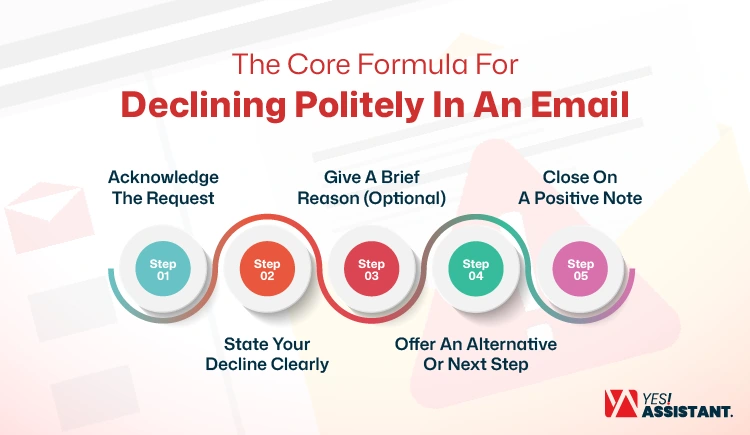
Here is a formula to structure your email:
Step 1—Acknowledge The Request
It is not possible to accept every invitation and request. But you can appreciate someone who reaches out to you with a nice opening line.
Example:
“Thank you for considering me for the project.”
Step 2 — State Your Decline Clearly
Declining a request in an email should be like saying “yes” or “no” right away. Don’t include unnecessary explanation in your decline statement. Just keep it within a few sentences because a “no” means “no,” and overexplaining will only create ambiguity.
Example:
“I can’t help you with your project, as I have some other priorities.”
Step 3—Give A Brief Reason (Optional)
Showing a reason for refusal may seem like a formality, but it is best if you don’t skip this part. Since explaining to someone about your situation and why you are saying “no” can sometimes make people feel slightly better. Avoid over-explaining yourself when giving a reason to the sender, because then it may look like you are just making an excuse.
Example:
“I can commit to other tasks due to a heavy workload.”
Step 4 — Offer An Alternative Or Next Step
Giving a direction or alternative when possible is a good behavior that you can practice in email to show that you care about other people’s problems. There are several ways you can guide someone to take the next step, such as referring them to someone else for a project or proposing a different timeline to them.
Example:
“I can suggest to you one of my colleagues who can help you with this project, if you are interested.”
Step 5—Close On A Positive Note
Naturally, we have to decline people’s requests, but closing your message on a positive note is common courtesy in conversation. It is also necessary to maintain a good relationship with a contact.
Example:
“I hope the project goes well. I am looking forward to future opportunities where we can work together.”
Polite Phrases To Use When Saying No In An Email
People often need a long time to think about how they should write the statement declining someone’s request, as refusing someone doesn’t feel good.
Phrases For Declining A Request
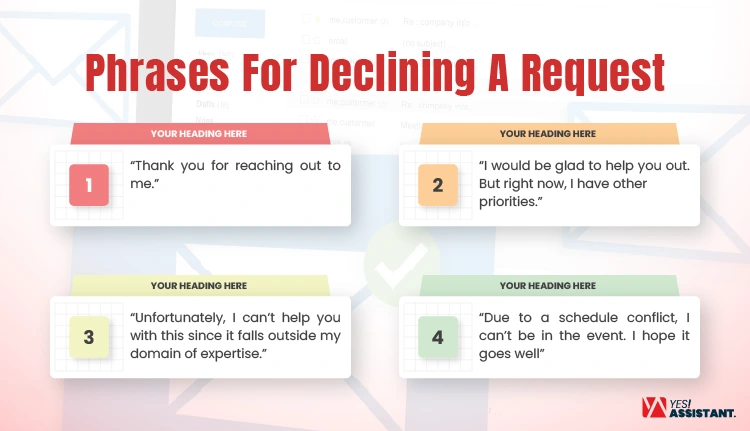
“Thank you for reaching out to me.” – It acknowledges that they have confidence in you.
“I would be glad to help you out. But right now, I have other priorities.” – It is a clear and straightforward way to decline someone.
“Unfortunately, I can’t help you with this since it falls outside my domain of expertise.” – Give a clear reason for why you are refusing the request.
“Due to a schedule conflict, I can’t be at the event. I hope it goes well.”- Directly address your position about the request and end with a positive tone.
Phrases for Declining With an Alternative
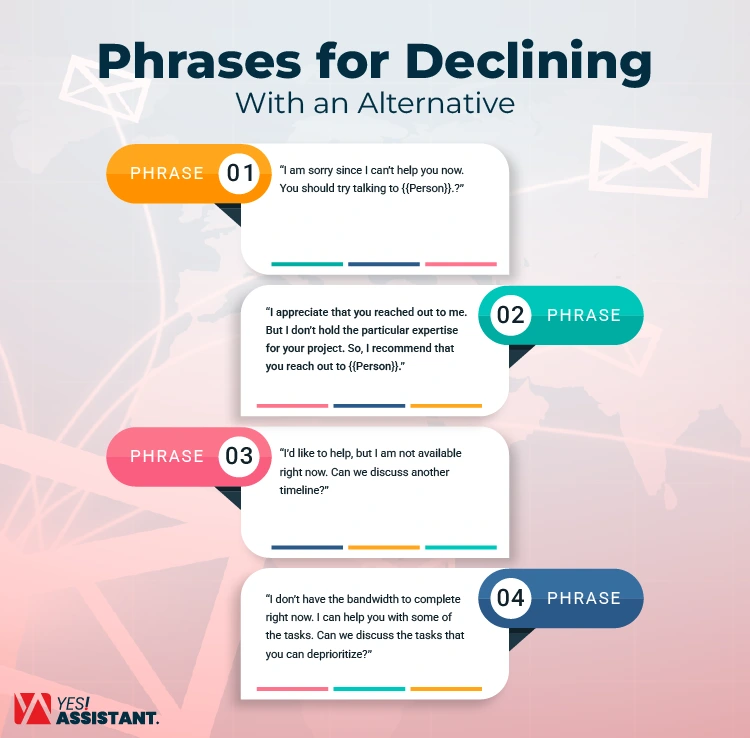
“I am sorry since I can’t help you now. You should try talking to {{Person}}.”
Reason: It is a direct way to refuse someone and suggest they reach a specific person who can help.
“I appreciate that you reached out to me. But I don’t hold the particular expertise for your project. So, I recommend that you reach out to {{Person}}.”
Reason: It shows that you are being direct and honest about your ability.
“I’d like to help, but I am not available right now. Can we discuss another timeline?”
Reason: It is useful for refusing someone who might be open to adjusting their timeline.
“I don’t have time to complete your whole task. But I can help you with some of the major ones. Can you share about your specific priorities for now?”
Reason: It is a way of avoiding a direct refusal and still wanting to help them to some capacity.
Phrases To Avoid
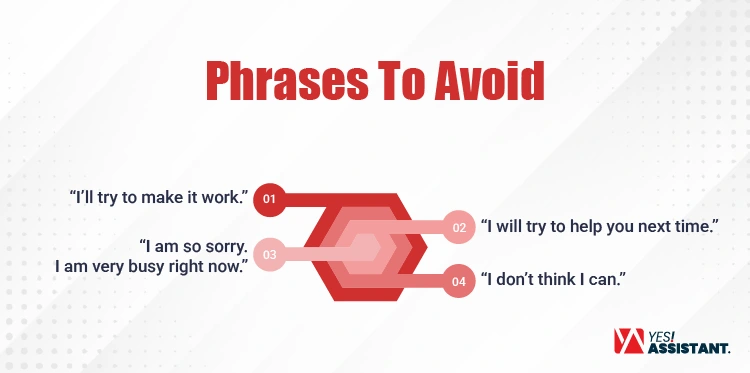
I’ll try to make it work.
Reason: Don’t give them an uncertain answer. They need an alternative if you can’t really help them.
I will try to help you next time.
Reason: Some people may not like it, considering that you are trying to give them false hope.
I am so sorry. I am very busy right now.
Reason: Don’t be apologetic this way. It can make you look like you lack authority and confidence.
I don’t think I can.
Reason: Be clear and direct with your answer. Just say you don’t have the expertise.
Polite Refusal Email Templates By Scenario
A pre-built format or template can help you write a refusal email faster. Here are 5 example templates that you can use for different situations:
Saying No To A Colleague’s Request
Subject: Re: {{Request Name}}
Hi {{Colleague’s Name}},
Thanks for reaching out to me.
I appreciate that you wanted my help with your project. But I can’t commit to it due to my current workload.
I recommend that you contact {{Person Name}}. He holds a great deal of expertise for this task.
I hope your project goes well.
Best Regards,
{{Your Name}}
Declining A Meeting Or Event Invitation
Subject: Unable to attend {{Meeiting or Event}}
Hi {{Sender’s Name}},
Thank you for inviting me to the {{meeting or event}}. I wish I could attend, but unfortunately, I won’t be able to do so.
I can’t be there, as my schedule is completely booked on that day.
I hope everything goes well. Please send my greetings to other guests on my behalf.
I look forward to hearing how the meeting went. Thanks again for inviting me.
Best Regards,
{{Your Name}}
Saying No To A Client Or External Partner
Subject: Unable to assist with {{Request}}
Hi {{Sender’s Name}},
Thanks for reaching out to us. We appreciate your interest in our business and service. But unfortunately, right now we cannot accept your request. Since our current bandwidth doesn’t leave us the opportunity to commit.
I recommend that you reach out to {{person or business}}. Please let us know if there is anything else we can help you with.
Best Regards,
{{Your Name}}
Saying No To A Manager Or Senior Stakeholder
Subject: Following up on {{Request}}
Hi {{Manager or Stakeholder Name}},
I appreciate your trust and confidence in bringing this task to me. But I would like to inform you that my current priorities are {{Priority 1 | Priority 2 | Priority 3}}.
I don’t want to take another task on the priority list because it can impact the quality of my work. So I am afraid that I won’t be able to deliver the task within the specific timeline.
I would be happy to take this on if one of my current tasks is reassigned or rescheduled.
Thank you for understanding me.
Best regards,
{{Your Name}}
Declining A Sale Or Vendor Email
Hi {{Seller or Vendor}},
I appreciate that you are reaching out to us. But right now, we are not actively reviewing any offer from the seller. I will save your information and specific details of your business for the future.
Thank you.
Best Regards,
{{Your Name}}
Tone And Word Choice When Refusing By Email
People can’t see your facial expression or voice when reading an email, but still, you should be careful about your email tone when you say no to them. It will help you to avoid any misunderstanding with someone you refuse. However, you shouldn’t be too soft with your response because it can make you look insecure.
How to Sound Firm without Sounding Rude
Many people think that being direct in refusing someone is rude. But when you overexplain stuff or use some word that creates ambiguity, such as “think,” “feel,” or “maybe,” it can put you in an insecure position.
Here are some best practices you should follow to sound firm:
Avoid over-explaining your position and be direct about refusing them. For example, don’t send a reply like the following:
“I think it would be possible to attend the event if my schedule didn’t overlap.”
Instead, say:
“Unfortunately, I won’t be able to attend the event since I have a prior commitment and it overlaps with my schedule.”
Read your message carefully before sending it to understand whether you are overexplaining the reason for refusal in your message.
People can often feel that you are making an excuse when you provide a detailed explanation for the decline. This is why you keep your message short and simple. Don’t say “sorry” multiple times or make emotional statements.
For example, don’t write something like: “I am really sorry to disappoint you.” Since it sounds like you are offering sympathy to the sender.
Adjusting Tone by Relationship Time
We can change the tone of our communication or speech based on our relationship with someone. The same thing is applicable when you decline someone’s request via email.
- Close Colleague: Stay warm and friendly in tone. Be casual in writing your message and reference any personal information, such as “I can recommend someone from the previous company {{company name}} worked for.”
- Manager or Stakeholder: While saying no to a manager or stakeholder, you need to be more strategic and formal. Some people often avoid a direct no here. Instead, you can clarify your situation and ask them for a suggestion so that you can proceed with their request. In this case, you could respond saying, “I could help you with the project if one of my existing responsibilities were reassigned.”
- Client or External Partner: Be direct and explain the reason clearly. For example, you can write something like, “I don’t have a free schedule to start working on your project, but I can recommend someone who might help you.”
- Vendor or Cold Contact: Just be formal and polite in refusing their request. There is no need to show extended warmth.
Common Mistakes to Avoid When Saying No by Email
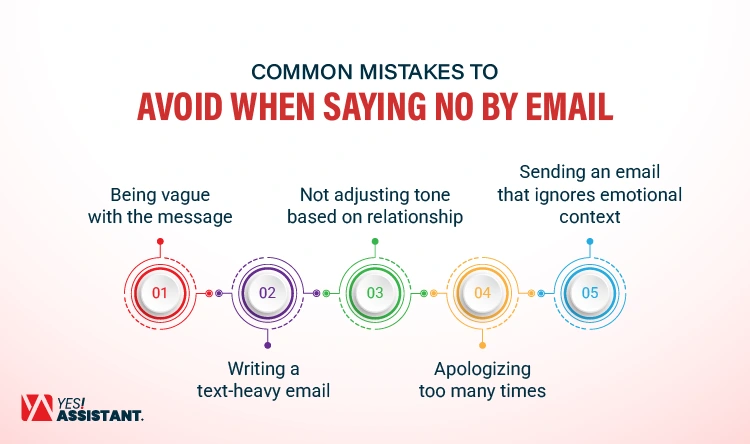
Here are some common mistakes that you should avoid while saying “no” to someone in an email:
- Being vague with the message: Be honest with your response if you have to say “no.” Don’t provide false promises with statements like: “I will see what I can do.” The sender needs a clear answer.
- Writing a text-heavy email: Reading a long message can be frustrating for the person who reached out to you with a request. So keep your email short and easy to read.
- Not adjusting tone based on relationship: The way you decline someone’s request should be customized based on the relationship with them. For example, a senior manager or stakeholder needs a more formal and softer response than a colleague.
- Apologizing too many times: It is completely fine to refuse someone when you have a valid reason. But if you apologize too many times or say “sorry” frequently in your message, it makes you look insecure or shows that you are only making up an excuse.
- Sending an email that ignores emotional context: The email you send to someone should politely have an acknowledgment and end. When your email is too short and direct, it can make a poor impression of you.
Conclusion
An email that you send someone refusing their request should be short and well-structured so that the sender clearly understands your response to their request. A formula or template can help you write an email faster when you have to say “no” to someone in an email.
When you have to refuse someone, you can provide a reason, but don’t make your message lengthy for that. The decline statement of your message should sound firm. All you need to do is just show the basics and respect for the sender.
FAQ
Is it rude to say no by email?
Refusing someone with a clear reason and warm tone is not rude. It is a basic formality or standard professional practice to acknowledge a request and close on a positive to decline a request. If you ignore someone’s message, that is something a recipient may consider rude.
Should you give a reason when declining?
No, providing a reason for decline is optional. It is recommended to include a brief reason to clear your position and maintain a good relationship with the recipients.
How do you say no without sounding harsh?
Acknowledging the request with polite phrases like “Thank you for reaching out” or “I am glad that you thought of me” can help you set a positive tone and avoid sounding rude.
Should you apologize when declining a request?
Yes, you can say “sorry” or apologize to show empathy to a recipient. However, avoid over-apologizing because it may seem that you are making an excuse.
What should you avoid saying in a decline email?
Avoid unclear responses, false hope, and over-explaining in a decline email. Since they can create ambiguity in your response or make it look like you are making an excuse to them.
Should the tone change based on who you’re declining?
Yes, based on your relationship with the recipient, you need to adjust the tone of your message. A close colleague can get a warm or casual tone, or a client. A manager and clients should be approached more formally and diplomatically. While you can say a direct no to vendor messages without adding unnecessary warmth.