
Why Smart Founders Don’t Do Everything: Are You Making This Mistake Too?
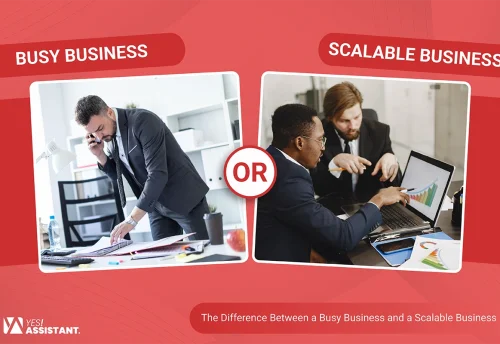
When you intend engage with everywhere at your business, your never grow your business eventually. When you aim to win a big-race, you must be strategic, attentive to great ideas and setting goals. A smart founder assigns small and repetitive tasks to team members, uses SOPs and builds leadership.
Significantly, smart founders avoid the hidden cost of limited output, delays in decision-making and create operational bottlenecks. Besides, you’ll learn to use the 80/20 rule to ensure the best outcomes and avoid small tasks to achieve big goals.
The Hidden Costs of Doing Everything
A smart leader looking for a decentralized team, by building and nurturing talents who can involve with usual decision-making regarding ongoing issues. Without analyzing visionary strategy setting needs, business leaders sometimes engage with small and repetitive works that cause burnouts and increase stress. This is hidden workload most entrepreneurs ignore, resulting in creating flaws on setting tactical decisions in business growth, reduces revenue.
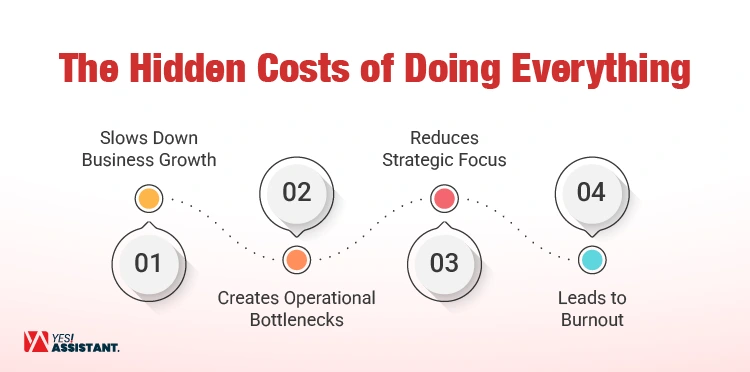
Slows Down Business Growth
Business leaders hardly believe in decentralizing leadership rather keep small to big issues under their own holder. This happens due to the person’s reluctance to functions their leadership to other members. This will limit businesses’ output as every decision made and controlled by one-handed leadership.
Key elements to slow-down business growth:
- No alternative decision-maker
- Operations limited to single person
- Missing opportunities due to decision-delay
- Inconsistent services lead to breaks productivity
Creates Operational Bottlenecks
In a conference meeting, the operation head briefs everyone about next project insights. During this time a sudden phone call comes from stakeholder to update ongoing project insights and the boss is engaged for certain times. So, rest of the teammates passes time as they cannot move anywhere without getting approval from “top-boss.”
Key issues to create bottlenecks:
- Major decision-making requires bosses inputs.
- Slow downs operations and reduce teams agility.
- Individuals feel burnout due to waiting repetitive clarification.
- This blocks operation multiple times and missed opportunity.
Reduces Strategic Focus
A founder should be the architect of the business, but they lose this role when they refuse to delegate. Without thinking about the future decision-maker, the leader becomes a firefighter by fixing small problems daily. Therefore, this reduced strategic focus means business stays jammed instead of growing towards long-term goals.
Key elements of reduced strategic focus:
- Daily tactical involvement obscures the ability to set and follow a clear roadmap.
- Management becomes a responder to immediate issues instead of proactive planning.
- Most valuable time for building strategic partnerships opportunity spoils by internal micro-management.
- The lack of creative “whitespace” stops the development of new products or service improvements.
What Leads to Burnout
You have no specific homework on which tasks related to strategic focus and create a highly impact on your business. Besides, you’re unable to separate values between high-impact tasks vs low-value works. Therefore, you try to engage with everything resulting in working long hours reduces productivity, creates decision fatigue that impacts on your quality.
values lead to burnout:
- Leaders engage from high-values to routine tasks.
- Making hundreds of decisions daily leads to mental exhaustion.
- This is how task overload leads to burnout from the constant demands.
- Teammates stop thinking rather than waiting for an update from superiors.
What Smart Founders Do Instead
In a conference meeting, project heads along with directors and officers attended the meeting to get direction about upcoming works. During the time, a customer drops messages to the head’s mobile but transfer the mobile to the assistant without seeing the display. A smart leader is always deeply concerned for highly-optimized outcomes, and this is why focus is the new competitive advantage to keep your business ahead.
Focus on High-Leverage Activities
It is significant to note that high-leverage activities lead to high return-on-investment, optimizing productivity within a strategic operational roadmap. Besides, hiring top talents, establishing cultures, and monitoring acts a multiplier of your business betterment. Moreover, leverage strategic partnerships to enhance innovation, market expansion and ensure operational growth.
Highly Engage with Company Vision
- A dynamic leader sets business operations with multiple-tiers, like – category A, B, C to ensure functional operations.
- Engage with senior management to know brief details instead of solving a single bottleneck.
Set KPI Within the Departments
- Set KPI to track data-driven measurable insights for strategic goals, enhance decision-making, and tracking performance.
- Take immediate actions based on KPI metrics that help teams to take corrective actions.
Delegate and Build Systems
It is significant to note that delegating repeatable tasks acts as an accelerator for scaling, allowing founders to disconnect their time from daily operations. By shifting focus towards system building, you optimize the business’s internal engine to run autonomously. Moreover, smart-leaders set a framework to ensure functional operations remain consistent within the departments of the company.
Establish Standard Operating Procedures
- Crafting standard operating procedures for every department to ensure that all tasks are executed following every step of operational rules.
- Establish clear guidelines that allow teams to fix immediate complexities without need of a founder’s direct intervention.
Use Automation Tools to Manage Repetitive Tasks
- Optimizing technological assets to handle data-driven workflows error and manage repetitive sequences within the business roadmap.
- Use automation to manage recurring tasks and building efficiency, reducing human error and ensuring operational growth through consistent process management.
Hire for Strength Gaps
A dynamic leader recognizes that identifying internal skills gaps, which is vital to business betterment and long-term market expansion. By bringing in specialists, you ensure that every department from finance to marketing is led by highly optimized talent. These strategic hiring steps, switch your focus on the company vision while experts handle specific operational bottlenecks.
Strategic Auditing of Internal Capabilities
- Potential leaders conduct a strategic audit of team’s capabilities to identify where the leadership lacks specific insights.
- Choose a full-time expert or outsource to specialize as an assistant to ensure business remains competitive and active.
Expert Integration Across Key Departments
- Engage with specialists who provide brief, data-driven details to the founder, allowing for smarter decision-making at the highest level.
- Establish a communication tier where experts solve single bottlenecks independently before reporting the final outcome.
It is significant to note that delegating repeatable tasks acts as an accelerator for scaling, allowing founders to disconnect their time from daily operations. Many founders choose a remote assistant service to handle administrative bottlenecks, you can focus entirely on system building. It can optimize your business’s internal engine to run autonomously.
The 80/20 Rule in Founder Productivity
A smart founder planned for a week with 100 hours a week to be successful. In fact, doing too much actually hurts your company. The “80/20” rule is effective in helping you find the few tasks that really matter. If you think you are working hard but nothing found effective in business, this is signs you’re spending time on the wrong work.
To be the best in your business, you must focus on the small number of big wins that earn the most money and progress.
Applying the Pareto Principle
The Pareto Principle is a simple way, just look at your daily schedule. Spend 20% time on your business, and then see how 80% of your success comes from consequences. For example, you have 10 tasks in your queue, just choose 2 that have great value, changing your business.
Best way to apply the Pareto Principle:
- Spend your valuable time with a list of tasks that have high-value and stop focusing on low-impact works.
- Look at the list of tasks and separate those are common time leaks in growing business and stop engaging with the tasks.
- If any repetitive and small admin tasks can be done by simply setting on the computer, just let it go. So, you lead to strategic tasks.
Examples of High-Impact Tasks
High-valued tasks are the core of a founder’s concern. These tasks list are little but require deep research and apply different methodology to make your business a market leader. When you spend time here, you’re just building your empire.
See the examples of high-impact tasks:
Grow Revenue Directly
Always engage with tasks that have high-impact and change your revenue cycle dramatically. This is like Lead Sales campaign and Direct Outreach.
Focus on Why your Plan Works Best
Demonstrate your visionary plan to secure the cash; thus, investors can work with for the next level investment. Like, Traction of momentum signal, and business model focus high-scaling.
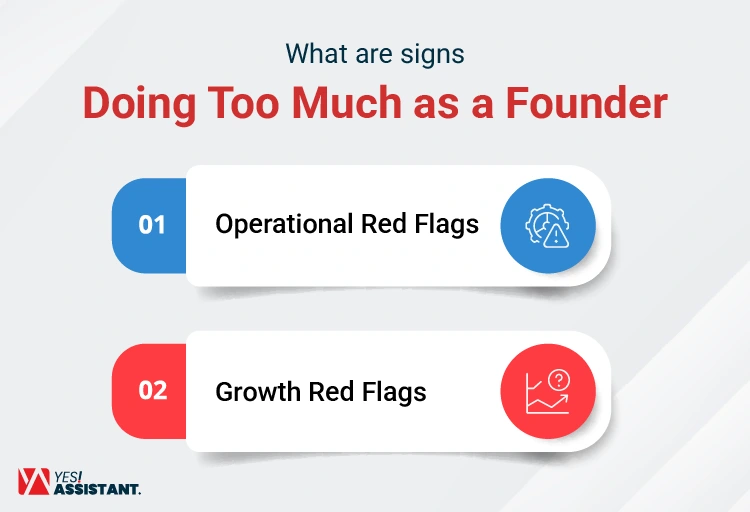
Signs You’re Doing Too Much as a Founder
Smart founders acts like seating at the driving area, but don’t engage with every single task. When you try to control everything, you become a firefighter that slows your company operation. This creates a heavy workload that leads to the mental tool of daily repetitive work, leaving you with no energy to think about the future.
Therefore, go slow, think deeply to take effective decisions that grow your business.
Operational Red Flags
Operational red flags are warning lights on the car’s dashboard. According to the point, red light signals means your business is starting to break because you are holding too much control. When small tasks require your attention, the system is really failing.
Key-terms of operational red flags
- Your team members start working with ordinary directions because you are too busy deciding and setting all directions.
- Listed-out important tasks seat at your desk as you’re too busy doing small tasks.
Growth Red Flags
Growth in the red flat means your business hit a glass ceiling. Even if you work harder, the company doesn’t get any bigger because it is limited by your personal time. A strong business grows when the founder isn’t concerned about small works.
Key-terms of growth red flags
- You are too busy fixing internal problems, but your core job is to make decisions on new business ideas.
- Besides, you hire smart people, but they are just waiting to get your permission before starting work.
Conclusion
A smart founder has three big winning characteristics, like money management, strategic goals & growth, and identifying key growth metrics. As an intelligent founder, you must drive with big-money making ideas, identify risks to ensure sustainable business expansion. Many visionary founders set remote staff up as backup resources who can handle small, repetitive, and reminder-setting tasks.
FAQs
Why Should Founders Delegate Tasks?
Founders are key-runner of the business, optimizing high growth of business. So, they should delegates team to handle repetitive and small tasks without high-level decisions.
What Should Founders Not Delegate?
Founders should not delegate tasks that belong to their business confidential, like high-level fundraising, key executive hiring, and defining long-term strategy, and product roadmap.
When Should a Founder Start Hiring?
Usually founder start hiring when recurring, and small tasks increases and distract them to focus on growth.