

Why Trusting Others Improves Outcomes: What Great Leaders Always Do
“Trust” begins with the foundation of care, competence and character, which require shifting self-control to empower more people. It has significant measurable improvement in productivity, engagement, innovation and profitability.
Moreover, trusting employees in a business leads to enhanced leadership, and generates new ideas through psychological impacts. Besides, you’ll get insights on how to build a better environment in your business through sponsoring trustworthy delegation, open feedback and recognition.
What Trust Means in Human Interaction
Trust in human interaction means building relationships through observable, consistent behaviours that demonstrate a person is safe, reliable, and legitimate. Trust is built over time through consistent, small, and repeated interactions where you need prove to be trustworthy partners
Besides, trust in human behaviors like listening to team members interest and curiosity rather than formulating a response while others engage in conversation.
Why Trust Leads to Better Outcomes
Focus your true” confidence over your teammates involved with trusting others information, integrity and initiatives. Over your sincere attitude to trust people, help you to take concrete business decisions, improve better collaboration and increase productivity. Significantly, it will create a culture in your company to create innovative ideas that keep you ahead of other businesses.
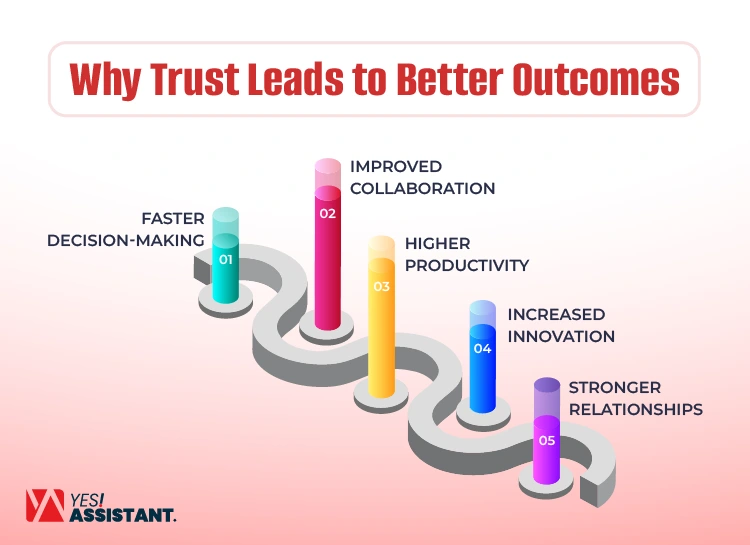
Faster Decision-Making
There is no effective solution to become a “commanding” leader. It’s better to delegate your team members to drive quickly and you respect their initiatives and information. You’ll see the consequences of “trust” over your partners through collecting quality information that help you to make decisions quickly.
Key to make faster-decisions
- Build an Open Communication Culture: This breaks barriers between departments, ensuring necessary data, perspectives and insights are available to make decisions.
- Build Functional Leadership : Distribute authority to your team members that reduces bottlenecks, allows leaders to focus on strategic and high-impact decisions.
- Support & Delegation: Foster a collaborative inquiry mindset, engage the team, and allow delegates to improve decisions that accelerate business growth.
Improved Collaboration
In order to create an improved and collaborative environment, build communication between departments, support functions and stakeholders. This will reduce blocks over sharing information that could create conflict due to exchanging no information within corresponding parties. Effective collaboration between sales and marketing teams builds successful sales process workflows.
Key to build a improved collaboration
- Prioritize Open Communication: Train and recognize your communication model, and link between inter-departmentals, top to down and share creative ideas.
- Set Clear & Shared goals: Ensure your team’s understanding and work following company smart goals before driving to business operations.
- Support Diversified working Style: Create a collaborative office environment for both office staff and remote support assistants.
Higher Productivity
In a “high-trusted” area employees working not for giving effort “end-to-end” productivity only, also explore more innovative ideas. The company who has journeyed over decades, remains competitive in the market introducing products experimenting with customer choices.
Key to build “trust” for higher-productivity
- Trust for Building Performance: Company who builds “high-level” trust over employees, leads to high engagement, innovation, and increased productivity.
- Sponsoring Potential Leadership: Taking a succession plan to identify potential leaders with consistency, integrity and enthusiasm to drive with collective results.
- Increase More Engagement: Create opportunity for all to engage with the company’s long-term goal and work within strategic values that ensure better productivity.
Increased Innovation
Getting psychological safety from company top management, creates opportunity to share new ideas, ask questions without fear, criticism, or rejection. When your teammates work out of fear, you can work with creativity and take action with risks. Out of fear explores one potential and innovation can be recognized effectively.
Why “trust” increase innovation
- Encourage Curiosity with Vision: Recognize ideas in slide-show, create opportunity about new ideas that create multiple questions with leaks or opportunities.
- Explore New Idea to Others: Arrange an open discussion about innovative ideas to get effective feedback from experts, and bring new ideas to light.
- Recognize Others Contribution: If a new idea comes from a group of people, demonstrate it to stake-holder, and recognize an individual’s contribution.
Stronger Relationships
When you trust your partners or team-member, this gradually turns into a strong relationship. Therefore, both come close to each sharing thoughts, ideas, and setbacks. This will reduce turnover rather than build collaboration that grows your business outcomes
Why Stronger relation improves outcome
- Safety Workplace: When your employees build confidence over you – they’ll find a friendly leader. This helps you to reduce turnover and make long journeys with dedicated people.
- Reduce Risks During Crisis: Your company may fall into a financial crisis, and drop selling. By this time, your employee will reinforce to the market to find the actual cause of the selling crisis due to stronger relationship and trust.
- Resources Never Fall into Traps: During your business stability, outsiders may offer your resources to share confidential information but will succeed due to concrete relationships.
Build a “trustworthy” culture in your business that relieves you from single controlling over everything. Besides, it’s important to build a credible relationship with remote virtual assistants to get more outcomes. Therefore, you’ll get strategic resources who can add up valuable information to your strategic roles.
Psychological and Behavioral Benefits of Trust
According to psychology, trust is a fundamental term to reduce anxiety at the workplace. When your employees feel trust in your business, it automatically enhances their emotional well-being, which acts as “social lubricant” in their mind.
Reduced Stress and Anxiety
Trust in your teammates, create an environment to solve-problems, and help you to make-decisions that reduce your stress and anxiety. When assigned teams or individual members to perform specific operations, they’ll start work without hesitation.
- Distribute small tasks to your assistants that help you to avoid mental toll of daily repetitive tasks, and focus on big-screens.
- High-level of trust over team members, leading to spending time on high-value tasks that actually grows your business.
- You build “trust” to your employees, meaning you’re nurturing their minds that easily perform better, maintaining time, speed, and accuracy.
Enhanced Emotional Well-Being
When you trust your employees, they feel better and safe at the workplace. Therefore, employees feel security, and focus on their creative initiatives rather than worrying about job instability. People like to work in a secure environment, it naturally strengthens social bonds between departments that make the workplace a collaborative community.
- All team members fully focus on innovation, based on their integrity and performance.
- Create a culture where inter-departmental connections build and employees feel them as valued partners rather than just resources.
- “Trust” removes the mental toll of suspicion that leads to better speed and accuracy.
Reciprocal Behavior
Trust is a two-way street that operates on the principle of mutual exchange between leadership and the team. When you trust your teammates, they will start trusting you too; even if there are sensitive confidential issues. This cycle ensures that your delegation and initiatives are met with the same level of integrity and effort you provide.
- If you trust your team’s skill, they will take more responsibility for their work.
- When you trust a teammate, you can delegate authority without supervision, as both of you’re working towards the same goal.
- Trust is reciprocal, it builds a functional leadership culture where everyone is happy to contribute for the company ahead of the competition.
How to Build and Maintain Trust
Building a culture at your company is not a one-time event, it’s a continuous journey that needs a sincere attitude from leadership. When you establish a clear framework regarding how you interact with your teammates, it’s a foundation for long-term business stability. Focus on reliability and transparency, you can ensure that your team remains enthusiastic to drive toward collective results without hesitation.
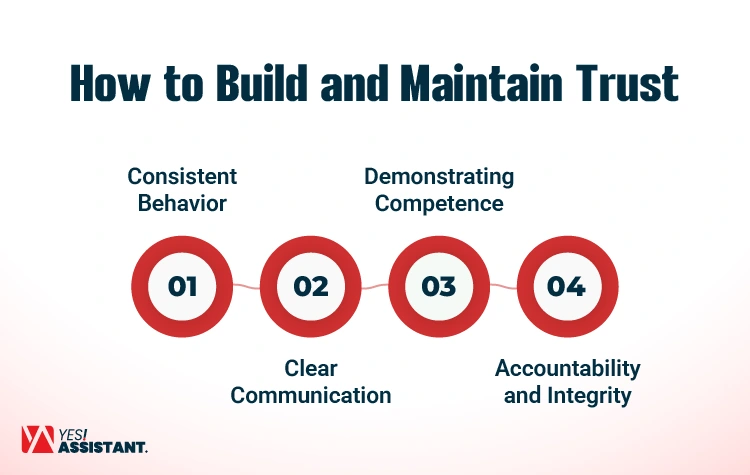
Consistent Behavior
There is no better way to build trust than by showing your team that your actions match your words. When you deliver on promises and maintain reliability over time, you demonstrate that you are a dependable partner in the business journey. Consistent behavior removes the guesswork for your employees, allowing them to focus on high-value tasks because they know what to expect from your leadership.
- What Values that Deliver Promises: Always determine about every commitment you make to your team or stakeholder with action to build concrete professional credibility.
- Why it will be Reliable: When you make consistent decisions and support functions, this creates a predictable and stable working environment.
- How to Avoid Leadership Gaps: Consistently work with strategic values that focus your behavior remains steady even during a financial crisis or market shifts.
Clear Communication
Be open, clear up confusions and build credibility across your company. When you emphasize open communication, you break down the barrier between your employees for mutual collaboration. Therefore, all employees will understand your long-term goals and strategic decisions.
- What to Inspire Your team: Set clear expectations, communications model and execute carefully. Set metrics to get insights on what type of communication-channel works best.
- Why it Reduce Information Blocks: Build a communication model that links inter-departmental flows which ensure your sales and marketing team work under an incorporated workflow.
- How to Build Collaborative Inquiry: Encourage your teammates to ask questions and share creative ideas without fear of rejection or criticism.
Demonstrating Competence
You don’t need to focus your expertise engaging with small, repetitive works. Better to assign your teammates to focus their competence as smart founders don’t do everything that has lower strategic values. Thus, encourage your employees to demonstrate skills and knowledge that creates a culture of excellence and improve performance and accuracy.
- What focus Professional Expertise: Apply high-value skills to strategic tasks that actually grow your business outcomes.
- Why It Provides Accurate Information: Collaborative culture ensures all data and insights shared with the team, helping them to execute operations with speed and accuracy.
- How to Develop skills: Identify potential leaders and encourage them to develop their competencies to ensure a strong succession plan.
Accountability and Integrity
When leaders respect teammates responsibility and honesty that builds trust, credibility and employees feel valued. In this case, employees focus on seriousness, when handling complicated situations and solving them. Companies also treat those dedicated people with rewards like promotion, increasement or incentives or profit shares.
- What Focus with Values: Behave with employees ethically and transparently in all interactions
- Why it’s Effective for Business: Engage with teammates’ empathy and interact accordingly. This creates great values and employees act like nurturing their family.
- How to Build Trust in Business: Taking responsibility for success and failures equally.
Conclusion
Trustworthiness starts before you prove your integrity. It begins with focusing on your belief in the Integrity of others. This is like you’re willing to enhance your trust first.
Trust in business focusing long-term goals, not just immediate outcomes. Consequently, “trust” has great outcomes including building new leaderships, grow businesses with innovations.
FAQs
How Does Trust Affect Decision-Making?
Trust affects decision-making though increases more engagement, collaboration, and generates new-ideas that grow business.
Can Trust Increase Productivity?
Yes, trust can increase productivity by fostering high-performance, speed-up decision-making and creating a creative communication culture can significantly increase productivity.
What Are the Benefits of Trust in Relationships?
The key benefits of ‘trust’ in relationships increase mutual respect, long-term strength against challenges.