
How Email Management Drains Focus: Fix It Before It’s Too Late
Many people work hard all day but struggle to finish their most important tasks. The main cause of the problem is the constant sound of new messages. Managing email without planning drains your focus; as this forces your brain to switch tasks between different stages without a break.
When you think inbox checking is a non-stop small task, lose your deep focus that could solve the high-impact issues. Learning why this happens helps you to stop reacting to others and start leading your own workday.
Why Email Disrupts Cognitive Flow?
When you are working on a big project, your brain is sparking on aiming at building a long-term strategic mission. During this time, you stop to check an email that interrupts your core functions for a while and restart again and again. This distracts your main focus every after interruptions which could finish within fastest and smartest work.
Constant Task Switching Reduces Efficiency
Think of your brain like a computer that has to close on a heavy program and open another interruption when you check your inbox. This constant restarting, exhausts and slows down everything you do within the whole day.
- Context rebuilding takes time: It often takes more than 20 minutes to get back to full focus after a single interruption.
- Errors increase after interruptions: When your mind is split between an email and a report, you are much more likely to make simple mistakes.
- Deep focus becomes difficult to sustain: Your brain loses the “power” it needs to stay on one hard task for a long time.
Notifications Trigger Reactive Behavior
A ping or a red bubble on your screen actions like a loud alarm that you feel forced to answer immediately. This turns you into a fighter who is always putting out small fires instead of a builder who is creating something new.
- Encourages shallow work habits: You get used to doing quick, easy tasks that don’t require much thinking.
- Creates urgency bias for low-priority tasks: You start to think that a fast reply is more important than a big goal just because the notification is “new.”
- Reduces your proactive planning: You spend the whole day reacting to what other people want instead of following your main focus.
Open Loops Increase Mental Load
An unread email is similar to a door you left halfway open. Your brain will always look back at you to see if it needs to be closed. Besides, these open loops keep your mind away from regular work, which reduces working memory capacity.
- Increases cognitive load: While you’re working your concentration is divided between ongoing and unfinished work, which increases cognitive load.
- Causes background stress: Though you aren’t looking at your inbox, your brain feels worried about what might be waiting for you.
- Reduces working memory capacity: You have limited brain space to solve problems because your inbox is taking up too much time.
As an owner, you’re managing everything at glance to be aware of what’s going on daily. But daily repetitive work can drain your core activities; thus, many owners choose remote virtual service to be free from daily burnout. Your remote team
member can perform daily administrative tasks, besides serving you accurate information for your strategic decisions.
How Email Overload Impacts Productivity
A full inbox changes how you work from the moment you wake up. You lose the day because your time is divided into small tasks rather than thinking on core strategic tasks that ensure business growth. This often creates inbox chaos, which becomes a growing problem for many people trying to build something big.
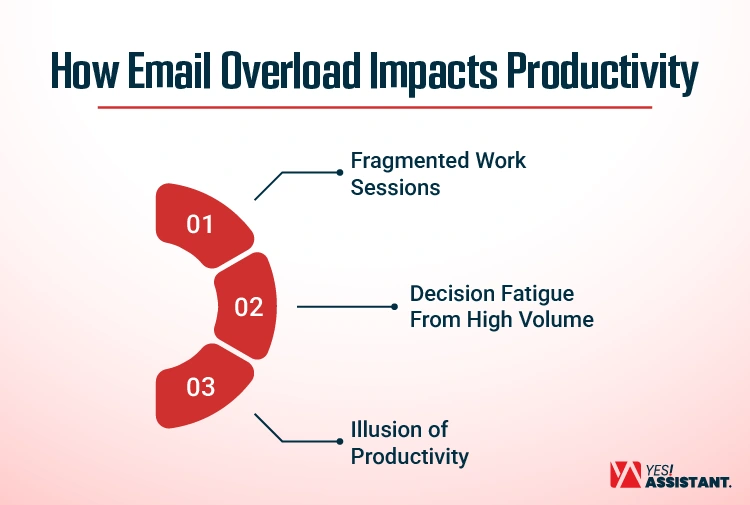
Fragmented Work Sessions
If you check your mail every few minutes, you never get the chance to work on anything difficult. Before you touch your mobile phone, or social media, checking your important emails makes your workday successful.
- Short break: You have only a few minutes to complete your work before the next assignment comes.
- Surface Thinking: You have limited time to solve difficult problems that need deep thought.
- Lower Quality: Focusing too much on email, your tasks quality will not meet the standard.
Decision Fatigue From High Volume
Email steals your mental energy that is required for important work. You decide what to do with different messages as your brain becomes tired of making big-decisions that are really essential for your business.
- Burned energy: Identify essential emails to keep and delete the reminder of the backlogs that cause burning energy.
- Wrong selection: You are getting tired in the afternoon that leads to making mistakes.
- Morning downtime: Spending your valuable time on emails means you waste your maximum brainpower on small things.
Illusion of Productivity
Replying to every email, you feel like you’re winning, by your speed all day busy with emails. It is easy to spend eight hours in your inbox means you stay busy but never grow your business.
- Wrong choice: You’re busy and successfully completed the work at hand, but you didn’t achieve your important goals that have high-values.
- Improper Priorities: Pass the day with solving others problems rather than focusing on your own work.
- Stuck in Place: Engage with small and repetitive tasks that silently kill productivity without you realizing it.
Key Statistics On Email and Focus
It takes 23-minutes to return and start focusing on your previous work. Just look once at email, it will distract your focus which is common time leaks in growing business. The report shows an email can keep you out of focus and push your core activities from actual work to the side.
Time Lost to Email Management
Engaging too much in reading email, nearly half your workday passed with reading and writing messages. The constant task switching wastes hours that you could spend on big projects or growing companies. Your brain isn’t a robot, so constant switching can waste your time and reduce efforts.
- Many owners spend 2 to 4 hours daily dealing with important emails.
- Your brain needs 20 minutes to start focusing on a hard task after you get interrupted by a ping.
- This small low-value work can eat up your important time that could be spent on high-quality work.
Frequency of Inbox Checking
Consistent checking email is a habit as if you’re taking breath. Instead of deep work, you treat email like a social media feed that needs to be refreshed every few minutes. Keeping your inbox open all day creates a mental tool of repetitive work that makes it impossible to stay focused on one goal.
- The average person looks at their email every 5 or 6 minutes, which never leaves a space in your mind to think about core activities.
- Opening an email tab all the day, like inviting distractions at your high-impacts of tasks.
- One-by-one checking email feels fantastic but creates another cognitive burnout for busy professionals.
Practical Ways To Reduce Email Distraction
To make your inbox “zero”, you should plan for sorting email, creating a standard folder, and reading, deleting and organizing emails. Therefore, you need to allocate a specific “time-box”, turn-off notification to avoid destruction, and keep your device remote. You may follow standard rules to complete, check, reply, sort and delete unnecessary email from your list.
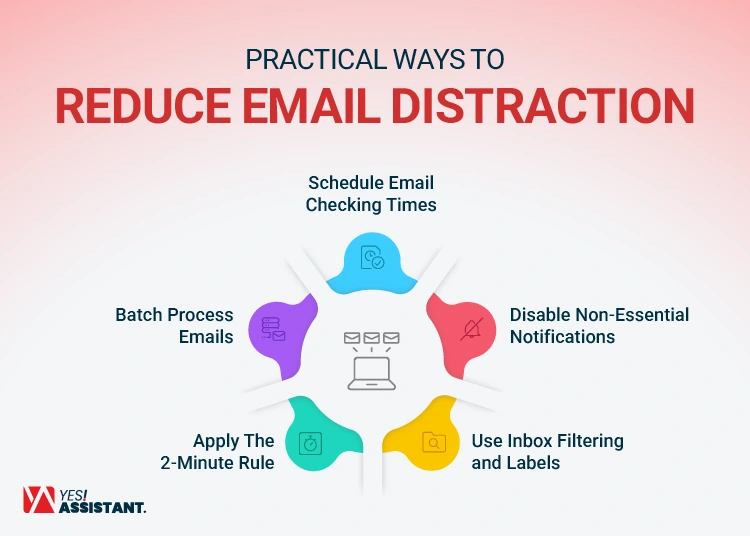
Schedule Email Checking Times
Consistently looking at your phone after it buzzes, rather you can choose a specific time a day to open your inbox. This helps you to stay in control of your schedule instead of interrupt from your main focus.
- Pick a morning, noon, and afternoon slot to handle all your messages at once.
- Close your email app while you are performing high-value work.
- Focus on big projects first before you even touch your inbox in the morning.
Disable Non-Essential Notifications
Identify which email server activates on your devices (Gmail, Outlook, Yahoo!Mail). Turn-off email alerts or notification devices to avoid sudden pings or popups that lead to distractions.
- Turn-off timers or alerts notification and check email at your defined time.
- Set up “don’t disturb mode” to keep your concentration on core jobs.
- Close apps from your devices and focus on high-value works.
Use Inbox Filtering and Labels
Setting up automatic rules with your inbox and freeing you from boring work . You can set rules with your inbox to put all newsletters in one folder and receipts in another. So, they don’t clutter up your main view.
- Create folders under high priority that you only see the most important notes first.
- Use rules to send junk mail straight to the trash or a “read later” pile.
- Keep your main screen clean; thus, you don’t feel overwhelmed when you open it.
Apply The 2-Minute Rule
If you see an email only needs a super short answer, do it right then and there. If it needs a lot of thought or research, put it on a calendar or a “to-do” list for later. So, it doesn’t stay stuck in your head.
- Reply immediately if it takes less than 120 seconds to finish the task.
- Move long tasks to a separate list. So, you don’t forget them.
- Clear out the easy stuff quickly to keep your inbox from piling up.
Batch Process Emails
Processing your email like a single task makes you much faster at finishing it. When you stay in reading email mode for thirty minutes, you can complete reading and replying to more emails. If you spend one hour every day reading and writing email, you can’t complete your tasks.
- Answer all your messages in one batch, and keep your brain focused on core activities
- Batch processing email can stop you switching between typing and other hard tasks.
- Finish your email session completely before moving back to your deep work.
Key Takeaway
At the end of the day, email is a tool that helps you to build relationships with your clients, stakeholders and teammates. But constant switching and decision fatigue can turn your productive morning into a drained working day. However, set clear boundaries to protect your mental energy and keep your focus free of distractions.
Significantly, you need to define a schedule time to check emails and keep your workplace silent to protect your mental energy. Therefore, taking control of your inbox is the first step towards recovering your working-day. This ensures to save your high-valued time for setting your business goals.