

Why Task Switching Lowers Efficiency: Here’s What You’re Missing
When you jump from one task to another, you feel overwhelmed and unproductive. Again, losing your focus leads to distraction and stress, ultimately lowering your task quality. This will lead to increased errors, rework, and disrupted operations.
In this blog, you’ll learn why task switching lowers your productivity. This includes cognitive switching costs, increase error rate, reduce your deep work capacity. Find effective ways to fix those issues with simple steps, like block time, batch similar tasks, and reduce interruptions.
What is Task Switching?
Task switching is the brain’s ability to quickly and effectively switch between different tasks or sets of rules. It’s a vital skill for individuals who plan and monitor multiple tasks in the same timeframe. However, the process of task switching is harder than repeating a task, often causing slower reactions and more mistakes.
Difference Between Task Switching and Multitasking
The comparison between task switching and multitasking – task switching is rapidly alternating attention between different tasks. While multitasking is the attempt to perform multiple high-attention tasks simultaneously. Most of the multitasking is just rapid task switching which reduces productivity, increases errors, and drains mental energy.
| Particulars | Task Switching | Multitasking |
| Definition | Switching from one to another tasks for sudden requirements. | Performing one more task within the same timeframe. |
| Cognitive Mechanism | Separate attention across multiple tasks (often results in an “illusion” parallel work). | Actively unloading one task set from working memory and loading rules for the next. |
|
Performance Cost |
Dual-task interference happens when your brain tries to do two things at once. Therefore, task quality decreases and creates errors. | Even if you think you are multitasking, your brain is actually jumping “in and out” and every jump has a price. |
|
Feasibility |
This effective only when one tasks is automated, and the other conscious. | Necessary for managing multiple responsibilities, but task overload leads to cognitive fatigue. |
|
Impact on Quality |
Leads to “shallow” work and missed details in all parallel activities. | Causes “attention residue,” where thoughts of the previous task interfere with the current one. |
Why Task Switching Reduces Productivity?
You start deep work that aligns with your goal, but drive to another task for operation needs. It certainly distracts your mind and takes 20 minutes more to concentrate on previous work. This will cost mental switching, attention burnout, increase error rate and reduce deep work capacity.
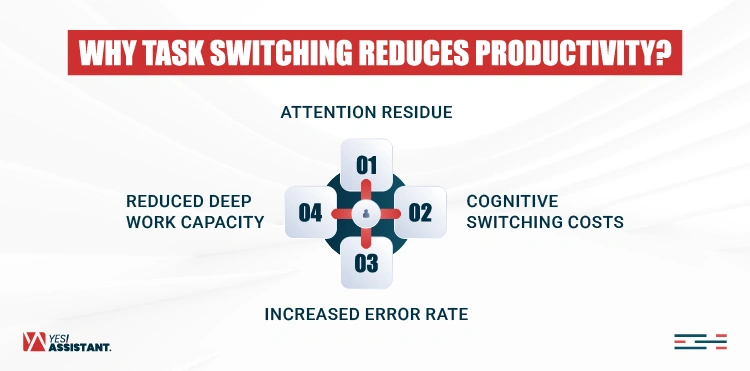
Cognitive Switching Costs
Always focus on one task, as multitasking is not as effective as concentrating on a single task. Your brain is not set up with multiple cognitive tasks simultaneously. Study indicates that when switching from one to other tasks, it costs up to 40% of your productive time.
This leads to increased costs due to poor tasks organization and decreased overall business efficiency.
- Lost Tasks Time: When switching to other tasks, your brain has to reset and refocus at previous tasks. According to study, any transition can take anywhere from a few seconds to several minutes, leading to loss of productivity.
- Causes More Mistakes: Constant switching between tasks increases error rates. Significantly, when you split your attention, it reduces your ability to process information deeply and accurately.
- Increased Stress: Giving Attention to multiple tasks create cognitive fatigue, lead to mental burnout and decrease your decision-making quality after a while.
Attention Residue
Instead of managing one task deeply, you switch to multiple tasks, and your attention is fragmented. Each time shift from tasks, your brain resets the context and slows down productivity.
- Decline in Quality: A fragmented attention spoils your deep concentration, causing more task errors. This results in rework for fixing those errors.
- Decision-Making Conflicts: Context switching causes overthinking about specific things, and interrupts making quick decisions. Thus, you ask for help to understand the situation.
- Facing Too Many Distractions: If you have not enough time for thinking deeply, it will uninterrupt your thought. Which leads to surface-level solutions instead of precise solutions.
- Feeling Completely Drained: Consistent switching creates annoyance, mental burnout, and making small or no progress in the process.
Increased Error Rate
Think of a chef, working a high–paced kitchen, cooking multiple items simultaneously instead focusing on one VIP item. Likewise, task switching reduces your productivity because the brain does not process multiple tasks in parallel. Switching between tasks costs time and energy.
- Take a short Break: When moving to new tasks, the brain must load a new set of rules and goals into working memory. If you are unable to complete tasks, you already applied wrong rules to the current stimulation. This leads to task confusion errors.
- Multi Step Instruction: A brain can hold 3 to 5 parts of information at once. The brain drops information when it is overloaded.
- The Temporary Offline Moment: Rapidly switching your focus can create a temporary blind spot. Therefore, your brain is to process new visual or cognitive inputs which return to previous tasks. This increases information errors.
Reduced Deep Work Capacity
Deep work is focusing on just one thing without any distractions. This is where your best ideas come from. When you switch tasks too much, you lose the ability to do the hard work.
- The Slow Start Problem: When you go back to a task, your brain remembers where you stopped.
- The Distraction Habit: If you continuously check your phone when you get bored, your brain learns to be easily distracted. Consequently, you will not concentrate for ten minutes to finish a school project or a work report.
- Surface-Level Thinking: You are rushing means you are doing easy parts of a job. Thereupon, you never dive deep enough to the big, important problems.
To protect your focus from these disruptions, many professionals utilize a virtual assistant service to handle repetitive operational tasks. By assigning administrative demands to a dedicated partner, you can maintain your deep work capacity and avoid mental burnout.
How to Reduce Task Switching?
Take the right steps to reduce task switching. You can use blocking schedules, batch similar tasks, stop digital response, and continue with a single task rule. This can strengthen your task switching to effective completion.
Use Time Blocking
Regular meetings, client appointments or using message chat can interrupt your concentration. Use a calendar to set specific times for important work. This helps to stop mental burnout that drops context switching on the day.
Steps to reduce task switching using time block strategy
- Book specific time on the calendar to use time blocks for proper task execution.
- Groups similars tasks into a single time block
- Block time for meetings, lunch time and personal routines before setting the calendar.
- Review time blocks, what time you spend more, and adjust those issues for the future.
Group Similar Tasks
Think about the laundry. You don’t wash one sock, dry it and fold it before starting the next sock. That would take all day. Better, you do all the washing at once.
- Try to send all messages and answers at the same time; therefore, your brain stays in writing mode. This stops you from wasting energy by switching between different types of thinking.
- You can set specific times for small jobs like filling papers or checking messages. So, complete all the tasks at once and make your afternoon tidy.
- Group tasks save your energy when you don’t need to restart your brain repeatedly. This helps you finish your work much faster and can give you comfort sooner.
Reduce Digital Interruptions
Notifications break your focus, even if they are short. Every alert stops your work and interrupts your concentration. You can stop these digital interruptions with the following steps.
- Close apps that you don’t use anymore and silence your phone. If you don’t hear a message alert, your brain will not knock you to check notifications.
- Always try to keep your phone out of the workplace, If you can’t see it, you won’t think about it more.
- Set an alert on your phone, like, “I’m busy right now, don’t interrupt me.” Therefore, people will not send messages, it helps your brain to stay calm and steady.
Apply the Single-Task Rule
The single-task rule refers to pick one job and do not stop until it is finished. It has opposite side to handle everything to do at once. This is how multitasking reduces business efficiency and makes you move slower.
- You must start your day by choosing the most important thing you need to do. Do not let yourself start a second job until you complete the first job.
- Remind yourself that you are doing the tasks that are most important in your life. This will keep your brain thinking or avoid switching you from the tasks.
- Before moving into another task, you should finish an ongoing task. Even if a small job pops into your head, write it down in note paper and stay focused on your current task. This prevents how admin tasks silently kill productivity pulling you away from your big goals.
Key Takeaways
The practical effect of task switching, like moving rapidly between different and irrelevant tasks, significantly drains your efficiency and productivity. This demonstrates a cognitive cost associated with task switching, primarily distracting your mental focus and reloading context. Which ultimately leads to errors and decreases quality of work.
Therefore, take important steps to reduce task switching through implementing time blocking by dedicating specific tasks, minimizing all distractions. Besides, you can group similar tasks, complete tasks which are now at your hand. Additionally, you can use a reliable system to immediately capture new ideas, requests and reminders.