


How to Manage a Remote BPO Team Effectively: Strategies and Challenges
A business can reduce its operating costs and get access to global talent with the help of a BPO service. This is why many businesses are getting interested in managing a remote BPO team along with an internal team. Studies show that remote BPO teams can be up to 15% more productive since they don’t commute to their workplace and have fewer office interruptions.
However, you often need to follow some specific strategies when your workers are supporting you from distant settings. This is because there are some challenges you may experience while managing a remote team. In this blog, we are going to explore the effective strategies you can follow to operate a team that might be spread across different countries or regions.
Key Takeaways
- A remote BPO team is a group of workers provided by a third-party service to handle specific activities for you.
- It is essential to establish clear goals and expectations to keep your remote team aligned with your business goals.
- To establish effective communication and stay updated on the tasks or activities remote workers are handling, you can use tools such as Slack, Zoom, Google Meet, or Microsoft Teams.
- Clear performance tracking metrics, or KPIs, can help you to remain specific and result-oriented while measuring the effort of a remote BPO team.
- It is very important to take effective measures to reduce data security risks when using remote workers because they don’t work under your direct supervision.
- To improve collaboration and communication with your remote team, you can create overlapping time schedules or work hours.
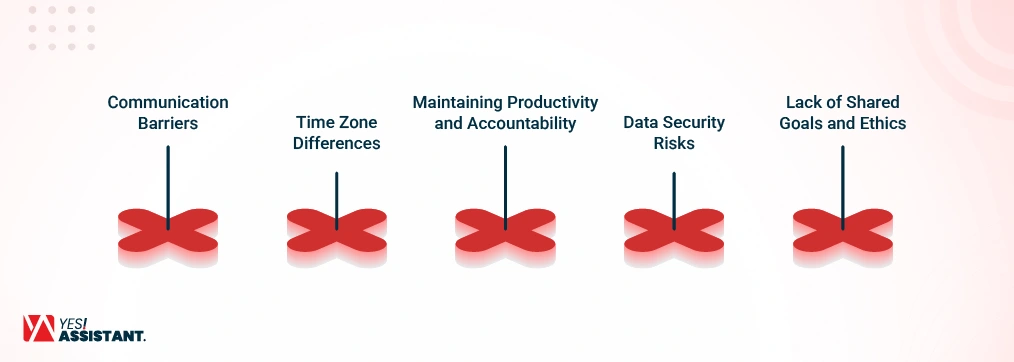
- Some of the major challenges of managing a remote BPO team are communication barriers, time zone differences, data security risks and a lack of shared goals and work ethics.
What Is a Remote BPO Team?
A remote BPO team refers to a group of workers from a third-party service whom you hire to perform specific activities such as customer support, accounting, or call center management. Using the remote workers of BPO services gives you more flexibility and scalability.
Here are some key benefits of using a remote BPO team for business:
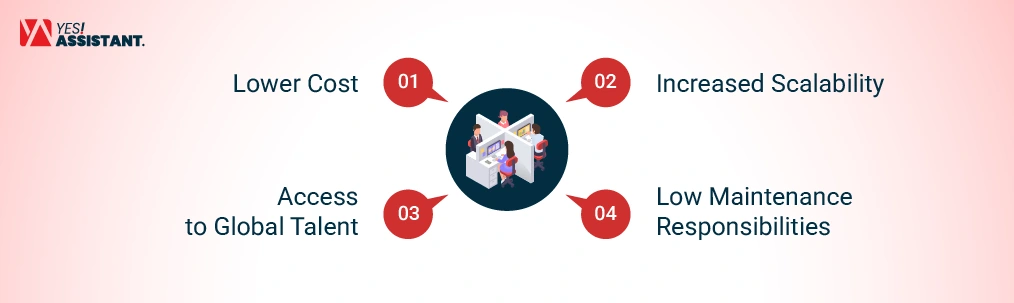
- Lower cost: The cost of hiring a remote BPO team can be lower for a specific task such as social media management or customer support.
- Increased scalability: The size of the team provided by a BPO partner can be scaled based on your workload.
- Access to global talent: A BPO provider can give you access to global talent, which can change your business and help you grow quickly.
- Low maintenance responsibilities: The BPO partner manages the team, including recruitment, onboarding, and training of workers.
8 Strategies to Manage a Remote BPO Team
A BPO service can help you improve productivity and help you achieve business growth if you know how to collaborate with them efficiently. Here are some strategies you should follow:
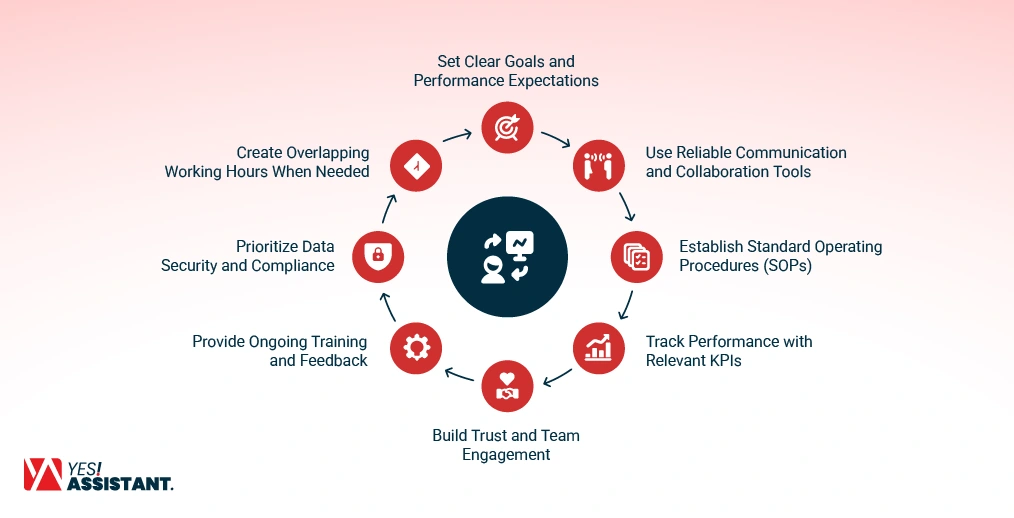
1. Set Clear Goals and Performance Expectations
When you hire a BPO team, they might try to deliver the best service to you. But if their effort doesn’t align with your business goals, then most likely they won’t be able to produce your expected output. This is why you should establish some clear goals and performance expectations for them.
There is a framework you can use for this, known as SMART. It can be very useful for setting specific, measurable, achievable, relevant, and time-bound goals. An example of a SMART goal can be to reduce errors in data entry or processing rate by at least 20% within 3 months.
2. Use Reliable Communication and Collaboration Tools
Studies show that about 29% of remote workers consider communication gaps a major challenge. Communication and project management tools help you coordinate with your team members who are working on your project. Some of the popular communication and collaboration tools businesses use are Slack, Asana, Trello, Microsoft Teams, Google Meet and Zoom.
It is necessary to secure your communication and project resources while working with a remote BPO team. Some of the techniques you can use to protect your data and files are VPNs, end-to-end encryption, and MFA. Try to create a centralized platform for sharing files and resources. This is because a cluttered system can slow down teams and have a negative impact on team productivity.
3. Establish Standard Operating Procedures (SOPs)
Standard Operating Procedures, or SOPs, refer to documents that includes an establish ways or steps to perform specific activities. A business needs to establish clear SOPs to get consistent output from a remote team or virtual assistant. So, it is better to create a documented workflow for specific repetitive tasks.
Here are the steps that you should follow to create SOPs for a remote BPO team:
- Step 1: Create a list of tasks: Identify the repetitive tasks that your remote team will need to perform frequently for you. Include some key details such as the risk of performing those tasks, common errors that can happen, and what new team members need to know.
- Step 2: Select a format: There is no specific format that you must follow for creating an SOP for the remote team. An SOP can be created in a checklist, flowchart, or video walkthrough format. Sometimes, you can also use multiple formats for creating an SOP. Just choose the right one based on the complexity of tasks and the individuals who will be responsible for performing them.
- Step 3: Write your SOP: Start writing your SOP after selecting a format. Try to be consistent with the format you choose for writing the SOP of a particular task. This is because if you continuously switch your format, it can be difficult for the remote team members to follow it. After writing, check whether you have included the key details such as purpose, scope, owners, tools and resources, expected outcome, and other information.
- Step 4: Take feedback and input from team members: Before outsourcing your business function and writing SOPs, you should collect feedback from your team members. Ask an in-house employee about how they perform a particular task and document the steps for it. Then, you can ask another team member to check it and detect issues.
- Step 5: Share and update the SOP: An SOP should be saved or stored in a centralized location so that both your in-house and remote team members can access it. The work process of your business may not always be the same. So you need to regularly review and update your SOPs.
4. Track Performance with Relevant KPIs
It is essential for a business to monitor and evaluate the performance of remote BPO workers against the business objectives. This measurement should be done using relevant KPIs for performing a task.
For example, when using a remote BPO team for customer-handling tasks, first-call resolution rate (FCR) tracks the number of issues that agents resolve during the first interaction. Other key metrics for measuring the performance of remote customer service agents include CSAT and AHT.
A clear performance metric helps you establish clear accountability for the remote BPO team. This is because without using any metrics, measuring your team’s performance will basically depend on a few basic factors, such as meeting deadlines or how soon they deliver tasks. That type of measurement process can easily create performance issues.
5. Build Trust and Team Engagement
A team works best when its members can trust each other and share their feedback on work progress. A study conducted by Slack showed that a worker can focus 2.1 times better when they feel trusted by their team. But building a relationship with a remote team is not easy. This is because, unlike an in-house team, you can’t meet them physically.
However, there are many tools and technologies that you can use to communicate with your remote workers and teams. Some of the tools that you can use for having a video conference with your BPO team are Google Meet, Zoom, Microsoft Teams, or Adobe Connect.
You can create weekly or monthly meeting events to follow up with your remote team. They can share their progress reports and common challenges. This will keep you informed about how they are handling your business activities.
6. Provide Ongoing Training and Feedback
BPO services regularly provide training to their employees so that they can handle their clients’ tasks efficiently. But there are situations when you may need to provide training and feedback to your BPO team. It can happen when you have made a change to your work process or integrated a new tool for workflow management.
This type of training will ensure that your remote BPO team can handle your tasks, maintaining the process and standards you expect. Giving feedback about their quality of work is also necessary because it helps them to correct their approach to performing specific activities for your business.
A BPO manager can use your feedback to review the performance of their agents in the following areas:
- Technical expertise: It usually refers to the ability to use tools and software for performing various activities.
- Communication skills: Ability to communicate with customers and team members in an effective way.
- Customer support: The level of skills an agent or virtual assistant has for providing support to customers and resolving their issues.
- Teamwork and collaboration: How a remote BPO worker collaborates with others when working on a project.
- Leadership: The ability of a remote worker to guide or supervise other workers.
- Sales ability: How an agent is performing in sales activities like lead generation or setting appointments.
Ongoing training and feedback help ensure that you get the best performance from your remote team. A BPO provider can improve its service and become more capable of meeting your expectations when you share useful feedback with them.
7. Prioritize Data Security and Compliance
A remote BPO team can handle some sensitive information about your business and customers. If that information gets exposed, your business can suffer reputational damage and compliance issues. This is why you need to define some security expectations for your BPO service provider or remote BPO team.
It is essential to choose a BPO service provider based on security certifications, data security policies and compliance capabilities to reduce data security risks. At the same time, you should use a data governance strategy for your business.
It is essential that you regularly review who has access to your data from the remote BPO team. If your remote BPO team member or virtual assistant no longer needs access to records, documents, or files, remove their access.
8. Create Overlapping Working Hours When Needed
Coordinating with the remote BPO team working in different time zones can be difficult. This is because you and your in-house team might finish your shift when they start their work. So you need to set preferred work hours for the remote BPO team members when you need to collaborate with them or have a meeting.
This can create overlapping work hours, but it will ensure that you both work together. So when drawing an agreement with a BPO provider, you need to set a preferred time for different remote teams. Then, you can manage two time zones on your Google Calendar. For example, an operational team or virtual assistants can work with you while the remote customer team will work when your in-house support team won’t be working.
Challenges in Managing a Remote BPO Team
Using a remote BPO team for your business can help you reduce the cost and complexity of hiring employees. However, there are also some challenges, including the following:
Communication Barriers
There are many tools or channels you can use to maintain communication with a remote team. But there are several challenges you may experience:
- Lack of nonverbal cues: When you communicate with a virtual assistant or remote worker using text-based channels, they can often miss many nonverbal cues. This can reduce their ability to interpret your message.
- Technical challenges: Network issues or server problems can make it difficult for you to connect with a remote team.
- Cultural differences: A remote BPO team may not be able to interpret your messages clearly due to cultural differences. Sometimes, you can use idioms or local terms, which might be difficult for them to understand.
Time Zone Difference
Establishing live communication and coordinating with a remote BPO team can be difficult due to time zone differences. Sometimes, you may need the support of a worker outside their regular work hours. A remote team member can also try to reach you at a time when you may not be active. This type of problem can cause delays in task processing or decision-making.
Maintaining Productivity and Accountability
It is not usually possible to directly monitor or supervise the activity of a remote BPO team. It’s because BPO service providers usually keep a manager or someone with a similar role to monitor their workers.
Some BPO services keep remote employees who may work from home or their own location. This means that they may not work under the direct control of someone. So in that case, it might be difficult to identify whether they are using their work hours productively and paying attention to their work.
However, there are some tools that you or your BPO partner can use to monitor the activities of remote workers, such as Hubstaff, ActivTrak, Connecteam, and DeskTime.
Data Security Risks
According to a survey report, about 20% of organizations experience data breach incidents from their remote workers. Businesses can provide regular training and strict instructions about data handling practices to their in-house teams. They use secure networks, access control, and other data security practices. But remote workers can use their own network or device for working. They can also work from home, which can increase the risks of data theft or breach.
In-house team members usually have strong alignment with your goals, and they share some common work ethics. This is what you can’t always expect from remote outsourcing team members. They will help you to achieve your goals, but their responsibilities will be defined by an agreement. An internal team usually has a strong relationship with its company and can often handle additional responsibilities when necessary.
Conclusion
A remote BPO team can help you save costs and reduce the complexity of recruiting additional staff for your business. It is necessary to follow some strategies to get the expected performance from your remote outsourcing team. Among these, setting clear goals and expectations, establishing SOPs and tracking performance are the major ones. There are also some specific challenges that you should be prepared to face when managing a remote team, such as communication barriers, time zone differences, and data security risks.
Frequently Asked Questions
How do you effectively manage a remote BPO team?
You need to have some strategies to manage a remote BPO team and keep them aligned with your business goals. It is essential to establish reliable communication, clear goals and expectations, and a strong performance tracking and measurement system to operate a remote team successfully.
What tools are commonly used to manage remote BPO teams?
Some of the tools that are commonly used to manage the productivity of remote team members include Hubstaff, ActivTrak, Connecteam, and DeskTime. You can use tools like Zoom, Google Meet, Slack or Microsoft Teams for communicating with your remote workers. For project management, you can use Asana, Trello, ClickUp, and some other project management tools.
What are the biggest challenges of remote BPO team management?
Some of the biggest challenges of remote BPO team management are communication barriers, time zone differences and data security risks.
How do you measure the performance of a remote BPO team?
It is necessary for you to use some defined metrics or KPIs to measure the performance of a remote BPO team for a specific task, such as CSAT, AHT, accuracy rate or error rate.
How can businesses improve communication with remote BPO employees?
A business needs tools like Slack, Google Meet, or Zoom to establish reliable communication with the remote workers. They can also create overlapping work hours when necessary to have live communication with the remote team members.