


12 Benefits of Business Process Outsourcing for Growing Businesses
Business process outsourcing is a formal operational model where you contract an entire function to a specialized service provider on an ongoing basis. This strategic framework delivers immediate advantage by reducing your operational costs. You can get access to specialized expertise, allowing rapid scalability, and freeing internal staff to focus on core revenue growth.
What is Business Process Outsourcing?
Business Process Outsourcing (BPO) is the practice of contracting with a specialized external party that can handle your company’s daily repetitive non-core tasks. Unlike a freelancer or contractor, BPO partners efficiently manage your daily repetitive tasks on a long-term, functional-level basis. Businesses mainly delegate these operational responsibilities, like payroll, customer support, and IT services, under Service Level Agreements (SLAs), a documented contract between the business and the customer.
The BPO partners strictly follow a contractual framework, ensuring the partnership operates under an enterprise solution rather than short-term gigs or bids.
BPO vs. Outsourcing vs. Offshoring: What’s the Difference?
Many business owners confuse these three distinctive terms due to overlap. Outsourcing is the broad umbrella term for hiring any external party to handle work. Offshoring is strictly a location descriptor that means moving operations to another country.
Furthermore, business process outsourcing services are the formal model where you contract an entire business function to a specialized provider on an ongoing basis. Understanding these differences helps you choose the right strategy for your business.
| Term | Definition | How it relates to BPO |
| Outsourcing | Hiring an outside party to perform tasks or services | The overarching category that includes BPO as a specific framework |
| Offshoring | Relocating business processes to a distant foreign country | A geographical choice because BPO can be done onshore or offshore |
| BPO | Contracting an entire business function to a specialized provider | The structured ongoing operational model under the outsourcing umbrella |
Types of Business Process Outsourcing
Companies group these services by the type of work they do and where the providers are located. Every company approaches outsourcing with different organizational goals. You can choose any model based on your functional needs or your targeted geographic location.
By matching these options, you can choose an option according to budget and preferences.
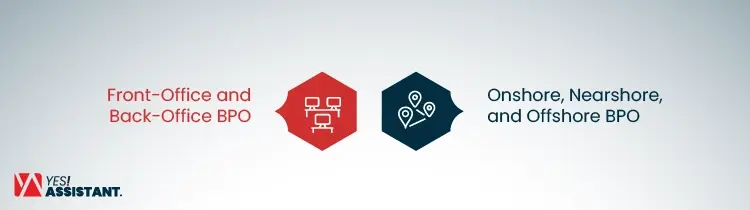
Front-Office and Back-Office BPO
Front office tasks involve direct interaction with your customers. Common examples include customer support and sales or technical help. In contrast, back-office support services focus on internal business operations. This work includes payroll and accounting or data entry and human resources.
Onshore, Nearshore, and Offshore BPO
Choosing a third-party partner depends on your budget and time zone requirements. Onshore means using a provider in your own country. Nearshore means hiring talent in a neighboring country with a similar time zone. Offshore involves contracting a provider in a distant country to maximize your cost savings.
| Type | What it means | Example |
| Onshore | The provider operates within your own country | A Texas business hires an administrative support agency in Ohio |
| Nearshore | The provider operates in a nearby country or timezone | A Chicago firm contracts a customer support team in Mexico |
| Offshore | The provider operates in a distant foreign country | A London startup delegates technical support to an agency in the Philippines. |
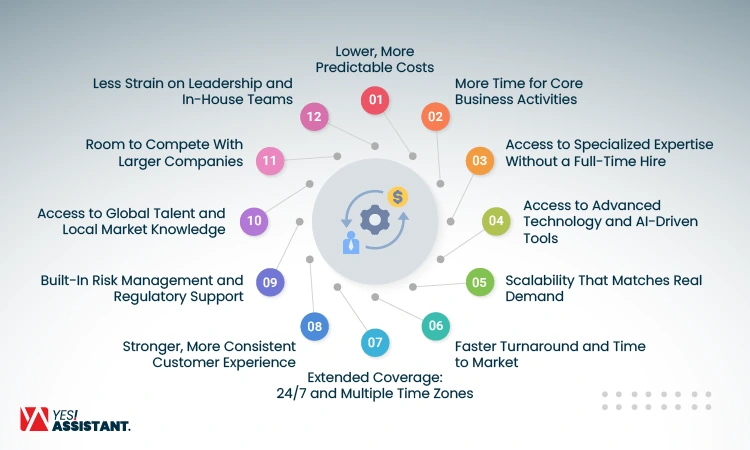
12 Benefits of Business Process Outsourcing
Delegating non-core functions to an external provider offers strategic advantages by optimizing administrative workflows and allowing companies to focus on growth without adding internal resources. This approach facilitates efficient management of daily tasks, such as payroll and HR, through specialized outsourcing models.
1. Lower, More Predictable Costs
Hiring full-time employees requires fixed expenses that put a heavy burden on your cash flow. This operational model converts high fixed “in-house” overhead costs into variable and highly scalable spend. You only need to pay for the exact service you used based on production volume or support hours.
- Reduce expensive recruiting fees and onboarding costs.
- Remove the burdens of employee benefits, like health insurance and payroll taxes.
- Save money on office space rents and expensive computer equipment
- Provide clear billing transparency through predictable monthly vendor invoices
2. More Time for Core Business Activities
Managing daily administrative tasks wastes your valuable time that you could spend on strategy. Many founders lose sleep due to lack of scaling capacity. Outsourcing these routine tasks frees your core team to focus completely on revenue generation.
- Removes daily administrative bottlenecks from the leadership schedule.
- Allows your team to focus on strategic product development.
- Keeps your internal staff focused on closing key sales deals.
- Gives business owners more time to focus on long-term growth plans.
3. Access to Specialized Expertise Without a Full-Time Hire
Finding and hiring top-level specialists is incredibly difficult and expensive. You can access highly trained professionals in technical fields without paying an executive salary. You can avoid salaries, benefits, or bonuses for the work you don’t need year-round.
- Provides immediate access to certified accounting, IT & HR experts.
- Eliminates the long training periods required for new internal staff.
- Secures specialized talent for short-term projects or technical campaigns.
- Delivers enterprise-level operational quality to growing small businesses.
4. Access to Advanced Technology and AI-Driven Tools
High-level service providers invest heavily in advanced technology infrastructure that small businesses cannot justify building. You secure direct access to automated workflows and advanced analytics dashboards without any initial capital expenditure. This model delivers immediate AI-enhanced performance while completely avoiding software procurement risks.
- Optimizes advanced robotic process automation for repetitive data entry tasks.
- Deploys advanced predictive analytics platforms to optimize your supply chain.
- Utilizes current AI-assisted customer service tools to accelerate response times.
- Eliminates expensive ongoing software licensing fees and update maintenance costs.
5. Scalability That Matches Real Demand
Hiring or laying off internal resources during market shifts creates massive operational conflicts. Third-party teams scale up or down instantly to match your current task volumes. This flexibility is quite difficult for seasonal e-commerce brands and rapidly growing startups.
- Increase support capacity quickly during the holiday shopping season.
- Reduce operational expenses immediately when consumer demand slows down.
- Avoid mental pressure even when daily work volume increases suddenly.
- You can easily cut additional resources and prevent legal complications.
6. Faster Turnaround and Time to Market
Building an internal team requires months of recruitment and training. It is better to establish external service providers, deploy skilled operational processes, and train the team from day one. This strong setup helps you launch new products, conduct market research, or introduce new services.
- Accelerates product deployment by bypassing lengthy internal setup stages.
- Deploys experienced production teams that understand complex industry workflows.
- Removes operational delays caused by internal staff training gaps.
- Secures a strong competitive advantage during time-sensitive product launches.
7. Extended Coverage: 24/7 and Multiple Time Zones
Managing a 24-hour working shift requires multiple shifts and complex scheduling. Global delivery teams naturally solve this problem by following several international time zones. Therefore, your business can manage continuous operations and offer multilingual customer support without disturbing your local teams.
- Provides immediate customer support during late-night and weekend hours.
- Stop arranging internal overnight shifts and paying extra.
- An external team delivers smooth customer support in multiple languages for global customers.
- Ensures critical back-office data processing continues even after internal office hours.
8. Stronger, More Consistent Customer Experience
Extended internal team size requires time to maintain steady service quality during busy operational periods. Specialized service partners deploy dedicated agents who fully focus on entire customer interactions. These teams utilize a standardized quality assurance framework to keep your brand communication consistent.
- Maintains response times by tracking clear service level metrics.
- Utilizes professional quality assurance supervisors to monitor performance consistency.
- Delivers structured agent training that aligns with your specific brand voice.
- Improves satisfaction scores through dedicated focus on consumer resolutions.
9. Built-In Risk Management and Regulatory Support
Building internal compliance frameworks requires years of deep industry expertise and significant financial investments. Established providers bring mature regulatory processes and specialized corporate data protocols directly to your operations. This comprehensive operational design transforms compliance demands into a distinct competitive advantage for your brand.
- Deploys data management systems that meet strict global privacy standards.
- Maintains updated knowledge regarding complex international telemarketing compliance rules.
- Protects consumer information using advanced cybersecurity frameworks and monitoring tools.
- Reduces severe liability risks by standardizing operational documentation workflows.
10. Access to Global Talent and Local Market Knowledge
You might not find more talented resources if you restrict yourself to only one place. Therefore, partnering with international service teams gives your business immediate access to global talent pools. These specialized professionals understand the unique cultural tones and regulatory rules of the regional market.
- Connects your brand with highly skilled specialists across multiple continents.
- Provides valuable insights into regional consumer preferences and buying habits.
- Navigates local business customs easily to accelerate your geographic expansion.
- Reduces hiring friction when entering competitive international target markets.
11. Room to Compete With Larger Companies
Small businesses often struggle to compete with the huge budgets of large companies. Outsourcing gives your business immediate access to the same quality of support infrastructure as large corporations. This design helps growing brands look bigger than they actually are.
- Matches the advanced customer support capabilities of multi-million dollar corporations.
- Deploys sophisticated back office outsourcing services without enterprise capital requirements.
- Enables small teams to pitch confidently for high-value enterprise client contracts.
- Levels the competitive playing field through professional service delivery standards.
12. Less Strain on Leadership and In-House Teams
When you force your in-house staff to do boring admin tasks besides their main jobs, they get frustrated. Besides, overwork makes employees highly burned out and silently kills their productivity. So, shifting your burdens to an external team protects the mental capacity of your core workplace.
- Prevents workplace burdens by removing repetitive tasks from internal roles.
- Allows core managers to focus completely on high-impact business decisions.
- Improves corporate retention by maintaining a balanced internal workload environment.
- Authorizes employees to rewrite meeting times quickly to reduce schedule conflicts.
Which Businesses Benefit Most From BPO?
Identifying your specific requirements ensures you delegate the correct workflows to your external team. The table below outlines how various business sectors deploy external support to maximize efficiency.
| Business type | Where BPO helps most | Common functions outsourced |
| Small business and startups | Bypassing heavy infrastructure costs and managing sudden growth spikes | Administrative support and calendar management |
| Healthcare | Maintaining strict data accuracy while reducing administrative burdens for staff | Medical records data entry and patient appointment scheduling |
| Real estate | Capitalizing on immediate marketplace inquiries outside of standard operating hours | Continuous lead generation follow-up and rental property research |
| E-commerce | Handling seasonal order volume fluctuations without hiring temporary local workers | Store product inventory updates and ongoing customer service support |
| Legal | Organizing large volumes of corporate case information under tight deadlines | Legal document processing and complex background web research |
| Sales and lead generation | Building a consistent pipeline of qualified prospects for internal closers | Daily outbound cold calling and initial prospect database building |
What to Watch For Before You Outsource
When you hire an external team, you trade daily micro-management for structured rules and reports, which can initially put pressure on operational control. You might face communication conflicts frequently during onboarding. Thus, you need to prioritize written documentation over casual verbal communication.
Furthermore, unforeseen integration blocks and lengthy setup times can quickly leak your capital and eat up your project savings. Review the comprehensive structural breakdown from the BPO vs. In-House Comparison to evaluate these operational tradeoffs deeply.
Is BPO Right for Your Business Right Now?
Determine the actual timeline to contract with an external operational team, considering your current operations bottlenecks. Then contract with an external team by auditing your current workflow backlogs, as onboarding usually takes 6 to 12 weeks.
Signs You Need BPO
If you see the following issues apparent in your business, then you must assess the problems and finalize your needs.
- Missed growth: Turning away opportunities due to administrative overload.
- Specialist turnover: Losing multiple niche specialists within the past year.
How to Assess Your Needs
Now, review your logs and check capacity to identify your needs:
- Analyze logs: Review software management logs to spot delays.
- Check capacity: Evaluate employee capacity charts to identify immediate needs.
If you are not ready for a full BPO integration, a dedicated virtual assistant offers a lighter-weight path to many of these same benefits.
Key Takeaways
Choose the right operational strategy to balance evaluation of your current business growth and cash flow limitations. Transforming your non-core administrative tasks to specialized vendors allows your internal team to prioritize scaling your company.
- External operational partnerships convert volatile fixed headcount expenses into predictable and variable monthly service invoices.
- Your business can become accustomed to sudden seasonal demand spikes when a new product launches without hiring or layoff conflicts.
- Partnering with specialized vendors secures immediate access to advanced AI-powered delivery tools without spending initial software setup costs.
- Shifting your routine workflows minimizes employee burnout by removing repetitive administrative tasks from your in-house management team.
FAQ
What’s the difference between BPO and hiring a Virtual Assistant?
Business process outsourcing provides a fully managed department from a structured agency provider. A dedicated virtual assistant offers a much lighter and flexible option for simple task-based support needs.
Does outsourcing actually save money in the first year?
It reduces your fixed labor overhead expenses immediately to improve current cash flow. However, initial onboarding transition costs and platform integration friction can occasionally impact your early financial returns.
What’s the difference between BPO and outsourcing?
Outsourcing is the broad corporate umbrella term for hiring any external party to perform work. Business process outsourcing is a formal contract model managing an entire ongoing function.
What are the risks of business process outsourcing?
You will face immediate communication gaps across different corporate cultures and regional environments. Handing over key processes also reduces your direct administrative control over day-to-day quality standards.
Can BPO help with compliance, like HIPAA or TCPA requirements?
Yes, established vendors deploy built-in regulatory protocols and secure data management frameworks. This specialized industry expertise protects your brand from liability by minimizing complex global legal and financial risks.