

What is the difference between BPO and In-House?
Key Takeaways
- Business Process Outsourcing (BPO) handles repetitive and non-core tasks to free you up for strategic focus, while in-house teams build your core business.
- Full-time internal employees cost 1.25 to 1.4 times more in base salary, including hidden benefits like payroll taxes, office equipment, and commercial rent.
- You can’t outsource core tasks like sales secrets, compliance data, and brand voices.
- External BPO teams can launch operational workflows within 1 to 2 weeks, involving advertising, interviewing and training to build skilled professionals.
- Virtual Assistant (VA) works like your staff, offering flexible, remote help with lower contractual commitment and zero concern over hiring talent.
- When you intend to use both “in-house” and “BPO”, use a hybrid model to keep core strategies internal while scaling repetitive workflows through flexible external partners.
What is BPO (Business Process Outsourcing)?
Business Process Outsourcing is the process of hiring a third-party service provider to handle companies’ daily non-core tasks. Usually, companies hire these vendors to manage repetitive admin tasks and rule-based operations. Moreover, companies mainly outsource tasks like customer support, data entry, back-office support, and hr & admin operations.
How BPO Differs From Freelancing or Staffing Agencies
Both freelancing and staffing agencies provide you with direct access to the individual expert or professional to gain insights about your tasks directly. You can inform, make decisions or plan for executing a specific task by meeting with corresponding resources. On the contrary, BPO services manage your tasks by hiring resources, managing tools and performing your daily tasks.
BPO (Business Process Outsourcing)
- Service providers operate as a separate operational layer.
- Manage your daily output and workflows
- Work under a defined Service Level Agreement (SLA)
Freelancing
- You directly hire a provider from a freelance site
- Directly assign tasks or assign with an ‘In-house” staff.
- You directly handle all training, scheduling and communication.
Staffing Agencies
- Recruiting agencies source, select and hire candidates for you
- The agency pays the salary but you handle tasks like your company staff
- When you need additional resources, the agency manages resources
What Does “In-House” Mean in This Comparison?
When you hire “in-house,” it means you’re building your own team from the beginning. You are the one who finds, interviews, and chooses people for your business interests. New hires sit with or work for businesses every day, following your directions and helping your business.
While you get more control, you also take on all the costs of running a business. Many people only think about the salary they have to pay, but there is much more to it. These extra costs add up fast. They are often hidden from your first budget plans but are very real expenses you must pay to keep your team running.
What Counts as a Hidden Cost of In-House Hiring?
Beyond just paying your salary, you have to pay for many other things to support your team. According to benefits analysis, companies have to pay an “in-house” salary at 1.25 to 1.4 times that, including benefits, taxes and overheads, as shown by Connecteam.
Here is a simple list of things you will need to pay for:
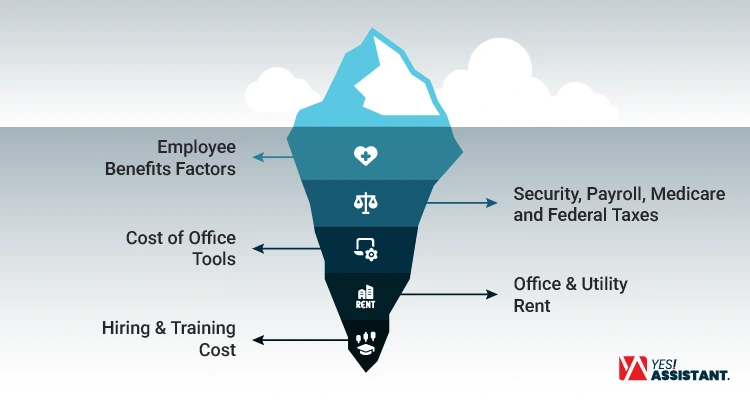
- Employee Benefits: The company provides employees with healthcare packages and Paid time off (PTO) can add an extra 20% to 30% to their base salary. (According to TheStaffHero).
- Taxes: Employers also pay Social Security, Medicare and federal employment and payroll taxes.
- Office Tools: Business owners are also investing in computers, monitors, desks, chairs, communications devices and physical office infrastructure.
- Office & Utility Rent: The company pays monthly rent for commercial workspace, high-speed internet, power bills, and cleaning staff costs.
- Hiring & Training Cost: Pays for new staff hiring advertisements, interview arrangements (like papers, refreshments) and training existing & new employees.
BPO vs In-House: Side-by-Side Comparison
Determining your business model between BPO and in-house is a great choice for the business leader. It mostly depends on what you want to achieve and how fast you need to grow. This table comparison helps you to see how they work differently; thus, you can pick the best option.
| Feature | BPO | In-House |
| Control | Shared with partner | Full, direct control |
| Scalability | Easy to grow fast | Hard to scale quickly |
| Cost Structure | Comparatively low, fixed fee | High, salary and benefits |
| Best-fit Stage | Applicable for startups and scaling | Mature, stable companies |
| Specialization | Expert teams ready | Train up “In-house” staffs |
| Time to Deploy | Very fast, within 1-2 weeks | Slow event takes several months to hire |
Is BPO Cheaper Than Hiring In-House?
Yes, outsourcing (BPO) is usually cheaper than hiring a team in-house, but it is not always a simple “yes” for every business. While you can save a lot of money on salaries and office bills, you must look at your total costs. Your savings will change based on where the work happens and what specific job you need help with.
It is also important to know that the first year often costs more because you have to spend time and money on training and setting up your new way of working. This can reduce the extra cash you save at the start.
Why Your First Year Costs More
When you start working with a new BPO partner, at first you need to help them with your business operations, working culture, and requirements. This is necessary to transfer knowledge, resulting in achieving the best results, but it may cost you in advance. You should plan for these first-year costs for future preparation.
- Time spent training
- Setting up software
- Moving your data
- Checking work quality
How to Find Real Savings
You might see advertisements that claim you can “save 70%” or other huge numbers. Please be very careful with these big promises. Many of these numbers come from marketing materials and are not facts you should rely on.
Before you believe any specific savings percentage or dollar figure, you should ask for a named, dated primary source to prove it. Always make sure the data is authentic and not just a sales pitch.
- Ask for sources
- Check the dates
- Verify vendor claims
- Use real data
What Are the Real Advantages of In-House Teams?
While outsourcing has its benefits, keeping an in-house team at your office provides unique advantages that outside partners can’t provide easily, Investopedia. Having your own team means they are fully part of your operational resources from day one. Therefore, you can teach them thoroughly about your business from the inside out, making them experts in how you want to implement it.
Let’s train your in-house team to better understand the business by working closely with them every day. So, your team will get a chance to have a deep knowledge of business history and culture that outsiders simply cannot match.
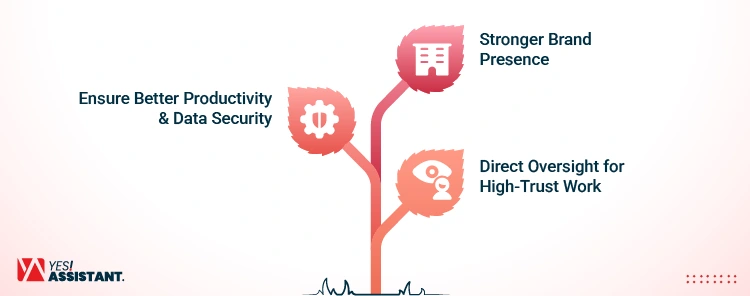
- Stronger Brand Feel: A clear voice tells your team how to deal with customers. When individual team members follow the same style, it builds strong relationships and trust with your customers.
- Better Productivity Over Time: Team members who stay long-term with you understand both your goals and how to work with you better.
- Direct Oversight for High-Trust Work: Having a dedicated in-house team ensures the protection of your customers’ sensitive data and privacy, with your full control and supervision.
It’s better to onboard an expert for your team, but you should keep certain things close to your hand. Especially your core mission and the heart of your business. Besides, your internal team drives with you directly; thus, keep the core tasks in-house to protect the soul of your company.
When Should a Business Never Outsource a Function?
There are moments when you must keep the reins in your own hands to stay safe and strong. You should never outsource tasks that define your company’s unique value or those that involve highly sensitive secrets, as these are the pillars that keep your business special.
Here is when you should keep work with your own team:
- Protect unique company secrets
- Keep brand identity strong
- Guard sensitive customer data
- Maintain your core mission
- Hold onto special knowledge
What Are the Real Advantages of BPO?
Running a business doesn’t mean you’re doing everything yourself. Outsourcing (BPO) gives you a smart partner to handle the daily work. Thus, you can focus on growing your big dreams.
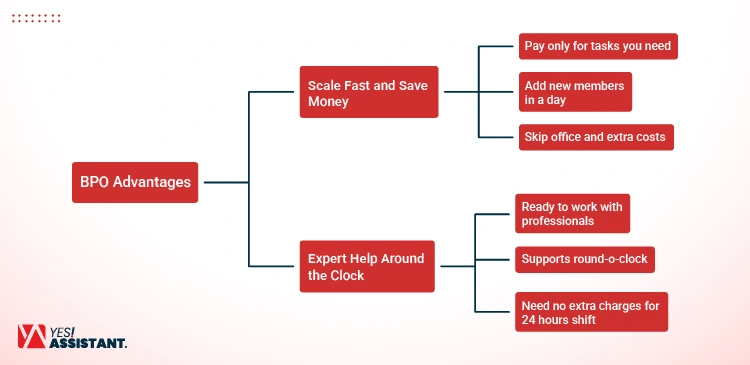
Scale Fast and Save Money
Operating a business with an “in-house” team is slow and expensive because you have to pay for office, equipment and employees. In contrast, BPO eliminates these setup costs and can help you to scale your team daily, as you can calculate paying for the work you need.
- Add new team members in days, not months.
- Pay only for the work you need done right now.
- Save money by skipping office costs and extra tools.
Expert Help Around the Clock
You don’t have to spend weeks providing training to new staff because BPO partners provide experienced professionals. These skilled people work for your business in other time zones. Your business operates when you sleep, giving you 24/7 without paying extra for late or night work.
- Ready to work with skilled professionals
- Continue operations and run 24/7
- No need to pay extra charges for a 24-hour shift
How Do You Decide Between BPO and In-House for Your Business?
Choosing between an ” in-house ” team and a BPO partner is vital to your business decision. To make it easier, look at these four areas. If you check these off, you will know which stage matches your business best:
- Work Volume: If your business has plenty of repetitive daily tasks, BPO is a great option for you. Again, if your daily repetitive tasks require changes or edits, let’s keep it in-house for better control and consistent operations.
- Budget Stage: If you need to start an operation and need to save money, outsourcing saves your cost. On the contrary, if you have the budget to invest in long-term staff, then in-house is a great option for you.
- Privacy Needs: When you handle highly private customer information, like compliance data-entry to secure your business. Then the in-house team can provide the safety and security to maintain close control of the sensitive information.
- Brand Control: If your brand voice heavily depends on matching your exact tone and culture. This keeps your team in-house and ensures that you build your strong brand identity.
Making decisions between two options, like outsourcing and hiring “in-house” needs strategic decisions. Before making the right decision, just think about which options match your business needs. Also, some businesses keep regulatory tasks “in-house” and outsource non-core tasks with a perfect balance.
Is There a Middle Ground?
Yes! You don’t have to choose between BPO and hiring in-house. Only a hybrid approach gives you the best options instead of both BPO and “in-house” systems. The alternative options also help you to build a high cost of a full office team.
- Flexible Help: You can easily scale your team up or down as per your business needs or changes.
- Expert Partners: Besides, you get to work with professionals who deliver great results from day one.
- Stay in Control: Keep your core team close while delegating others to handle the additional work.
- Grow Easier: It is a smart way to get the help of a team without facing any difficulties during hiring full-time staff.
The middle ground is often where your business finds the most success. It allows you to grow at your own pace while your business runs smoothly.
BPO vs In-House vs Virtual Assistant Staffing: Where Does a VA Fit?
Choosing between BPO and in-house operations is of significant importance, which need deep-analysis to choose the best one. Between the two options, one requires strict and rigid rules, while the other costs too much time and money. If your business needs flexible help that grows with you without long-term commitment, Virtual Assistant (VA) can be your best option.
Why VA Staffing is the Perfect Middle Ground
If you are not quite ready to hire a full department or sign a giant contract with a BPO company, VA staffing gives you the best of both options. Managing a virtual assistant, you’ll get professional, dedicated help with exact-match skills. It’s a position that is flexible, simple and designed to help your business in a remote setup.
- Lower Commitment: You don’t need to sign a long-term contract as you can with big BPO companies.
- More Flexibility: It is easy to start with a VA, which is really needed for your business.
- No Hiring Headaches: Companies don’t need to onboard skilled professionals through interviewing and training.
- Get Started Fast: A third-party vendor has a bunch of talent, and businesses can start with a VA easily.
Business owners don’t have much time to execute repetitive routine tasks. Most businesses hire a virtual assistant to get flexible support and reach their goals. This helps you to focus on your business big-screens.
Conclusion
Select options between BPO and In-house staffing considering your specific business goals, budgets, and operational needs. Outsourcing offers scalability and cost savings, which is the right choice for a startup to save costs and grow quickly. In the meantime, an “in-house” system can ensure strong control over privacy, customer data and core strategy.
Many successful businesses choose a hybrid model to balance outsourcing and internal operations. Therefore, choose the best offers with which you can build a team that helps you to drive long-term success. Finally, the right decision secures your company and focuses on future growth.
FAQ
Is outsourcing riskier than hiring in-house?
It depends on your business situation. Outsourcing has significant compliance risks regarding data privacy, which “in-house” team costs higher overhead and management costs.
How fast can a BPO team be deployed compared to in-house hiring?
Typically, BPO teams can deploy in 1-2 weeks. In contrast, “in-house” staffing, hiring and training often take several months.
Does BPO work for small businesses, or only enterprises?
BPO is effective for both small businesses and enterprises. Startups need to outsource tasks to save costs, while enterprises manage daily repetitive operational tasks.
What functions should always stay in-house?
Regarding business conditions and regulatory rules, businesses’ core secrets, sensitive customer data, brand strategy, and long-term goal mission should remain in-house.
Can a business switch from BPO back to in-house later?
Yes, businesses can switch from outsourcing tasks. However, a hybrid model ensures a flexible connection during these operational shifts.