
BPO vs Shared Services: Understanding the Right Fit for Your Company
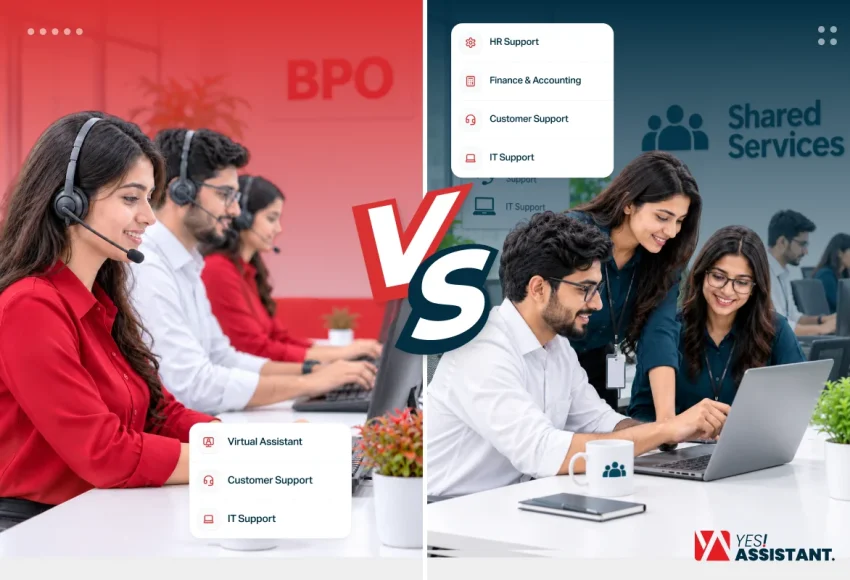
Understanding which is right between BPO and shared services requires understanding your business needs. Business process outsourcing (BPO) handles repetitive and non-core business processes with an external provider. BPO offers quick setup time and low upfront cost. On the other hand, shared services is an in-house model that centralizes specific business functions. It is great for standardization, control, consistency and improved data sensitivity.
None of the models are perfect. The right choice varies based on your company’s size and growth stage. It also depends on your requirements around speed, cost and control. This guide breaks down how BPO and shared services differ. It also covers when each model makes sense and why many businesses choose a hybrid approach.
Key Takeaways
- BPO involves outsourcing processes to an external service provider, whereas shared services keeps them in-house.
- BPO has quicker initial deployment, taking 60-90 days (with 9-18 months for full implementation), while shared services typically take 12-36 months from design to stable delivery.
- BPO suits routine, non-core tasks and businesses that require speed or scalability; shared services suit large, multi-region businesses that are looking to standardize and increase the security of their data.
- However, these two models are not mutually exclusive, and many businesses use a hybrid model.
What is Business Process Outsourcing (BPO)?
Business process outsourcing (BPO) is a model where an external provider handles certain business processes. Rather than hiring and managing your own team, you engage with an outside third-party firm. BPO provider uses its own staff, required tools and systems to provide different types of outsourced services.
BPO providers also have experienced professionals and utilize technology, which makes it relatively more efficient than self-development. According to location, there are 3 types of BPO: Offshore BPO, Nearshore BPO and Onshore BPO.
What are the Key Features of BPO?
Just like every business model, BPO also has some key features that differentiate it from others. Here are the key features of BPO:
- Third-party Contracting: Handles the client’s business processes such as data entry, cold calling, lead generation, etc.
- Partial Outsourcing: Most of them are non-core functions, core functions are handled by the client’s in-house employees.
- Specialized Expertise: The providers offer pre-trained professionals with specific expertise.
- Flexible Contracts: Contracts can be made flexible to be adjusted more rapidly than internal staff.
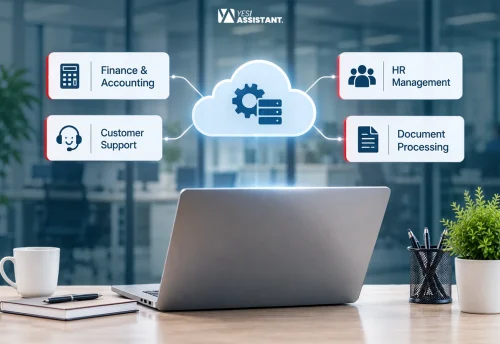
- Usual Functions: Usually include HR, accounting, customer support and technical support.
- External Accountability: A contract determines the service quality and performance, rather than internal management.
Benefits of BPO
BPO offers benefits that very few can offer. This is the main reason why businesses are so dependent on BPOs. A common example of BPO in action is when a third-party provider manages specific business operations on a company’s behalf. Here are some core benefits of BPO:
- Cost Savings: Reduces operating costs and allows for more controlled budget management.
- Access to Skilled Talent: On-demand access to trained specialists without the cost and time of hiring full-time experts.
- Scalability: Easy to scale operations up or down quickly in response to market demand.
- Risk Reduction: Lowers legal and financial liabilities tied to layoffs during restructuring.
- Better Service Quality: Puts experienced providers in charge of specialized tasks, rather than relying on internal staff who’d need extra training.
- Improved Focus on Core Business: Frees employees from repetitive tasks so they can focus on core tasks.
- Stronger Leadership Focus: Frees up leadership’s time for strategic planning, since the vendor manages day-to-day staffing and operations.
When Should You Choose BPO?
In certain situations, speed, scalability and cost flexibility are primary concerns and BPO is the correct option. BPO can be an appropriate choice if control is not your primary concern, but rather the other advantages. Here is when you should choose BPO:
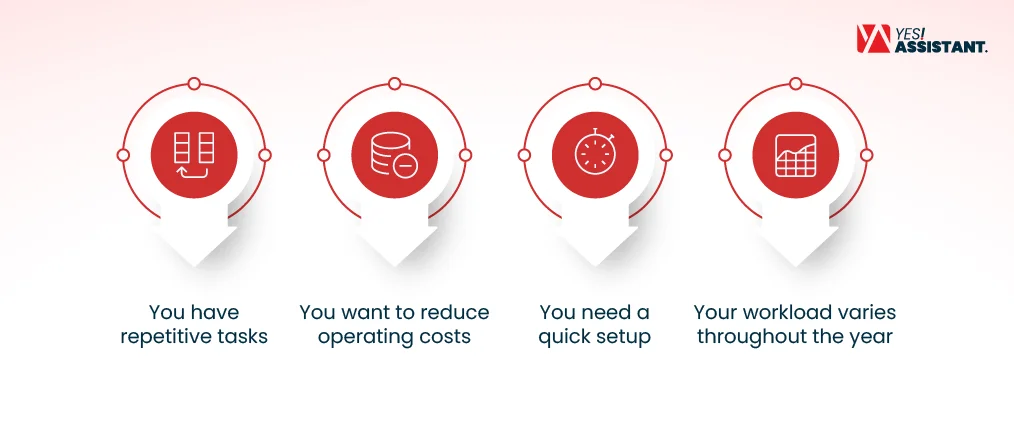
- It’s routine work: The tasks are repetitive, well documented and don’t set your business apart from competitors.
- You are too small to compete on cost: A large provider that does this work for many clients will be able to do it at a lower cost than you will be able to do it in-house.
- You need it running fast: Outsourcing can get up and running faster compared to building your own in-house team.
- You have varying workloads throughout the year: Paying a vendor means you can deal with busy seasons without the need to hire additional personnel you will not need all year long.
Shared services is an organizational business model. It is a centralized unit or team that delivers standardized or routine support all across the company. Rather than every department handling their own payroll, accounts payable and customer service, a single team handles these tasks. This is an in-house approach that centralizes repetitive tasks instead of duplicating them across departments.
The shared service unit is tasked with providing high-quality service in a cost-saving and ideal way. Shared services have similarities with an external provider, but it is an in-house approach. This in-house approach creates accountability, efficiency and improves customer satisfaction.
Since shared service has its own way of operating, it comes with some key features as well. Here are the key features of shared services:
- Centralized Delivery: HR, finance, or information technology functions are centralized within an in-house department.
- Internal Ownership: No outside vendor; staffed and run by the company.
- Service Level Agreements (SLAs): Define expected cost, speed and quality standards.
- Standardized Processes: Processes that are the same throughout all business units.
- Flexible Structure: Can be configured as a single hub, regional hubs or hub-and-spoke.
- Central Governance: A single leadership team that is accountable for performance, rather than individual departments.
Shared services are an in-house model and it comes with specific benefits. Here are some of the benefits shared services provide:
- Reduced Cost Per Task: The more tasks you can accomplish in one go and the less duplicate work, the lower the cost per task.
- A Consistent Approach: This reduces errors and ensures uniformity and compliance, particularly if you are working in multiple countries.
- Improved Response to Change: One central team is able to respond faster to new rules or a company’s acquisitions than multiple separate teams that need to coordinate.
- Better Visibility Into the Business: All of your information is in one place, so it’s simpler to see trends and make better calls.
Shared services models are appropriate when control, data sensitivity and long-term improvement are key considerations rather than anything.
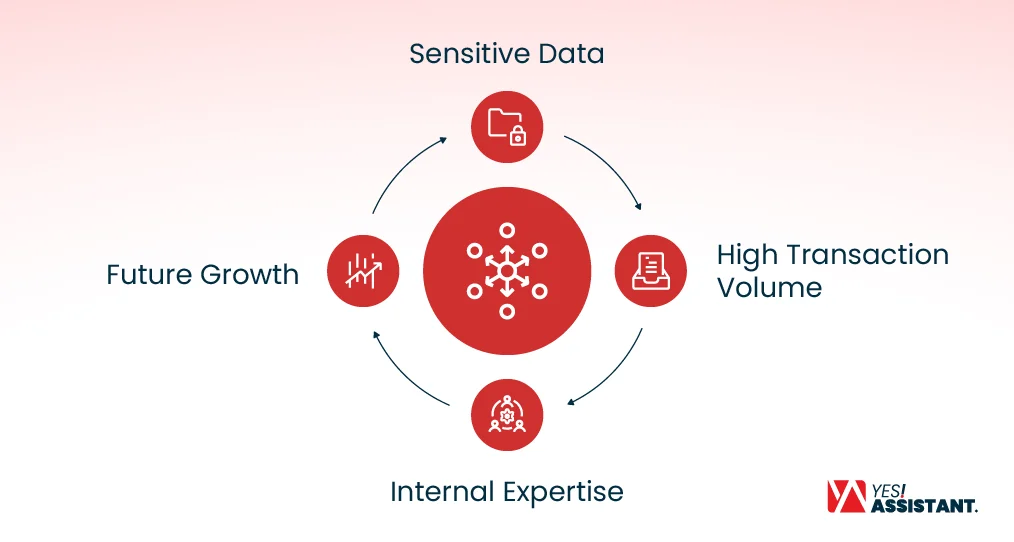
- Compliance Requirements for Sensitive Data Remain in-house: Financial data, employee information and tax information are examples of sensitive data that typically have rules making it unsafe to share with external parties.
- The Volume: If you make the requisite number of transactions across various departments, you capture the savings a vendor would provide without adding its markup.
- Knowledge Stays Close to the Business: An internal center keeps process expertise, improvements and career growth within the company instead of handing it to an outsider.
- Sets You Up for Growth: Shared service centers are the natural starting point if you eventually want to build a full Global Business Services organization.
BPO vs in-house services always have differences and these differences make each suitable for different approaches. Here are some major differences between BPO vs Shared service:
| Criteria | BPO | Shared Services |
| Ownership and Control | Managed by an external vendor | Owned and managed by the company itself |
| Service Delivery Model | External provider, often serves multiple clients | One internal unit, serves only the company |
| Major Cost Structure | Per-FTE, Hourly Rate, and Per-Transaction | Allocation, Chargeback, ABC, Fixed Fee, Cost-Plus, Tiered |
| Access to Expertise and Talent | Immediate access to vendor’s trained staff | Built gradually through in-house hiring |
| Scalability and Flexibility | Scales quickly via contract changes | Scales slower, tied to internal hiring and budget |
| Technology and Infrastructure | Uses the vendor’s existing systems | Company builds and maintains its own |
| Management and Governance | Governed by contracts and SLAs with a vendor | Governed internally by company leadership |
| Implementation Time | Takes initially 60 to 90 days; usually 9-18 months for proper implementation | Usually 12-36 months from design to stable delivery |
The right fit depends on your specific business needs. Every business has different priorities, so the right model depends on those specifics. Neither BPO or Shared service are one-size-fits-all solutions. For that reason, what is the right fit for you will depend on what your business needs most: consistency, savings or speed.
Shared services make the most sense in companies that focus more on control, privacy and consistency. Large, multi-region companies often prefer shared services over BPO. Rather than saving costs, they are focused on maintaining consistency across every location.
BPOs are famous and widely recognized compared to shared services. The core reason is that many businesses focus on cost reduction, scalability and an expert workforce. This business model helps businesses to focus on core tasks and outsource repetitive tasks such as data entry. This is a practical choice for most businesses because constant task switching lowers efficiency.
Which Businesses Choose Which Model
Here is a comparison of which business model is suited for which businesses:
| Model | Best Suited For |
| BPO | Small to large businesses focused on fast, efficient scaling and cost flexibility |
| Shared Services | Large international companies prioritizing consistency across regions |
Three important questions to ask yourself before making the decision:
- What’s your business size and what industry are you in?
- Do you already have processes in place that lack consistency?
- What growth stage is your business currently at?
So this comes to a simple conclusion: if you have a small to large business focused on fast, efficient scaling and cost saving, BPO is for you. Otherwise, for a large international company prioritising consistency and control, shared services proves to be a good choice.
Conclusion
The decision between BPO and shared services hinges on the objectives you’re aiming to achieve: speed, cost reduction or control and consistency. BPO is best suited to non-core activities such as customer service, which benefit from rapid, scalable and flexible deployment and cost optimization, particularly when paired with the right outsourcing provider.
Shared services are best for companies with multiple regions and those that value standardization and data sensitivity. There is no one right or wrong; some companies use a hybrid approach, with outsourcing of non-core functions and in-house handling of sensitive functions.
FAQs
The main difference between BPO and shared services is that BPO is handled externally by a third party. On the other hand, shared services are handled in-house with a dedicated team. Shared services offer increased data security, high accuracy, and direct control. But BPO offers cost reduction, high scalability, and expert employees with years of experience in the industry.
No, BPO is not universally better than shared services. It totally depends on the business priorities. But BPO is faster, cost-effective and quicker to launch. On the other hand, shared services offer more control, consistency and proper handling of sensitive data.
Yes, it is possible to combine shared services and outsourcing. Even many businesses prefer hybrid models for the best output. Businesses keep sensitive tasks in-house and complete other tasks using a BPO.
Not usually; BPO providers often offer lower costs compared to shared services. The provider’s country, cost of living and working with multiple businesses make it possible for BPO providers to offer a lower cost. But shared services lack a BPO provider’s multi-client economies of scale, so the per-unit cost can still end up higher than outsourcing despite there being no vendor markup.
There is no fixed time for how long it takes to implement shared services vs outsourcing. It totally depends on the business requirements and execution. BPO initially takes 60-90 days and (9-18) months for proper implementation, while shared services usually takes 12-36 months from design to stable delivery.
No, shared services and outsourcing are different. Shared services is an internal unit the company owns and staffs, serving multiple business units. Outsourcing (BPO) hands the process to an external third-party provider. Both consolidate work for cost and efficiency, but shared services keeps control in-house; BPO transfers it to a vendor.