


The Impact of Delayed Task Completion: Are Your Delays Holding You Back?
Every delay has far-reaching consequences. Every businesses’ are waiting to go ahead of you, even convenience your long-term customer to switch from you. When you are delayed in tasks or project completion, it will badly affect your business, and damage your reputation.
In this blog, you’ll learn the primary causes of delayed task completion, like lack of clear goals, poor time management, and cognitive factors. Besides, learn key effects of delayed tasks, leading to reduced productivity, delice quality, and negative impact on team performance. Significantly, you’ll know strategies to prevent delays with structured plans, set priority, and use automation to smooth operation.
Primary Causes of Delayed Task Completion
Delayed task completion often results from a combination of poor planning, resource limitation and psychological factors. The key causes include lack of scope, ineffective boundaries, insufficient estimation of time and procrastination.
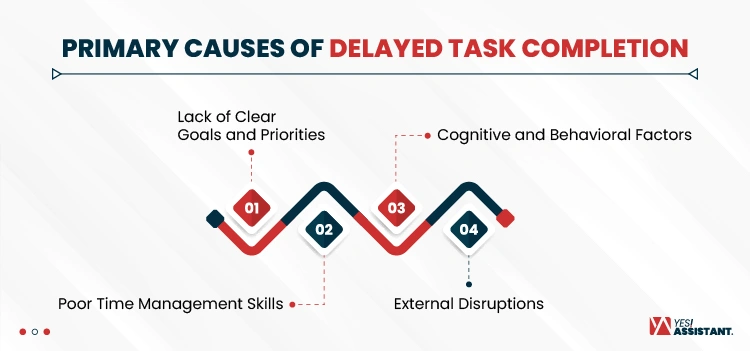
Lack of Clear Goals and Priorities
Most of the people fail due to lack of clarity and direction, which is one of the reasons for failing to execute tasks. When tasks or goals are poorly defined, it’s easy to get lost resulting in rejection of the work completion. This happened when tasks were not clearly defined, unable to break down manageable tasks, and no clear roadmap for execution.
- Undefined Task Scope: Without a clear roadmap, you can’t define tasks status on “Done” mode, leading to endless refinement and delays.
- Prioritization Gaps: Using no specific framework like Eisenhower Matrix (urgent but unimportant) task often takes precedence over high-impact work.
- Absence of Success Metrics: Key performance indicator is a matrix that helps you to measure the progress. Without using KPI, you never able to identify traps that lead to missed deadlines.
Poor Time Management Skills
Effective task competition requires good time management skills. But lack of prioritizing tasks, estimating time and proper scheduling are key factors to delay completing tasks within duration time. This often leads to indecision, which causes delay.
- Ineffective Estimation: When you fail to understand how long a task require to complete, including actual working time, potential problem and lead to get solutions. Many planners fall into time traps due to lack of time estimation skills that results poor time management.
- Overcommitment: Receiving too many tasks with committing “yes” to complete the job within duration time but no clear idea about task completion time. Therefore, overcommitment leads to no single tasks focus or onboarding in due time.
- The Planning Mistake: Cognitive bias often leads individuals to underestimate the time needed for a task based on a perfect version of the workflow. Their ignorance occurs due to past experiences with similar delays.
Cognitive and Behavioral Factors
Delaying tasks is often linked with avoiding self consciousness. This is likely an anxiety, monotony, or stress. By delaying these tasks, you temporarily escape from horrible feelings, even at the cost of future pressure.
- Decision Fatigue: Making too many small decisions throughout the day drains your mental energy, making it harder to handle complicated tasks later.
- Perfectionism: The desire for a flawless output often leads to over-refinement. This results in spending too much time on minor details that actually don’t change the final result.
- Low Self-Efficacy: Sometimes, a person doubts about their ability to do a task well. This makes them afraid of failing. This fairness subconsciously delays the start of work.
External Disruptions
There are too many things that stop your focus from core activities. This is like social media, notification, multitasking and noise environments that contribute to procrastination.
- Context Switching: Constant interruption or task switching forces your brain to reboot its focus, which can decrease productivity up to 40%.
- Team Dependencies: Sometimes delays happen systematically. This is like a task delayed simply because it is waiting on a blockage from another department or colleague.
- Technological Friction: Inefficient tools or frequent software notification may break your working flow. Thereupon, you require time and effort to restart deep focus on the task at hand.
You may be overwhelmed by decision fatigue, or burnout to switch between tasks. In this case, business owners take support from virtual assistant services to reclaim the workday. This is a smart way to stop overcoming clients and focus on your high-impact work.
Key Effects of Delayed Task Completion
Late delivery hurts both personal productivity and your teammates. Studies show failing to meet deadlines resulting in meeting idle time. By which your teammates slow down for the following reasons.
Reduced Productivity Levels
Delayed task completion has both personalized and business effects. This increases stress, and losses on company financial levels.
- Lower output per time unit: When tasks are complicated or increase difficulty or poor time management, leads to higher mental workloads. This significantly lowers the team’s productivity.
- Task overflow: Any delayed project forces you to work during personal time, creating a long time struggle to balance work and life.
- Compound Backlogs: A small delay can increase backlogs, making you too busy with past works, can delays to engage with new tasks.
Decline in Work Quality
Any kind of tough deadlines lead to a high rate of errors as you may have no sufficient time to review and refine tasks. When the workload creates pressures on you, this can lead to time pressure due to meeting deadlines.
- Rushed completion errors: After a delay, when you rush on heavy loads to meet the deadline, it significantly increases mistakes.
- Missed care and review: Among all other high-valued business, health is one of them. Therefore, tasks delays and workflow interruptions are directly linked to missing nursing care and a decline in safety competence.
- Setting Good Enough Trap: Setting for average work means focused on speed, not value. These are clear signs you’re spending time on the wrong work because you are focused on finishing the task rather than delivering value.
Increased Stress and Burnout
In a business, team members are about to complete the task; by this time, management pressure on finishing backlogs to stay on track with ongoing jobs. This creates mental fatigue, and increases stress which impacts on decision-making.
- Pending task accumulation: Pressures on ongoing tasks and growing backlog of tasks are primary drivers of occupational burnout.
- Mental health impact: High work stress from missing deadlines correlated with increased anxiety, depression, and physical symptoms like fatigue, or sleep disorders.
- Loss of Control: When your “to-do” list grows faster than you can finish it, you lose the sense of autonomy over your workday. This is a major contributor to chronic workplace stress.
Negative Impact on Team Performance
Individuals may perform well, but an organization never depends on “on man army strategy”. This disengaged employee lowers their morale across the entire team as your project turn into a slow pace.
- Workflow disruption: Team performance is never covered-up by the individual’s performance. This disrupts your other team members, leading to impact on real performers.
- Collaborative failure: Efficient team performance depends on shared understanding and timely delivery. Any delays disrupt the unity and increase the overall performance pressure on colleagues.
- Erosion of Trust: Consistent delays damage reputation. This will lower your team’s morale and stop collaboration effectively.
Strategies to Prevent Task Delays
Preventing delay is like building a strong fence to keep a situation out of trouble. If you want to finish your work on time and get rid of backlock, you need a solid plan. Here is how you can stay on track and keep your team happy.
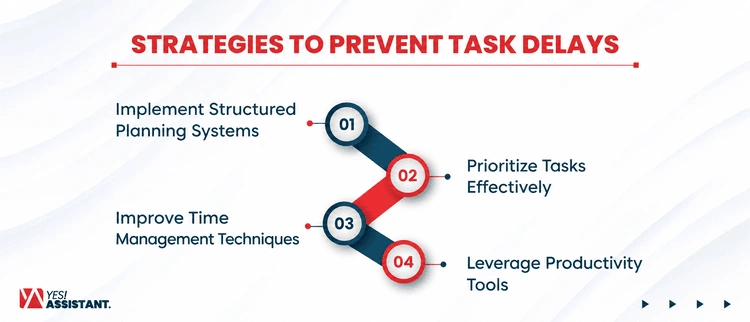
Implement Structured Planning Systems
Large projects can make you feel overwhelmed. This will lead to procrastination, often waiting until the last minute to fix this. Let try the simple steps:
- Keep it in Brief: Get one big task and break it into five small parts. It is much easier to finish a small task than handling a bulk amount of functions.
- Set Mini-Deadlines: It’s better to set multiple “check-in” dates instead of single due dates. This is a powerful way to manage large projects rather than depending on one final deadline.
- Create a Map: Draw a simple map from start to finish. When you know exactly what comes next, you don’t get stuck on what to do.
Prioritize Tasks Effectively
You may have a list of tasks but all are not priority listed. Some things you spend all day doing small things that don’t have focus now. This is the biggest common time leaks in growing business because it steals your time from the work and actually makes money.
- Use the “Must vs. Maybe” Rule: Let’s think and ask yourself, “If I do one thing today, which one will help the most?” Do that one first.
- The Urgency Box: Use a simple grid to see what is really urgent and what belongs to extra.
- Keep Eyes on the Reward: Prioritize your tasks that have high-impact, recognition and grow your business. This helps your teams to perform well.
Improve Time Management Techniques
Remember, time is money. Follow a standard time management rule. This will save time by changing how you work.
- Set Every Hour for a Job: This is time blocking. Don’t engage with a messy list of tasks, rather than pick a specific time to complete just one task following the time blocking rule.
- Stop Multitasking: You may think multitasking facilitates completing the task quickly but it drains your brain. Engage with one-by-one single tasks to complete fast.
- Take Short Breaks: Just take five minutes to be refreshed. It certainly pulls your mind to work smoothly.
Leverage Productivity Tools
You don’t need to drain your brain by remembering everything. Technology can do it as your personal assistant that never forgets a deadline.
- Use a Digital To-Do List: You can use special apps or digital reminders that ping you when a task is due. This prevents the cost of poor tasks organization from hurting your professional reputation.
- Use Robots to do the Boring Tasks: Apply automation software for repetitive tasks, like sending the same email or filling a report.
- Share the View: Use tools where all your teammates can see the plan. When everyone is aware about the progress, everyone stays motivated to finish on time.
Conclusion
Task delay is the most alarming for a business owner. Most of the task delays can lead to increased backlogs, pressures from stakeholders, and increased stresses. Team members of the project become overwhelmed for the unexpected tasks loads due to missed deadlines.
Moreover, delaying in assignment damages your business reputation, increases overheads, and operating costs. However, you’ve options to avoid these problems, like following a standard matrix to make a priority list. Besides, you can use automation software for repetitive tasks, follow KPI to track and measure shortfalls.