


Why Unplanned Days Lead to Poor Results? Here’s What You’re Missing
Operating a business without a clear daily roadmap leads to motionless growth and wasted business capital. When you miss a structured system, your team spends high-value energy reacting to distractions rather than executing strategic goals. Shifting from unplanned days to a proactive schedule allows you to focus on the tasks that actually scale your business.
In this blog, you will learn how unplanned days create focus gaps and increase stress levels for your entire team. You’ll also explore six professional strategies to reclaim your time through daily planning, time blocking, and strict task prioritization. Let’s identify how to break down complex projects and limit interruptions to ensure consistent, high-quality business results.
5 Reasons Unplanned Days Lead to Poor Results
Starting your day without a plan is like, you are going on a trip to a new place without a map.. You might keep moving but probably won’t end up where you want to be. When a working day starts with no clear structure, you aren’t just losing time, you are losing the ability to grow your business.
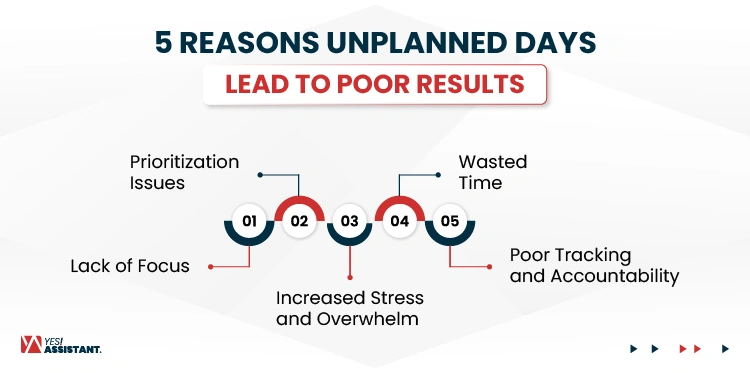
Lack of Focus
When you don’t have a predetermined goal for the day, your brain tries to do everything at once. You might start an email, jump to a social media post, which is distracted by a phone call. This constant shifting make it possible to do your best work because you mind never fully settle on one tasks
- The Focus Gap: This happens when your attention is split between too many small things.
- Why Deep Work Matters: Without focus, you never finish a major project that could actually keep your business ahead.
- The Final Outcome: Unable to sort out top-priority or scheduled tasks that create an attitude to push important tasks into tomorrow, which cause your efficiency drops.
Prioritization Issues
Unplanned days make your day like an emergency. If you don’t decide what is important before you start, you will spend your day putting out fires instead of building something great. Therefore, you end up being reactive, answering everything and message buzz rather than being strategic about your time. This is a major sign for the cost of poor task organization.
- The Urgency Trap: This is the mistake to treat a small notification with full efforts as you did for a major client project.
- Why Ranking Tasks is Vital: You should spend toward the 20% of work that brings in 80% of your results.
- The Final Outcome: Complete your day being busy but realizing you didn’t actually achieve anything.
Increased Stress and Overwhelm
It’s a stressful start when you don’t have a plan. Always you finish a small task, but don’t do your actual daily target. This contradiction drives you to a stress response in the brain. Which makes it harder to think clearly or stay calm when things get tough.
- A Cloud of Indecision: This is the mental tiredness you feel when you have to choose your next steps dozens of times a day.
- Why Mental Clarity is Key: A steady mind chooses a better option and doesn’t get agitated with small mistakes.
- The Final Outcome: Your brain is distracted during the interval, leading to poor choices and turning into a bad mood.
Wasted Time
Without a schedule, time simply leaks away. You might spend twenty minutes wondering where you saved a file or ten minutes starting at your inbox. These idle periods add up fast.
When there is no start or end time for a task, the work tends to extend out to fill the whole day, leaving no room for growth or rest.
- The Time Leaks: These are hidden minutes lost to task-switching and looking for information.
- Why Time Boundaries Matter: Setting a clock for a task, forces you to work faster and stay on track.
- The Final Outcome: You realize it’s 5:00 PM and you still have half of your tasks list staring back to you.
Poor Tracking and Accountability
Without a written goal, you have no way to measure your progress to prove you reached the finishing line. Unplanned days make it easy to hide from the truth, you can’t measure your progress or see where you are failing. Without a clear record, it becomes very easy to miss deadlines and it will down your team or your client.
- The Accountability Void: It’s hard to know if you have got a successful day when there is no way to track your progress.
- Why Measurement is Crucial: This helps you see patterns in your habits that you can fix on what is not working.
- The Final Outcome: You lose other’s trust and fail to reach the big goals you set for your company.
Unplanned workdays reduce business performance by creating a lack of focus, causing decision fatigue, and leading to wasted operational capital. Delegate your administrative tasks, availing supportive assistants who can handle daily tasks and a solid schedule helps businesses to grow. Therefore, you consider using a virtual assistant service to manage daily priorities and reclaim lost time.
How to Minimize Unplanned Activities at Your Company?
Operating a business without a strategic roadmap results in wasted capital and stagnant growth. Without fixing a system, your team spends high-valued energy on law-impact tasks that are signs of an unplanned day. When you control your day, you stop reacting to every small distraction rather than focusing on what makes your company grow.
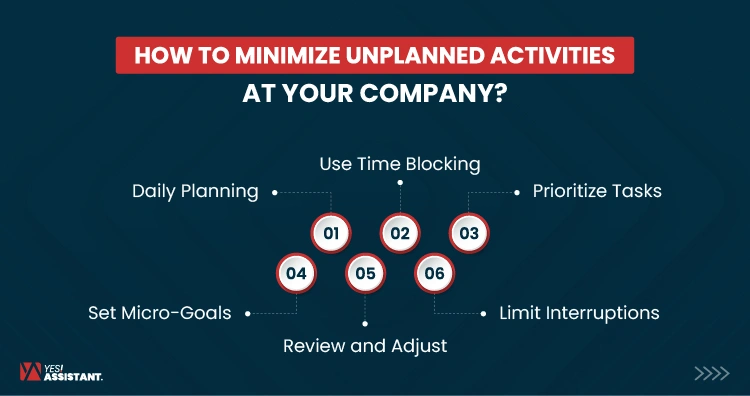
Daily Planning
A daily plan tells you exactly where to start that you don’t waste time wondering what to do. This keeps your brain quiet because you don’t have to make tough choices while you are already busy. It’s the best way to avoid common time leaks in growing business.
- Identify Top Priorities: List out three most critical tasks that you must finish before you leave your workstation.
- Action-Focused; Strategic planning prevents mission drift by keeping your daily actions aligned with your primary business objectives.
- The Result: You finish the day feeling proud because you actually hit your targets.
Use Time Blocking
Time blocking is like putting your tasks into fences; therefore they can waste you the whole day. You must decide that 9:00 AM to 10:00 AM is only for one specific job. During the time nothing else exists significantly, it will stop you from jumping back and forth between small tasks, which is a major part of how multitasking reduces business efficiency.
- The Time Box: This is a set of appointments on your calendar with yourself to do one piece of work.
- Why it matters: It forces you to focus deeply on one thing at a time instead of doing five things without planning.
- The result: Complete your work faster because your brain will not work consistently to restart the task.
Prioritize Tasks
Every task is not equal. Some grow your business, while others just keep you busy. Using a simple system to rank your work helps you to track the big rocks first.
This ensures you aren’t stuck in dealing with the mental toll of daily repetitive work while the important goals are ignored.
- The Rank System: This is a way to label up your tasks, like “A” (Must do), “B” (Should do), or “C” (nice to do).
- Why is this important: It makes sure your best energy goes to the work that actually brings in money or helps people.
- The result: It’s better to finish your most important goal than to do things that don’t matter.
Set Micro-Goals
Large tasks are hard to start because this overwhelmed you at the beginning stage. If you break a big task into small portions, it is easier to start. Small tasks keep your mind moving forward because you see constant progress.
- The Tiny Step: Break a large project into small, 15-minute tasks to make it easier to finish.
- Why it matters: It prevents you from feeling overwhelmed; thereupon, you can keep working smoothly.
- The result: You keep moving forward all day long without overthinking about how the work is too hard. Remind yourself about the tasks that are easy to proceed.
Review and Adjust
After completing your tasks, take five minutes to check the tasks. See which portion accelerates your mind to move forward and which portion distracts you very much. If you don’t look at your mistakes, they will probably happen again tomorrow. So, don’t overlook your mistakes, rather check every single step to make your tasks free from errors.
- The Daily Check-Up: This is a quick look at what you finished and what needs to move to tomorrow.
- Why it matters: It helps you to spot patterns like a specific meeting that always runs too long.
- The outcomes: Your planning gets smarter and more accurate every single week.
Limit Interruptions
Every notification or quick question breaks your focus and slows down your work. You need to create a silent zone for your most important work. By turning off pings and setting boundaries, you can protect the most valuable asset like your concentration, and attention.
- The Focus Shield: This is a set of rules, like turning off mail alerts, or putting your phone in a drawer.
- The Efficiency Angle: Maintain continuous workflow prevents the delays associated with fragmented tasks, ensuring projects are delivered on schedule.
- The result: When you stay focused on your work, you can do better and finish it faster.
Conclusion
Changing your mind from an unplanned to proactive system means building a high-impactful culture at your company from uneven structure. These shifts let your team stop putting fires and start to focus on the strategic work that scales your business.
Minimize unplanned tasks and strengthen your planning strategy before starting the day to ensure maximum results. Focus on saving your energy for leading well. This helps you build a business that will be sustainable and stays as profitable.