

Global Capability Center vs. BPO
Expanding your business into a new country is a major decision. Understand the key differences between outsourced vendor partnerships and internal corporate hubs. In this guide, you’ll learn about startup upfront costs, long-term expenses, operational control and hybrid strategies that incorporate both models for maximum efficiency.
Key Takeaways
- Outsourcing tasks like repetitive administrative work to a third-party vendor saves your startup expenses.
- Building an overseas corporate facility grants total control over proprietary technology and intellectual property.
- Combining internal hubs with external service partners creates a flexible global delivery strategy.
- Evaluating long-term total cost of ownership helps businesses choose the right operational model.
GCC vs. BPO: Understanding the Two Delivery Models
A business process outsourcing partner handles repetitive daily workflows for a company. Before outsourcing tasks like customer support or data entry, companies look for the signs that their business actually needs a BPO service to optimize non-core tasks. These third-party teams handle your routine workflows and freeing your internal team to focus on core products.
Besides, a Global capability center operates differently as an overseas office fully owned by the main company. The parent company runs these regional hubs directly to keep control over operations and technical projects.
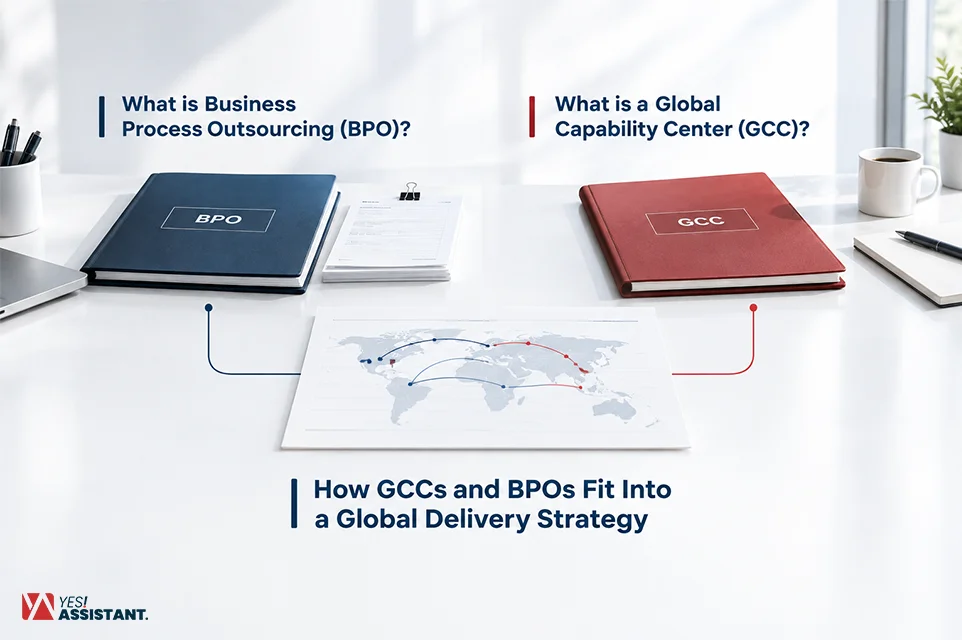
What is Business Process Outsourcing
Business process outsourcing (BPO) means hiring an outside partner to manage your regular company tasks. Organizations use BPO to cut operating expenses and save money on hiring full-time “in-house” staff.
Vendors manage your workflows using their own staff, office space and technology tools. Teams learn more about BPO vs. KPO when they compare basic administrative tasks with advanced knowledge services that require deep industry expertise.
What is a Global Capability Center (GCC)?
A Global Capability Center is an office operated by the parent company and its daily processes. Businesses build these centers to handle software development, research and specialized customer care in regions with lower labor costs.
- The parent or main corporation has direct control over every team member and daily process inside the facility.
- Companies select leaders to set up these hubs to build long-term company value and protect proprietary technology from outside exposure. Now, 92% of GCC leaders deliver value beyond cost savings, according to EY’s 2025 GCC Pulse Report.
- This setup lets organizations grow their overseas workforce without sharing operational control with third-party vendors.
How GCCs and BPOs Fit Into a Global Delivery Strategy
Companies build global business hubs by mixing internal and external service partners. Businesses balance their operational needs by incorporating offshore vs. onshore vs. nearshore BPO options to find the right physical locations for their tasks. In contrast, organizations assign standard customer service tasks to external vendor networks while keeping advanced product development inside their own regional hubs.
Considering two systems, GCC required adjusting in-house control with local facilities. By this time, BPO (business process outsourcing) works only to assign non-core workflows to an external partner and they will manage resources, offices, tools and maintain local administrative requirements.
GCC vs. BPO: Head-to-Head Comparison
When you compare operational models, scaling options like BPO vs. in-house help you to clarify external vendors or internal teams. This also helps you to handle specific functions effectively.
GCC vs. BPO: Key Differences
GCC is an in-house arrangement under a company’s offshore hub, whereas BPO fully depends on external business within an external party. See the differences below:
| Specifics | BPO | GCC |
| Ownership Structure | A BPO relies on an independent third-party vendor to execute tasks. | GCC operates as a wholly-owned foreign subsidiary of the parent company. |
| Operational Control | Companies have limited control over operational oversight and outsourced vendor staff. | Parent organizations directly maintain operation and control over every employee inside a GCC facility. |
| Strategic Focus | BPO contracts significantly center on cost reduction and high-volume administrative task execution. | GCCs focus on long-term capability building, innovation and proprietary research. |
Pros & Cons of BPO and GCC
Between BPO and GCC models, there are some beneficial factors and also problems.
BPO (Business Process Outsourcing)
Pros: Outsourcing allows your facility to start operations quickly without spending upfront costs and gives your operation to a large team of experts.
Cons: Depending on external partners can potentially face data security risks, communication barriers and common BPO mistakes that lower the quality of your services to your clients.
GCC (Global Capability Center)
Pros: Building a remote operational hub under the parent organization can ensure absolute control over intellectual property. Also, it establishes deep cultural alignment with the parent brand and scalable access to global talent. 174 Fortune 500 companies now run GCCs in India for this reason, according to a 2025 ANSR-UnearthInsight report.
Cons: Establishing an overseas corporate hub demands high upfront costs, complicated local laws, and extensive time investment to build local management teams.
GCC vs. BPO Cost Analysis: Upfront Investment vs. Long-term TCO
Choose a business model. You need to review current and future expenses. Companies evaluate these monetary factors carefully as initial investment differentiates between external vendor contracts and building an internal overseas facility. Smart financial planning helps business owners manage long-term operational budgets effectively.
Why BPO Has a Lower Barrier to Entry?
Outsourcing requires a small amount of money to start your operation quickly because the vendor already has the necessary infrastructure. Businesses don’t need to buy expensive tools or build complex networks to start operations. As a result, BPO cost savings enable small and mid-sized businesses to scale their daily workflows without risking large amounts of capital.
- Immediate Infrastructure Access: Vendors provide ready offices and pre-configured software tools. So, teams can start working from day one without spending more.
- Predictable Operational Budgets: After receiving BPO services, companies pay simple monthly fees based on actual task hours or completed tasks. This saves companies from the risk of investing large capital.
- Zero Hiring Overhead: Companies don’t need to hire new staff for surplus tasks. Your external partner handles recruitment, resource management and all kinds of benefits directly.
What Drives GCC Setup Costs?
Setting up a global capability center requires a large amount of money before the facility opens. These are like establishing an overseas corporate office that needs significant capital for physical construction, advanced technology and legal setup. Everest Group’s GBS Cost Benchmarks track these setup and delivery costs across 25+ roles and 10 global delivery locations.
- Invest in Office Space: Purchasing or leasing a secure office building in major areas under international technology hubs requires a significant amount of upfront cost.
- Global Talent Hiring: Recruiting top-level engineers and leadership talent in foreign markets involves high salary offers and talent-hunting consultancy fees.
- Regulatory Compliance: Establishing local business licenses, international tax and strict legal frameworks adds considerable upfront administrative expenses.
When Does a GCC Become Economically Attractive?
When a parent company establishes a corporate office, it becomes a highly profitable asset once the organization reaches a specific operational scale. But it creates financial burdens and decreases your business capital at the beginning. This occurs because the facility handles large volumes of complex work and takes time to improve internal efficiencies.
- High Employee Headcount: Operating with hundreds of internal staff members lowers the average cost per worker compared to paying continuous vendor margins.
- Complex Intellectual Property: Managing proprietary software and high-value research internally prevents expensive leaks or costly external vendor markups.
- Long-Term Operational Stability: Long-Term Operational Stability: Sustained multi-year deployment repays the heavy initial building costs across stable ongoing financial returns. Deloitte’s 2025 GBS Survey found about half of organizations achieved over 20% savings from their GBS models.
- High Rate of Resource Cost: Operating a corporate office with hundreds of internal staff members lowers the overage cost per worker compared to paying continuous vendor margins.
GCC vs. BPO: Total Cost of Ownership Factors
This is the actual cost of a project, which is higher than starting a project. Total cost of ownership means all the hidden costs of managing remote teams over many years.
- Vendor Management Overhead: Outsourcing requires monitoring vendor performance by dedicated internal staff, like auditing invoices and resolving service disputes continuously.
- Hidden Scaling Expenses: Expanding an outsourced team can cause sudden price hikes and extra contract fees increasing long-term expenses.
- Internal Control Efficiency: Owning an enterprise facility reduces friction losses and boosts productivity, which improves your financial returns across the full organization.
The Hybrid Model: Can GCCs and BPOs Work Together?
Connecting different operational models allows modern businesses to build flexible networks that balance cost efficiency with tight internal control. Companies don’t have to pick one way to grow globally. Leaders can mix their own internal teams with outside vendors to handle everything smoothly.
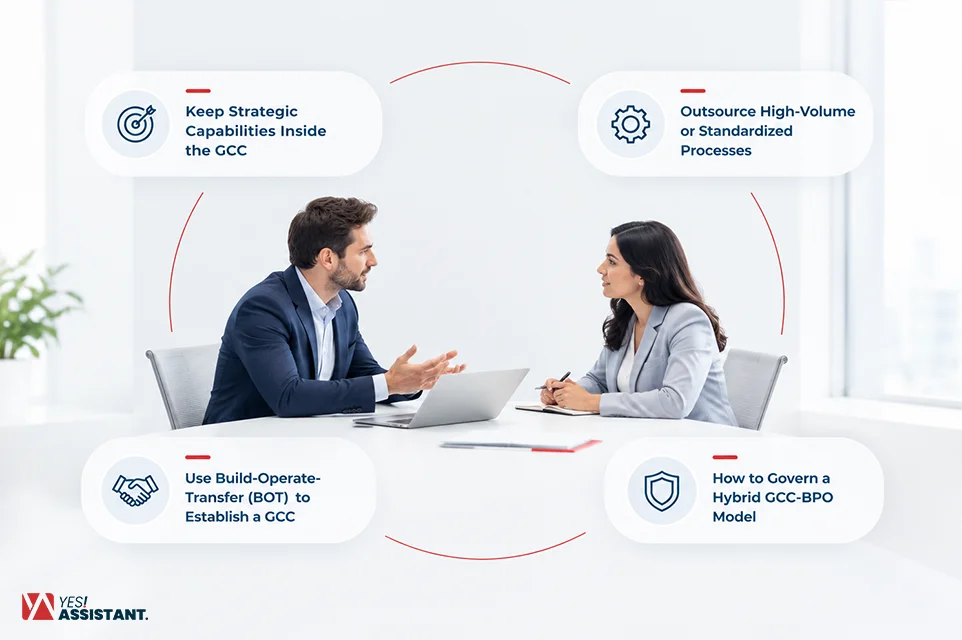
Keep Strategic Capabilities Inside the GCC
Keep your best ideas secret to keep your position ahead of your competitors. Organizations keep their most sensitive work in their own facilities, where trusted employees manage vulnerable secrets directly.
- Product Innovation Control: Internal engineers design advanced software features without exposing confidential code to outside parties.
- Executive Decision Making: Senior management guides high-level corporate strategy from the regional hub to ensure brand alignment.
Outsource High-Volume or Standardized Processes
Routine operational tasks succeed when you hand them over to specialized external agencies that manage repetitive workloads efficiently. Companies often utilize types of BPO services to delegate repetitive customer queries, data entry, and basic transaction duties to expert vendors.
- Front Office Execution: Customer support hotlines and digital chat options run smoothly when managed by trained vendor personnel.
- Back Office Operations: Routine record-keeping and administrative tasks are handled effectively through back office outsourcing.
- Financial Data Management: Fast-paced daily tasks such as invoice processing in accounts payable move swiftly through standardized external workflows.
- Operational Specialization: Delegating these standard workflows to an external provider allows your core team to focus on strategic growth. To choose the right structure for your company, evaluate the differences between front office vs. back office BPO alignment to see where bottlenecks sit.
Use Build-Operate-Transfer (BOT) to Establish a GCC
Starting a new office in another country creates significant pressure on business leaders. Companies build partnerships with experienced setup specialists who launch the facility, run daily workflows and finally hand over complete ownership to the parent organization.
- Phase One Construction: External setup partners handle local real estate leasing, legal registrations, and initial staff hiring.
- Phase Two Management: The developing team manages daily administrative functions and stabilizes operational performance.
- Phase Three Transfer: Corporate leadership assumes direct legal ownership and full executive control of the mature facility.
How to Govern a Hybrid GCC-BPO Model
Managing a mixed delivery network requires clear guidelines to keep internal teams and external vendors working together harmoniously. Companies establish strict performance standards using clear BPO SLA (Service Level Agreement) terms to ensure third-party partners meet expected productivity milestones.
- Remote Supervision: Leaders maintain smooth daily collaboration by managing a remote BPO team through regular digital check-ins and shared performance dashboards.
- Legal Safeguards: A clear drafting of a comprehensive BPO contract checklist helps you to understand deliverables and operational boundaries.
- Data Protection Protocols: Understanding strict privacy rules ensures full GDPR compliance in BPO workflows, keeping your sensitive customer information completely protected.
- Remote Supervision: Business leaders maintain consistent daily collaboration by managing a remote BPO team through a digital check-in system and sharing performance dashboards.
Conclusion
Choosing your right delivery model depends on your business goals and growth plans. External outsourcing helps companies reduce startup costs and handle daily administrative tasks quickly. Besides, building an overseas corporate center gives the organization total control over sensitive technology and long-term innovation.
Many successful businesses combine both approaches to build a flexible network that balances low operational costs with secure internal control.
FAQs
What is the main difference between GCC and BPO?
A business process outsourcing partner handles routine tasks for businesses. A global capability center operates an overseas office fully owned and managed directly by the main parent corporation.
Is a GCC more expensive than a BPO?
Establishing an overseas corporate hub requires high upfront investments for real estate and local talent acquisition. Outsourcing services involve lower initial startup costs because vendors already own the infrastructure and require minimal capital.
Why do technology companies prefer GCCs over BPOs?
Tech companies want to fully protect and control their own software and ideas. Owning an internal regional hub lets engineering teams innovate freely without risking data exposure to outside service providers.
Is a GCC the same as a captive center?
Both terms describe an overseas corporate facility owned and operated directly by the parent organization. Companies use these names interchangeably to mean an internal center rather than an external vendor partnership.
Can a GCC replace a BPO?
An enterprise can shift certain standardized duties from external vendors into its internal corporate hub. Many businesses incorporate both models actively to handle repetitive small tasks efficiently, besides protecting core operations.
What is the best model for AI and generative AI?
Building an internal center works best for artificial intelligence because it protects sensitive algorithms and proprietary datasets. Companies also use RPA in BPO workflows when automating simple administrative tasks through external vendor partnerships.