

How Better Systems Create More Free Time-Most People Miss This
Building a system is like you’re following a master blueprint for a project as it ensures every single step fits together. Most people waste their opening work hours questioning where to start, which drains your energy before you start your job. By setting up a clear process, you stop overthinking and start working confidently.
In this guide, you will see how to turn on daily tasks into a system creating free times. This includes removing repetitive planning, reducing context switching, and increasing efficiency by repetitive work. Besides, how you can build a system identifying repeating tasks, standardize the process, automate work, and optimize regularly.
Why Systems Are the Key to Creating More Free Time?
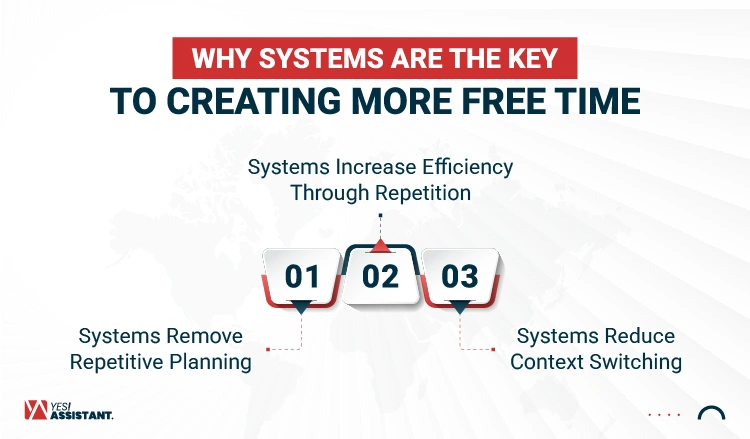
Systems are like a pre-made plan for your day. Instead of walking-up and wondering what to do first, a system tells you exactly where to start. This means your brain doesn’t have to work as hard to make decisions. When you always follow the same steps to execute a task, you get much faster at finishing your work.
Since you aren’t wasting minutes trying to figure-out things or doing the same task twice, those saved minutes add up. At the end, you have a big stack of extra time to play, rest or hang out with friends. This savings causes your system to do the heavy lifting for you.
Systems Remove Repetitive Planning
When you use a system, you need to stop being a “planner” rather than being a “doer.” By sitting at your desk and starting with a pre-scripting plan that follows a set of steps you wrote down before. This is like having a recipe for your favorite meal, and how to make it.
You don’t have to guess how much salt you need to add, because the paper tells you exactly what to do. Since you aren’t starting from zero at every single time, you can jump right into your work without feeling stuck or confused.
- You can start your most important work at the moment you sit down.
- Your brain doesn’t get tired from making too many small decisions.
- Every task feels easier because the “how-to” guide is already finished.
Systems Reduce Context Switching
Starting one task with a system but constantly jumping to other jobs is a major time-killer. This means, you are trying to run a race but stop at every foot to check your phone that never gets any speed. Only a set of systems can help you to group similar jobs together; therefore, you will stay on track.
It is very important because how multitasking reduces business efficiency is a real problem that slows everyone down. By using a structured schedule, you protect your time from interruptions and finish your job in half of the time.
- Grouping your similar tasks help you to stay in a “state of flow” longer.
- You stop losing time while your brain tries to switch gears.
- A steady schedule saves your mind from focus distractions.
Systems Increase Efficiency Through Repetition
According to the professional state, doing a task the same way every time makes you an expert. When you use the same steps for your business, your brain works much faster and handles every requirement quickly. This is a great way to avoid the mental toll of daily repetitive work, and make the task easy to do without thinking.
- Practicing the same process makes you much faster at your job.
- You make fewer mistakes because you know the steps by heart.
- Getting faster every day creates more hours of freedom every week.
Building a system is the first step to success but you can enjoy your free time when you aren’t running it alone. Assign a remote virtual assistant, you can delegate these step-by-step guides to a trusted professional. This allows you to focus on high-level strategy while the remote assistant handles the repetitive “how-to” tasks.
How to Build Systems That Actually Save Time
Building a system is like following a master blueprint for a project because it ensures every single operation steps fits together. Therefore, you need to follow the instruction book that snaps everything perfectly. This way you stop thinking and start finishing.
Here is how you can build a system that work for you within every steps:
Step 1: Identify Repeating Tasks
At the beginning step, you need to be a detective. Look at your calendar and see what jobs you do every single day or every week. Maybe it is answering emails, posting on social media, or sending bills to customers.
If you do it more than once, it needs a system. By writing down exactly what you do right now, you can see your time is going.
- Make a list of tasks that you perform daily or weekly.
- Write down every small step of your tasks like flow-chart that direct you to start and finish your job.
- Notice which tasks feel like they have way too much energy.
Step 2: Standardize the Process
Write down a list of tasks and stick it to your convenient place, where you can look at it everyday. When you have a clear operational flow-chart, you don’t have to think about what comes next. You just follow the list.
This is a great way to avoid the hidden workload most entrepreneurs ignore because it turns a messy into simple routine that anyone could follow:
- Create a simple “1-2-3” checklist for your most common tasks.
- Give a short and clear name at every step of tasks that make no confusion.
- Set your checklist in one place where your eyes always go naturally.
Step 3: Remove Unnecessary Steps
The same way is simpler than always done them that way. Look at your new checklist and ask, “do I really need to do this part?” if a step doesn’t help you finish the goal, throw it away. Facilitating your choices makes the whole system run faster and keeps you from getting tired.
- Delete any steps that actually help you to get the job done.
- Combine two small steps into one big, and easy to executive.
- Try to make the process as short and simple as possible.
Step 4: Automate Where Possible
Robots can perform tasks more than a human. You can integrate software systems with email or sort files while you sleep. Using these tools help you to prevent the mental stress of daily repetitive work.
- Find a digital tool that can handle your complete checklists successfully.
- Link your apps together; therefore, you can talk to each other automatically.
- Let the computer handle the math, the scheduling and the sorting.
Step 5: Review and Optimize Regularly
A good system is always growing; thus, always try to make it better. Check once a week, just see how your systems are performing. If something goes slowly or is annoying, let it change.
Through checking performance, you can make sure your “instruction book” stays up to date and keeps saving your time effectively.
- Every Friday, set a timer for 15 minutes to check your systems.
- Ask yourself if any new “time leaks” have popped up in your week.
- Update your checklists whenever you find a faster way to do things.
FAQ
How Do Systems Help With Time Management?
Systems including software and methodologies, improve productivity by optimizing workflows, prioritizing tasks, and reducing cognitive overload. They can give a clear plan to finish your work faster and enjoy more free time.
What is the Difference Between a Habit and a System?
A habit is an automatic, individual behavior. While a system is a collection or framework for habits and processes designed to achieve specific, and consistent outcomes. Habit focuses on your action, whereas a system focuses on processes involved providing structured support and continuing functioning when you are busy.
Can Small Systems Make a Big Difference?
Absolutely, a small system can make a big difference, often playing as the foundation for significant, sustainable and long-term results. A system doesn’t depend on intense and one-time efforts. Besides, a small, repeatable and consistent action creates compound effects that lead to saving a huge amount of time.
Key Takeaways
A concrete system is the secret to work smarter instead of just working harder. When you stop jumping between the tasks and follow a plan, you save your mind from focus distractions. This is a clearly pre-outlined checklist or plan that makes you happy when your mind is busy with the right tasks.
Furthermore, this can grow your business healthy when your systems are sharp. Let’s start with a small one, build your first checklist today and watch how much extra time you save every single week.