
The Productivity Myth of Hustle Culture: It’s Burning You Out for Nothing
People often think that working long-time and being on a list of jobs is the way to be successful. Hustle culture makes people feel proud of being tired. It wrongly teaches us to be busy all the time which is similar to doing a great job.
If you push yourself too hard everyday, you will eventually exhausted like hit a wall. Engaging with more work doesn’t ensure your business can grow more. Therefore, you may start working more hours but getting less outcomes.
In this blog, you will learn about how working long hours drains your brain and increases mental fatigue following a common myth. Also, you will get a clear roadmap to build a sustainable work system that protects your peach while growing your business.
What is Hustle Culture?
Hustle culture is a belief or myth, by which people think that this is the only way to succeed by working all the time. It’s a lifestyle where being very busy in the workspace is seen as a badge of honor. Thereupon, if you aren’t working, you feel like you are falling behind.
It says that resting is a weakness, you should spend every moment working towards a goal or making money. Hustle in work sounds like a way to win, but it really increases stress all the time. People in hustle culture focus on how many hours they work instead of how they actually get the work done.
Common Hustle Culture Myths (And The Reality)
Hustle culture in the workplace has many fictions that sound true but actually hold you back. Let’s look at the most myths and the facts behind them.
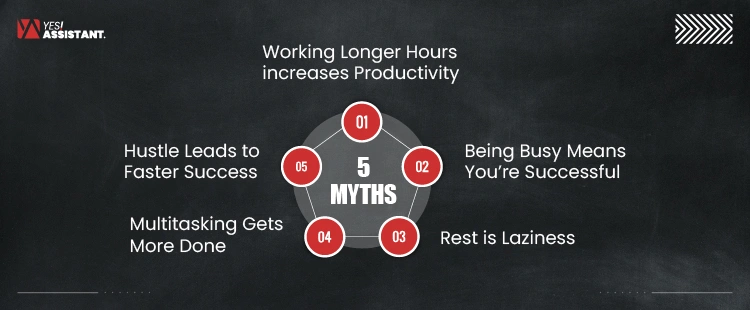
Myth 1: Working Longer Hours Increases Productivity
Many people believe that working 12 hours gives much better results than working on 8 hours a day. There will be more work done and ensure better productivity. But science shows that working with extra hours drains your brain and gets tired resulting in poor quality of work.
- The Brain’s Wall: After a few hours of hard work, your brain slows down to generate more ideas or input new things. This is called diminishing returns. You should spend two hours on a task, then take a small break.
- More Mistakes: When you get tired, you make more errors. Then you have to spend the next day fixing those errors, which wastes your essential working hours.
- The Sleep Debt: Working more hours means cutting your sleeping hours. Without getting enough rest, your memory and focus will disrupt that and decrease your efficiency for the next morning.
Myth 2: Being Busy Means You’re Successful
You often praise people who are very busy at his work. However, having a lot to do is not the same as getting things done.
- Movement vs. Progress: A busy person may move like a “rocking horse” but never reach a targeted designation. Being busy is often just movement without moving towards your big goals.
- Focus on Results: Success is measured by results, but not considering the list of tasks you have done.
- The Busy Trap: Many business owners stay busy with small tasks. Because you think this is safer to do hard work that actually grows a business. This is why Business owners stay busy but never grow due to lower-value.
Myth 3: Rest is Laziness
It is easy to feel like you are failing when you take a break after a certain period of engaging with brainstorming work. In reality, rest is a tool that makes your day better and smooth your tasks.
- Brain Cleaning: When you rest, your brain cleans itself and organizes information. This helps you to solve difficult problems easily when you return to work.
- Sustainable Energy: Without refilling your fuel tank by gas, you never go for a long-drive. Therefore, you must stop every after certain distances at a feeling station to refuel and continue your journey. According to the way, if you don’t restart, you can’t successfully complete a big project.
- Creative Sparks: Most of the great ideas generated from deliberate thinking. When you’re in a relaxed mood, your mind starts screening. Taking a break explores your creative room to breathe.
Myth 4: Multitasking Gets More Done
People think they are heroes for answering emails while sitting in a meeting. Actually, this just drains your brain, as you’re doing two things poorly.
- The Switching Cost: After switching to the tasks, your brain loses focus. It takes a few minutes to get back the flow of what you were doing.
- Low Quality Work: When your brain works multiple tasks at a time, your brain divides accordingly. Thus, the quality of your work drops. This is how multitasking reduces business efficiency is a major concern for growing your business.
- Mental Drain: Engaging with multiple tasks at once drains your brian out much faster on one single task at a time.
Myth 5: Hustle Leads to Faster Success
The myth says if you work twice as hard, you will get rich twice as fast. Usually, this may be slightly correct but think of the other side. Because opposite things happen with poor outcomes.
- The Burnout Crash: If you push too hard, you will eventually crash your energy. Remember, a burnout can stop your progress for weeks or even months. Which is much slower than steady work.
- Short-Term Thinking: The hustle culture may contemporarily focus you only on today. To be successful, you need to think about next year, which requires a calm and clear mind.
- Losing the Passion: When you turn business into a 24/7, once you love the job gradually shifts into hated long-hours of work. Success isn’t worth it if you are too tired to enjoy it.
Significantly these myths lead to burnout and slow down your business. Many business owners use virtual assistant service to handle the hustle works. This frees you to focus only on big, strategic goals.
Solution: A Smarter Approach to Productivity
If the previous strategy doesn’t help you to win, it is time to try something new. Being smart with your energy is much better than just being tired. Here is how you can get more things done by executing things differently.
Shift From Time-Based to Outcome-Based Work
It’s not important how many hours you sit at your desk. This is more important to look at what you are actually finishing perfectly. These two scenarios help you to see the difference between being busy and being successful.
- Pick Your Wins: when you start the day, just choose three tasks that you must complete with duration time. If you finish those tasks before closing your office hours, you really did a great thing.
- Measure the Result: Don’t focus on work that has no significant result. You may sort and clean your inbox, but should not spend more time on it. Rather than you can spend little on emails and return your strategic focus on new sales.
- Stop Clock-Watching: When you focus on the result, you must stop engaging with fake work that just to look busy. This is one reason why business owners stay busy but never grow, they focus on the clock instead of the goal.
Prioritize High-Impact Tasks
You may list tasks, but all tasks are not equal. Some jobs help you to make money, while others just keep you in one spot. Therefore, you should be intelligent to choose the big rocks that give your significant result.
- Use of 80/20 Rule: Usually a few tasks have high-value that bring most of your success. So, spend your best effort on these few things first.
- Identify the Wrong Work: Look at your list and find the signs you’re spending time on right work. Just leave up the task has no high-impact that could not help your business grow.
- Say No More Often: Be positive on every opportunity. But all things don’t bring opportunities. Therefore, you must be habituated to say “no” to the small, unimportant distractions that pop up every hour.
Embrace Deep Work
Deep work means, engaging with a work with full concentration and turning off your phone. Just focus on the hard tasks for a set amount of time. It is like the super charging your brain.
- Kill the Distractions: Close all unnecessary apps, email tabs, and put your phone in another room. This stops the brain itch that makes you want to check progress.
- Work with Intention: Set a timer for 60 minutes. During this time, your only job is to finish one specific, important project.
- One Thing at a Time: Focus is like a laser. When you point it at one spot, it becomes a strong destination. When you spread it out, it becomes weak and useless.
Schedule Rest and Recovery
You should plan for breaks as you’re planning for your meetings. Rest is not a reward for finishing your work; but it’s the fuel in your work in the first place.
- Micro-Breaks: Stand up and stretch for five minutes every after one hour. This keeps your brain smooth at work and eases your blood flowing to be sharp minded.
- Protect Your Sleep: A tired brain never makes good decisions. Getting eight hours of sleep is a business strategy, not a luxury.
- Mental Resets: Take a walk or sit in a quiet zone without any screens. This lets your brain process the mental toll of daily repetitive work; therefore, you can feel fresh again.
Build Sustainable Work Systems
You will be succeed in doing the right things every day, doesn’t mean working 20 hours once a week. A proper working system stays steady even when you don’t feel motivated.
- Choose Systems over Motivation: When you’re tired engaging with heavy duty, your motivation will go away. A good system, like a daily checklist, works even when you don’t feel like it.
- Organize Your Tasks: Use a simple tool to track what is your valuable things to be done. This saves the cost of poor task organization and stops things from failing through the cracks.
- Create a Routine: Take an effective step that make it easier for your brain to start a task. This makes your work much lighter and easier.
Conclusion
Breaking free from productivity is the myth of hustle culture isn’t about work less: it’s about working with intention. To control your time and business growth, you should stop measuring the worth of the task rather than focus on high-optimizing outcomes. To win, you need a fresh and rested brain to handle the hard parts of running a business.
By embracing deep work and building systems that prioritize recovery, you can move from busy owner to productive leader. Remember, your business depends on your exhaustion is not a sustainable one. Let’s start a smart habit today, and you will find your business well-being that have a space to ensure growth.